목 (Mok) — Neck · Junction · Voice · Thirst
One Sound · All Pure Native Korean Meanings — Neck, Junction, Voice, and Thirst
[※ 도식: mok_color_diagram.png]
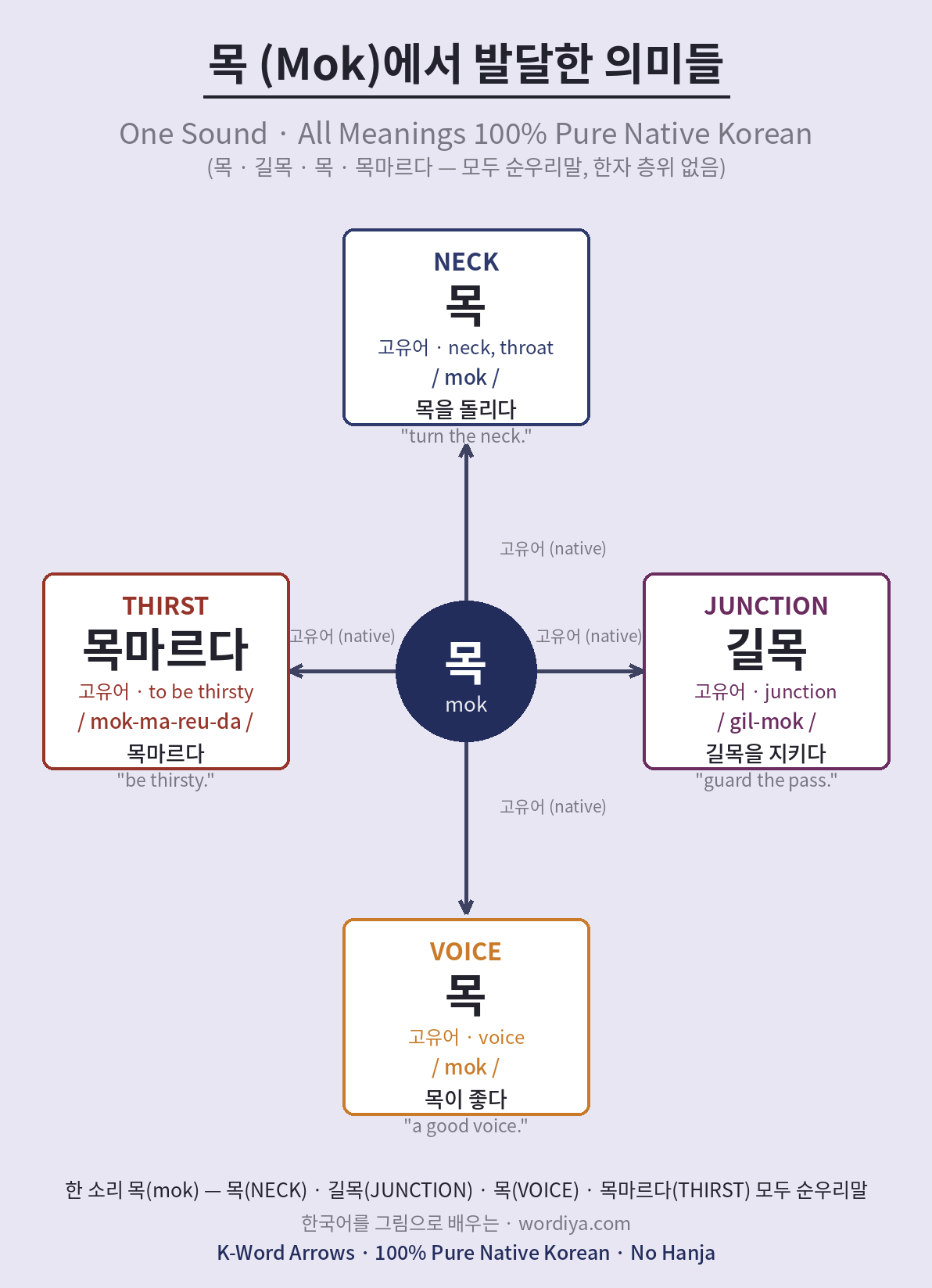
One Korean sound holds the body's neck, the narrow junction where paths meet, the voice that rises from the throat, and the thirst that dries it — all together. When Koreans say "목을 돌리다" (to turn the neck), they mean the physical body part. When they say "길목" (a junction), the same syllable names the narrow neck of a road where everything must pass. When they say "목이 좋다" (a good voice/spot), the same sound names the voice from the throat. And when they say "목마르다" (to be thirsty), the same root names the dryness of that same throat. One Korean syllable, four connected domains — the neck, the narrow passage, the voice, and the thirst. Every meaning is pure native Korean (고유어), zero Hanja anywhere.
· · ·
① NECK — 목 (mok) · pure native Korean
The first meaning of 목 is the neck and throat — the narrow part of the body connecting head and torso, through which food, air, and voice all pass. This is the primal, physical meaning from which every other meaning of 목 extends: a narrow passage. Pure native Korean.
Related pure native Korean expressions:
- 목 (mok, neck/throat) — 머리와 몸통 사이
- 목덜미 (mok-deol-mi, nape) — 목의 뒤쪽
- 목구멍 (mok-gu-meong, gullet) — 목 안의 구멍
- 손목 (son-mok, wrist) — 손의 목
- 발목 (bal-mok, ankle) — 발의 목
- 목을 매다 (mok-eul mae-da) — 절박하게 매달리다
Example sentences:
- 목을 좌우로 돌려 풀었다. (Mok-eul jwa-u-ro dol-lyeo pul-eot-da. — I loosened my neck by turning it side to side.)
- 넘어져서 손목을 삐었다. (Neom-eo-jyeo-seo son-mok-eul ppi-eot-da. — I fell and sprained my wrist.)
- 감기로 목구멍이 아프다. (Gam-gi-ro mok-gu-meong-i a-peu-da. — My throat hurts from a cold.)
· · ·
② JUNCTION — 길목 (gil-mok) · pure native Korean
The second meaning is 목 as a narrow junction — the "neck" of a road, a strategic passage where everything funnels through. Just as the neck is the narrow point of the body, a 길목 is the narrow point of a route. Korean says 길목(a road junction), 골목(an alley), and 목이 좋다(a well-placed spot). Pure native Korean.
Related pure native Korean expressions:
- 길목 (gil-mok, road junction) — 길의 요긴한 목
- 골목 (gol-mok, alley) — 좁은 갈래 길
- 목이 좋다 (mok-i jot-da, a good location) — 길목이 좋다
- 목을 지키다 (mok-eul ji-ki-da, guard the pass) — 요지를 지키다
- 건널목 (geon-neol-mok, crossing) — 길을 건너는 목
- 병목 (byeong-mok, bottleneck) — 병의 목처럼 좁은 지점
Example sentences:
- 이 가게는 목이 좋아 장사가 잘된다. (I ga-ge-neun mok-i jo-a jang-sa-ga jal-doen-da. — This shop is well-located, so business is good.)
- 군사가 길목을 지켰다. (Gun-sa-ga gil-mok-eul ji-kyeot-da. — Soldiers guarded the pass.)
- 골목마다 아이들이 뛰논다. (Gol-mok-ma-da a-i-deul-i ttwi-non-da. — Children run about in every alley.)
· · ·
③ VOICE — 목 (mok) · pure native Korean
The third meaning is 목 as the voice — the sound that rises through the throat. Korean speaks of 목소리(voice), 목청(vocal power), and 목이 쉬다(to go hoarse). The voice is what passes through the neck — bodily and direct. Pure native Korean.
Related pure native Korean expressions:
- 목소리 (mok-so-ri, voice) — 목에서 나는 소리
- 목청 (mok-cheong, vocal power) — 목의 힘
- 목이 쉬다 (mok-i swi-da, go hoarse) — 목소리가 잠기다
- 목이 메다 (mok-i me-da, choke up) — 목이 막히다
- 목을 가다듬다 (mok-eul ga-da-deum-da) — 목소리를 고르다
- 목청껏 (mok-cheong-kkeot, at the top of one's voice) — 있는 힘껏
Example sentences:
- 그녀는 목소리가 참 곱다. (Geu-nyeo-neun mok-so-ri-ga cham gop-da. — She has a really lovely voice.)
- 응원하느라 목이 다 쉬었다. (Eung-won-ha-neu-ra mok-i da swi-eot-da. — I went hoarse from cheering.)
- 감동해서 목이 메었다. (Gam-dong-hae-seo mok-i me-eot-da. — I got choked up with emotion.)
· · ·
④ THIRST — 목마르다 (mok-ma-reu-da) · pure native Korean
The fourth meaning lives in the verb 목마르다 — literally "the throat dries," to be thirsty. From physical thirst to burning desire (성공에 목마르다, to thirst for success), Korean uses the same neck-word. The dryness of the throat becomes the image of all longing. Pure native Korean.
Related pure native Korean expressions:
- 목마르다 (mok-ma-reu-da, to be thirsty) — 목이 마르다
- 목이 타다 (mok-i ta-da, throat burns) — 몹시 목마르다
- 목을 축이다 (mok-eul chuk-i-da, wet the throat) — 갈증을 풀다
- 목마름 (mok-ma-reum, thirst) — 목마른 상태
- ~에 목마르다 (~e mok-ma-reu-da, thirst for) — 간절히 원하다
- 목이 컬컬하다 (mok-i keol-keol-ha-da) — 목이 마르고 텁텁하다
Example sentences:
- 운동 후라 몹시 목마르다. (Un-dong hu-ra mop-si mok-ma-reu-da. — I'm very thirsty after exercising.)
- 물 한 잔으로 목을 축였다. (Mul han jan-eu-ro mok-eul chuk-yeot-da. — I wet my throat with a glass of water.)
- 그는 성공에 목말라 있었다. (Geu-neun seong-gong-e mok-mal-la iss-eot-da. — He was thirsting for success.)
· · ·
Bonus ① — The Unified Etymology of 목: One Root, Four Narrow Passages
Korean historical linguists trace 목 to a native root meaning "a narrow passage or connecting point." This single root branched into four surface meanings while preserving the deep image: (1) neck — the narrow passage of the body, (2) junction — the narrow passage of a road, (3) voice — what passes through that narrow throat, (4) thirst — the drying of that same throat. This is why 손목(wrist = "hand-neck"), 발목(ankle = "foot-neck"), and 병목(bottleneck) all use 목 for any narrow connecting point. Only Korean unifies these under one native root, with zero Hanja layer.
Bonus ② — 손목·발목·병목: The Neck of Everything
Korean attaches 목 to any narrow connecting point in the body or the world. 손목 is the "hand-neck" — the wrist. 발목 is the "foot-neck" — the ankle. 병목 is the "bottle-neck" — used exactly as English uses "bottleneck" for congestion. Korean saw that every system has its narrow throat — the point where everything must pass, and where everything can be blocked. To control the 목 is to control the flow.
Bonus ③ — 목이 좋다: The Korean Art of Location
In Korean business wisdom, nothing matters more than 목 — the location. "목이 좋다" (the neck is good) means a shop sits at a junction where foot traffic must pass. Korean merchants have long known a good 길목 is worth more than a good product, because a narrow passage concentrates the flow of people. The same word for the body's throat became the master metaphor for the flow of commerce — both are about who controls the narrow passage.
· · ·
What makes 목 remarkable is that it holds the body's neck, the road's junction, the rising voice, and the drying thirst together in one native Korean sound. From the nape you turn to loosen tension to the busy alley where a shop thrives, from the voice that goes hoarse with cheering to the throat that burns with longing — Korean recognizes all as the same primordial image: the narrow passage of the throat. When you say 목 in Korean, you speak the ancient language that saw a single narrow passage in the body, the road, the voice, and the longing heart.
K-Word Arrows: Korean Homonyms Visualized · ⓒ wordiya.com
'K-Word Arrows: Korean Homonyms Visualize' 카테고리의 다른 글
| 깃 (Git) — Feather · Collar · Bedding · Dwell (0) | 2026.07.09 |
|---|---|
| 참 (Cham) — True · Genuine · While · Endure (0) | 2026.07.08 |
| 터 (Teo) — Site · Foundation · Intention · Burst (0) | 2026.07.08 |
| 결 (Gyeol) — Grain · Wave · Moment · Temper (0) | 2026.07.08 |
| 줄 (Jul) - Rope · Row · Decrease · Know-How (0) | 2026.07.07 |


