결 (Gyeol) — Grain · Wave · Moment · Temper
One Sound · All Pure Native Korean Meanings — Grain, Wave, Moment, and Temper
[※ 도식: gyeol_color_diagram.png]
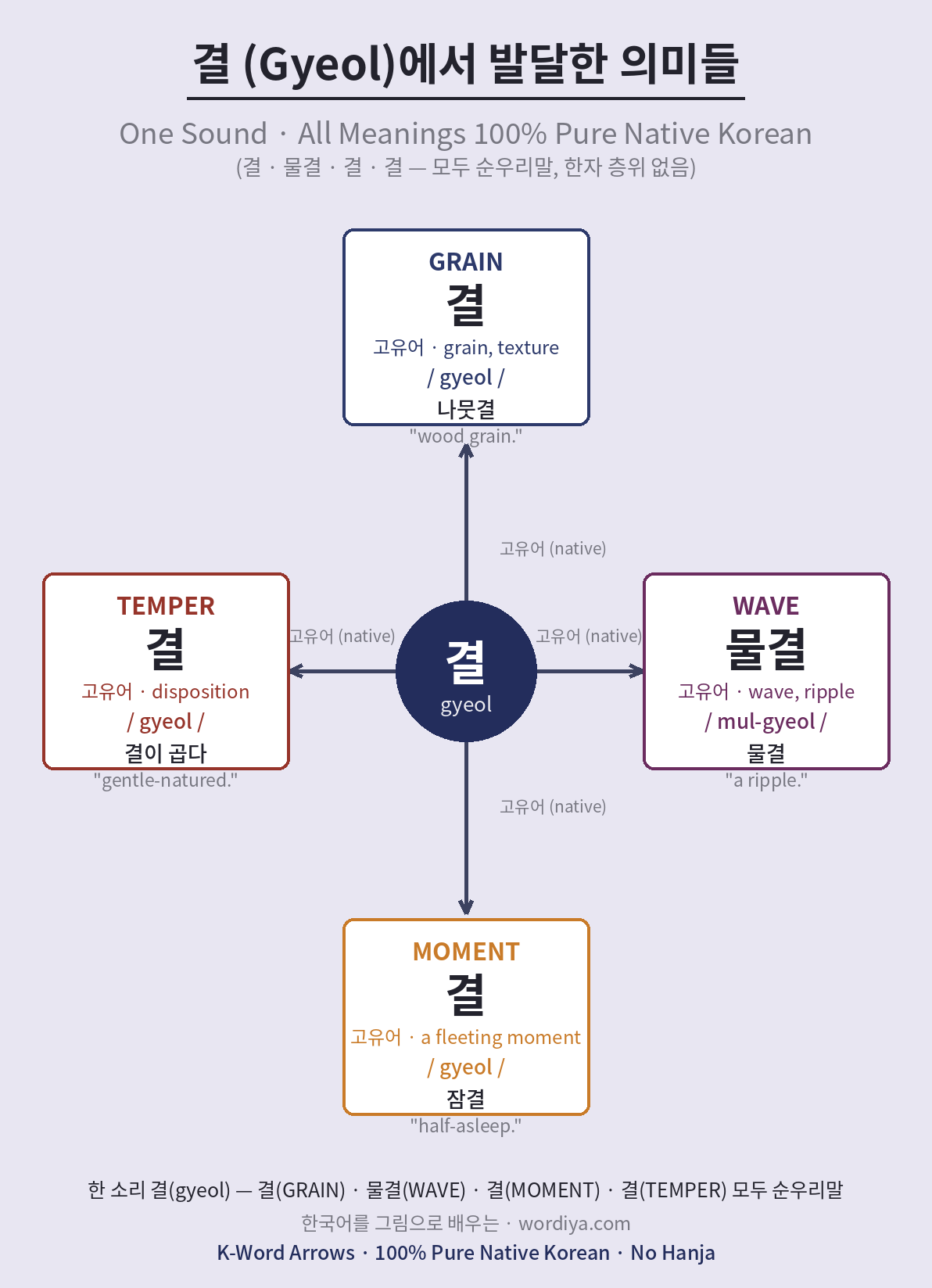
One Korean sound holds the grain of a surface, the ripple of water, the fleeting layer of a passing moment, and the grain of a person's character — all together. When Koreans say "나뭇결" (wood grain), they mean the fine lines running through a material. When they say "물결" (a wave), the same syllable names the undulating lines that run across water. When they say "잠결" (half-asleep), the same sound marks the thin, passing layer of a fleeting moment. And when they say "결이 곱다" (gentle-natured), the same word names the inner grain of a person's temperament. One Korean syllable, four completely different domains — surface, water, time, and character. Every meaning is pure native Korean (고유어), zero Hanja anywhere.
· · ·
① GRAIN — 결 (gyeol) · pure native Korean
The first meaning of 결 is the grain or texture — the fine directional lines running through a material such as wood, skin, silk, or hair. This is the concrete, visible meaning from which every other meaning of 결 extends: the lines that run through a thing. Pure native Korean, one of the oldest texture-words in the language.
Related pure native Korean expressions:
- 결 (gyeol, grain/texture) — 표면을 따라 난 무늬
- 나뭇결 (na-mut-gyeol, wood grain) — 나무의 결
- 살결 (sal-gyeol, skin texture) — 피부의 결
- 머릿결 (meo-rit-gyeol, hair texture) — 머리카락의 결
- 비단결 (bi-dan-gyeol, silk texture) — 비단처럼 고운 결
- 결이 곱다 (gyeol-i gop-da, fine-grained) — 결이 부드럽다
Example sentences:
- 이 탁자는 나뭇결이 아름답다. (I tak-ja-neun na-mut-gyeol-i a-reum-dap-da. — This table has beautiful wood grain.)
- 아기의 살결이 정말 곱다. (A-gi-ui sal-gyeol-i jeong-mal gop-da. — The baby's skin is really soft.)
- 그녀의 머릿결이 비단결 같다. (Geu-nyeo-ui meo-rit-gyeol-i bi-dan-gyeol gat-da. — Her hair is smooth like silk.)
· · ·
② WAVE — 물결 (mul-gyeol) · pure native Korean
The second meaning is 결 as the undulating lines of water — a wave, a ripple. The metaphor is direct: like grain runs across wood, ripples run across water. The most common compound is 물결 (mul-gyeol, "water-grain"). By extension Korean speaks of 감정의 물결(waves of emotion) and 시대의 물결(the tide of an age). Pure native Korean.
Related pure native Korean expressions:
- 물결 (mul-gyeol, wave/ripple) — 물의 결
- 잔물결 (jan-mul-gyeol, small ripple) — 작은 물결
- 물결치다 (mul-gyeol-chi-da, to ripple) — 물결이 일다
- 바람결 (ba-ram-gyeol, a breath of wind) — 바람의 결
- 감정의 물결 (gam-jeong-ui mul-gyeol) — 감정의 파동
- 시대의 물결 (si-dae-ui mul-gyeol) — 시대의 흐름
Example sentences:
- 호수에 잔물결이 일었다. (Ho-su-e jan-mul-gyeol-i il-eot-da. — Small ripples formed on the lake.)
- 바람에 물결이 반짝인다. (Ba-ram-e mul-gyeol-i ban-jjak-in-da. — The waves sparkle in the wind.)
- 바람결에 그 소식을 들었다. (Ba-ram-gyeol-e geu so-sik-eul deul-eot-da. — I heard the news on the wind / by chance.)
· · ·
③ MOMENT — 결 (gyeol) · pure native Korean
The third meaning is 결 as a fleeting moment — a thin, passing layer of time, used in compounds like 잠결(half-asleep), 꿈결(dreamily), 얼떨결(in a daze), and 어느 결에(before you know it). The metaphor is beautiful: a moment is a thin "grain" of time you slip through. Pure native Korean, essential narrative vocabulary.
Related pure native Korean expressions:
- 잠결 (jam-gyeol, half-asleep) — 자는 사이
- 꿈결 (kkum-gyeol, dreamily) — 꿈꾸는 듯한 사이
- 얼떨결 (eol-tteol-gyeol, in a daze) — 정신없는 사이
- 어느 결에 (eo-neu gyeol-e, before you know it) — 어느 사이엔가
- 아침결 (a-chim-gyeol, in the morning while) — 아침 무렵 사이
- 무심결 (mu-sim-gyeol, unintentionally) — 무심한 사이
Example sentences:
- 잠결에 전화를 받았다. (Jam-gyeol-e jeon-hwa-reul bad-at-da. — I answered the phone half-asleep.)
- 꿈결처럼 아득한 기억이다. (Kkum-gyeol-cheo-reom a-deuk-han gi-eok-i-da. — It's a memory faint like a dream.)
- 어느 결에 봄이 왔다. (Eo-neu gyeol-e bom-i wat-da. — Spring arrived before I knew it.)
· · ·
④ TEMPER — 결 (gyeol) · pure native Korean
The fourth meaning is 결 as the grain of a person's character — disposition, temperament, the natural "texture" of a heart. Korean says 결이 곱다(gentle-natured), 결이 거칠다(rough-natured), 성결(temperament), and 결이 삭다(one's temper subsides). This is the hidden fourth face of 결: the inner grain of a human being. Pure native Korean.
Related pure native Korean expressions:
- 결 (gyeol, disposition) — 마음의 결
- 결이 곱다 (gyeol-i gop-da, gentle-natured) — 성품이 부드럽다
- 결이 거칠다 (gyeol-i geo-chil-da, rough-natured) — 성품이 거칠다
- 성결 (seong-gyeol, temperament) — 성품의 결
- 결이 삭다 (gyeol-i sak-da, temper subsides) — 화가 가라앉다
- 결이 다르다 (gyeol-i da-reu-da, of a different grain) — 성향이 다르다
Example sentences:
- 그는 결이 고운 사람이다. (Geu-neun gyeol-i go-un sa-ram-i-da. — He is a gentle-natured person.)
- 시간이 지나니 결이 삭았다. (Si-gan-i ji-na-ni gyeol-i sak-at-da. — As time passed, the anger subsided.)
- 우리는 결이 잘 맞는다. (U-ri-neun gyeol-i jal mat-neun-da. — Our temperaments match well.)
· · ·
Bonus ① — The Unified Etymology of 결: One Root, Four Grains
Korean historical linguists reconstruct 결 as a native root meaning "the fine lines or layers running through something." This single root branched into four surface meanings while preserving the deep image: (1) grain — the lines running through a solid surface, (2) wave — the lines running across water, (3) moment — the thin passing layer of time you slip through, (4) temper — the inner grain of a person's character. All four are dimensions of the same primordial concept: the running lines within a thing. Only Korean unifies these four under one native root, with zero Hanja layer.
Bonus ② — 물결·바람결·숨결: The Poetry of 결
Some of the most beautiful pure native Korean words are built on 결. 물결(mul-gyeol) is "water-grain" — a wave. 바람결(ba-ram-gyeol) is "wind-grain" — a passing breath of wind, and also "by chance." 숨결(sum-gyeol) is "breath-grain" — the living rhythm of breathing, the very sign of life. Korean did not borrow Chinese words for these; it built native metaphors by attaching 결 to water, wind, and breath. Each names the fine, moving lines that run through a living thing.
Bonus ③ — 결 in Everyday Korean: Reading the Grain of Life
To live well in Korean is often to "read the 결" of things. A carpenter follows the 나뭇결 so the wood will not split. A calm person has a fine 결 of temperament. A wise person moves with the 시대의 물결 rather than against it, and catches news 바람결에. Even sleep and dreams are described as 결 — the thin layers we pass through at night. From wood to water to character to time, 결 teaches a quietly Korean wisdom: everything has a grain, and the art of living is to move along it, not against it.
· · ·
What makes 결 remarkable is that it holds the grain of a surface, the ripple of water, the fleeting layer of a moment, and the grain of a heart together in one native Korean sound. From the wood grain a carpenter follows to the ripples crossing a lake, from the half-asleep haze of 잠결 to the gentle temperament of a fine-grained person — Korean recognizes all as expressions of the same primordial image: the fine lines running through a thing. When you say 결 in Korean, you speak the ancient language that saw a single grain running through the wood, the wave, the moment, and the human heart.
K-Word Arrows: Korean Homonyms Visualized · ⓒ wordiya.com
'K-Word Arrows: Korean Homonyms Visualize' 카테고리의 다른 글
| 목 (Mok) — Neck · Junction · Voice · Thirst (0) | 2026.07.08 |
|---|---|
| 터 (Teo) — Site · Foundation · Intention · Burst (0) | 2026.07.08 |
| 줄 (Jul) - Rope · Row · Decrease · Know-How (0) | 2026.07.07 |
| 얼 (Eol) - Spirit · Immature · Dazed · Foolish (0) | 2026.07.07 |
| 턱 (Teok) - Chin · Ledge · Treat · Unreasonable (0) | 2026.07.07 |


