줄 (Jul) - Rope · Row · Decrease · Know-How One Sound · All Pure Native Korean Meanings — Rope, Row, Decrease, and Know-How
[※ 도식: jul_color_diagram.png]
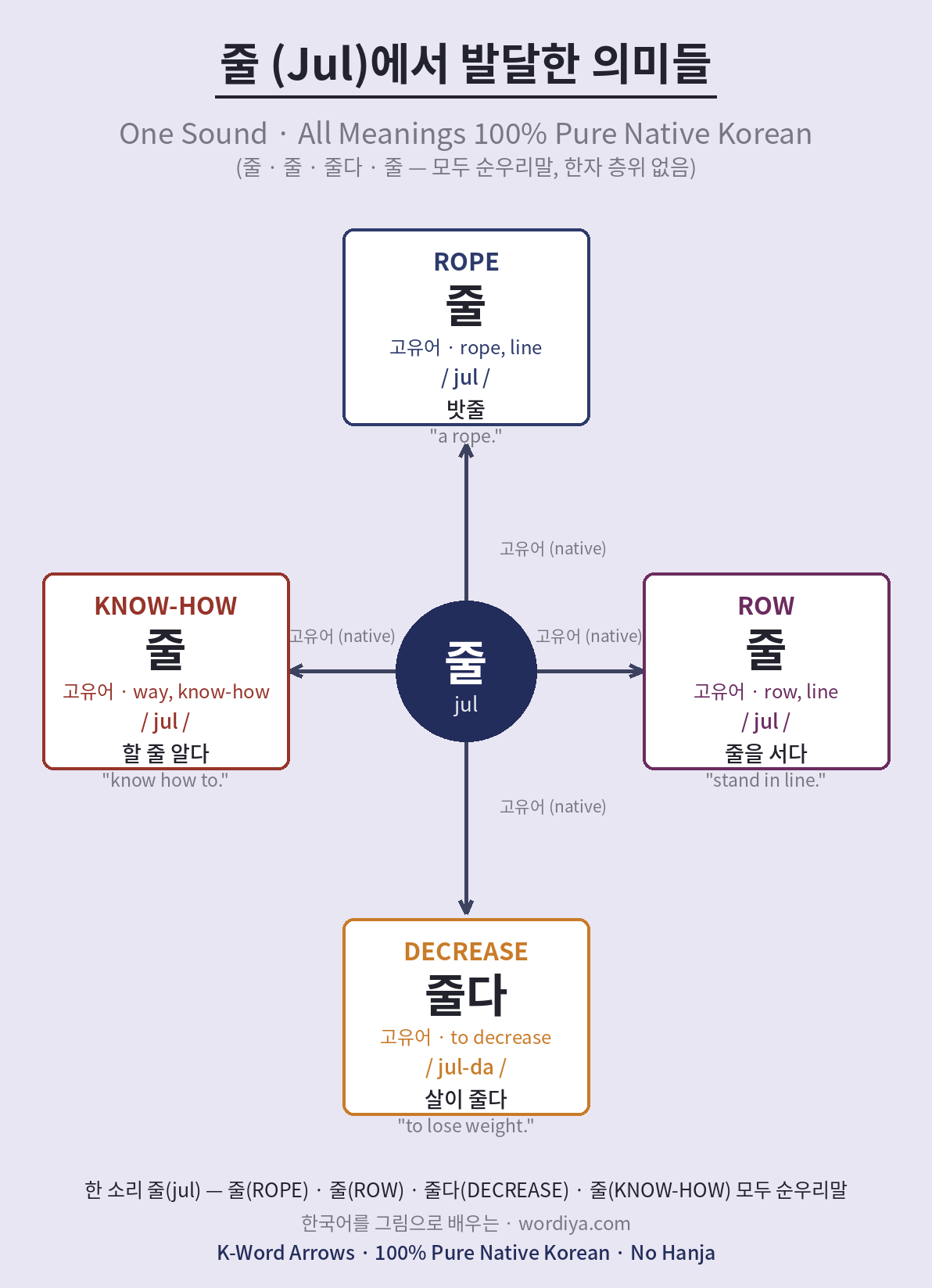
One Korean sound holds the physical cord, the ordered line, the act of lessening, and the knowledge of how to do a thing — all together. When Koreans say "밧줄" (a rope), they mean the physical cord. When they say "줄을 서다" (to line up), the same syllable names an ordered row of people or things. When they say "살이 줄다" (to lose weight), the same sound marks the act of decreasing. And when they say "할 줄 알다" (to know how to do something), the same word names the capacity or way of doing. One Korean syllable, four completely different domains — the physical cord, the ordered line, diminishing, and know-how. Every meaning is pure native Korean (고유어), zero Hanja anywhere.
· · ·
① ROPE — 줄 (jul) · pure native Korean
The first meaning of 줄 is the physical cord — rope, string, line, cable. From a thick ship's rope to a thin fishing line, all belong to the single native Korean category 줄. This is the primal, concrete meaning from which every other meaning of 줄 metaphorically extends: a continuous line. Pure native Korean, one of the oldest tool-words in the language.
Related pure native Korean expressions:
- 줄 (jul, rope/string) — 가늘고 긴 끈
- 밧줄 (bat-jul, thick rope) — 굵은 줄
- 빨랫줄 (ppal-laet-jul, clothesline) — 빨래 너는 줄
- 줄넘기 (jul-neom-gi, jump rope) — 줄을 넘는 놀이
- 낚싯줄 (nak-sit-jul, fishing line) — 낚시하는 줄
- 전깃줄 (jeon-git-jul, power line) — 전기가 흐르는 줄
Example sentences:
- 밧줄로 짐을 단단히 묶었다. (Bat-jul-lo jim-eul dan-dan-hi mukk-eot-da. — I tied the load tightly with rope.)
- 빨랫줄에 옷을 널었다. (Ppal-laet-jul-e os-eul neol-eot-da. — I hung the clothes on the clothesline.)
- 아이들이 줄넘기를 한다. (A-i-deul-i jul-neom-gi-reul han-da. — The children are jumping rope.)
· · ·
② ROW — 줄 (jul) · pure native Korean
The second meaning is 줄 as an ordered line — a row, a queue, a rank. The metaphor is direct: like a rope, a line of people or things forms one continuous strand. Korean uses 줄 for standing in line (줄을 서다), a line of text (한 줄), and even a social "line" or faction one aligns with. Pure native Korean, everyday vocabulary.
Related pure native Korean expressions:
- 줄 (jul, row/line) — 늘어선 열
- 줄을 서다 (jul-eul seo-da, to line up) — 차례로 서다
- 한 줄 (han jul, one line) — 한 행
- 줄줄이 (jul-jul-i, in a row) — 잇따라
- 앞줄 (ap-jul, front row) — 맨 앞의 줄
- 줄을 잇다 (jul-eul it-da, to form a line) — 끊이지 않고 이어짐
Example sentences:
- 사람들이 길게 줄을 섰다. (Sa-ram-deul-i gil-ge jul-eul seot-da. — People stood in a long line.)
- 공책에 한 줄씩 썼다. (Gong-chaek-e han jul-ssik sseot-da. — I wrote one line at a time in the notebook.)
- 손님이 줄줄이 들어왔다. (Son-nim-i jul-jul-i deul-eo-wat-da. — Guests came in one after another.)
· · ·
③ DECREASE — 줄다 (jul-da) · pure native Korean
The third meaning is the verb 줄다 — to decrease, to lessen, to shrink. The metaphor connects back to the rope: a line growing shorter. Korean uses 줄다 for weight loss (살이 줄다), shrinking numbers (인구가 줄다), and reduced amounts. Its causative form 줄이다 means "to reduce." Pure native Korean, an essential everyday verb.
Related pure native Korean expressions:
- 줄다 (jul-da, to decrease) — 적어지다
- 줄어들다 (jul-eo-deul-da, to dwindle) — 점점 줄다
- 줄이다 (jul-i-da, to reduce) — 적게 하다
- 살이 줄다 (sal-i jul-da, to lose weight) — 몸무게가 줆
- 소리를 줄이다 (so-ri-reul jul-i-da, lower the volume) — 소리를 낮춤
- 줄어든 (jul-eo-deun, decreased) — 적어진
Example sentences:
- 요즘 체중이 많이 줄었어. (Yo-jeum che-jung-i ma-ni jul-eoss-eo. — I've lost a lot of weight lately.)
- 소음을 좀 줄여 주세요. (So-eum-eul jom jul-yeo ju-se-yo. — Please reduce the noise a bit.)
- 인구가 해마다 줄어든다. (In-gu-ga hae-ma-da jul-eo-deun-da. — The population decreases every year.)
· · ·
④ KNOW-HOW — 줄 (jul) · pure native Korean
The fourth meaning is the abstract 줄 — the way, method, or know-how of doing something, used in the pattern "-ㄹ 줄 알다 / 모르다" (to know / not know how to). This is the hidden fourth face of 줄: an abstract "line" connecting a person to the way a thing is done. Korean uses it constantly to express ability and expectation. Pure native Korean, essential grammatical vocabulary.
Related pure native Korean expressions:
- -ㄹ 줄 알다 (-l jul al-da, to know how to) — 방법을 앎
- -ㄹ 줄 모르다 (-l jul mo-reu-da, not know how to) — 방법을 모름
- 할 줄 알다 (hal jul al-da, to know how to do) — 할 방법을 앎
- 읽을 줄 알다 (ilg-eul jul al-da, to know how to read) — 읽기가 가능함
- 그럴 줄 알았다 (geu-reol jul al-at-da, I knew it would be so) — 미리 예상함
- 어쩔 줄 모르다 (eo-jjeol jul mo-reu-da, to be at a loss) — 방법을 모름
Example sentences:
- 나는 수영할 줄 안다. (Na-neun su-yeong-hal jul an-da. — I know how to swim.)
- 네가 올 줄 알았어. (Ne-ga ol jul al-ass-eo. — I knew you would come.)
- 너무 놀라 어쩔 줄 몰랐다. (Neo-mu nol-la eo-jjeol jul mol-lat-da. — I was so surprised I didn't know what to do.)
· · ·
Bonus ① — The Unified Etymology of 줄: One Root, Four Lines
Korean historical linguists reconstruct 줄 as a native root meaning "a continuous line or strand." This single root branched into four surface meanings while preserving the deep image of a line: (1) rope — the physical strand, (2) row — the ordered line of people or things, (3) decrease — the line growing shorter, (4) know-how — the abstract line connecting a person to the method of an act. All four are dimensions of the same primordial concept: continuity along a line. Only Korean unifies these four under one native root, with zero Hanja layer.
Bonus ② — 줄을 서다: The Two Faces of Standing in Line
The expression 줄을 서다 (jul-eul seo-da) — "to stand in line" — carries two meanings in Korean, one literal and one deeply social. Literally, it means to queue. Figuratively, it means to align oneself with a person or faction — to "get in someone's line." In Korean workplace and political culture, "줄을 잘 서야 한다" (you must stand in the right line) expresses the importance of choosing the right allies. K-dramas about corporate or palace intrigue constantly use this metaphor: characters rise or fall depending on whose 줄 they stand in.
Bonus ③ — 줄 in Everyday Korean: From Jump Rope to Lifeline
Few native Korean words appear in as many daily compounds as 줄. A child plays 줄넘기 (jump rope). A fisherman casts a 낚싯줄 (fishing line). A household hangs laundry on a 빨랫줄 (clothesline). A climber trusts a 밧줄 (rope) with their life. And in the most emotional usage, a person in crisis reaches for a 동아줄 (dong-a-jul) — the thick rescue rope of Korean folklore, made famous by the tale of the sun-and-moon siblings who climbed a heavenly 동아줄 to escape a tiger. From the mundane to the mythic, 줄 threads through Korean life as the image of connection itself.
· · ·
What makes 줄 remarkable is that it holds the physical cord, the ordered row, the act of decreasing, and the know-how of doing together in one native Korean sound. From the rope that ties a load to the queue at a bus stop, from the weight that slowly drops away to the quiet confidence of knowing how a thing is done — Korean recognizes all as expressions of the same primordial image: the line. When you say 줄 in Korean, you speak the ancient language that saw a single continuous line running through the rope, the queue, the shrinking, and the knowing.
K-Word Arrows: Korean Homonyms Visualized · ⓒ wordiya.com
'K-Word Arrows: Korean Homonyms Visualize' 카테고리의 다른 글
| 터 (Teo) — Site · Foundation · Intention · Burst (0) | 2026.07.08 |
|---|---|
| 결 (Gyeol) — Grain · Wave · Moment · Temper (0) | 2026.07.08 |
| 얼 (Eol) - Spirit · Immature · Dazed · Foolish (0) | 2026.07.07 |
| 턱 (Teok) - Chin · Ledge · Treat · Unreasonable (0) | 2026.07.07 |
| 꿈(Kkum): Dream · Ambition · Fantasy · Unimagined (0) | 2026.07.06 |


