얼 (Eol) - Spirit · Immature · Dazed · Foolish
One Sound · All Pure Native Korean Meanings — Spirit, Immature, Dazed, and Foolish
[※ 도식: eol_color_diagram.png]
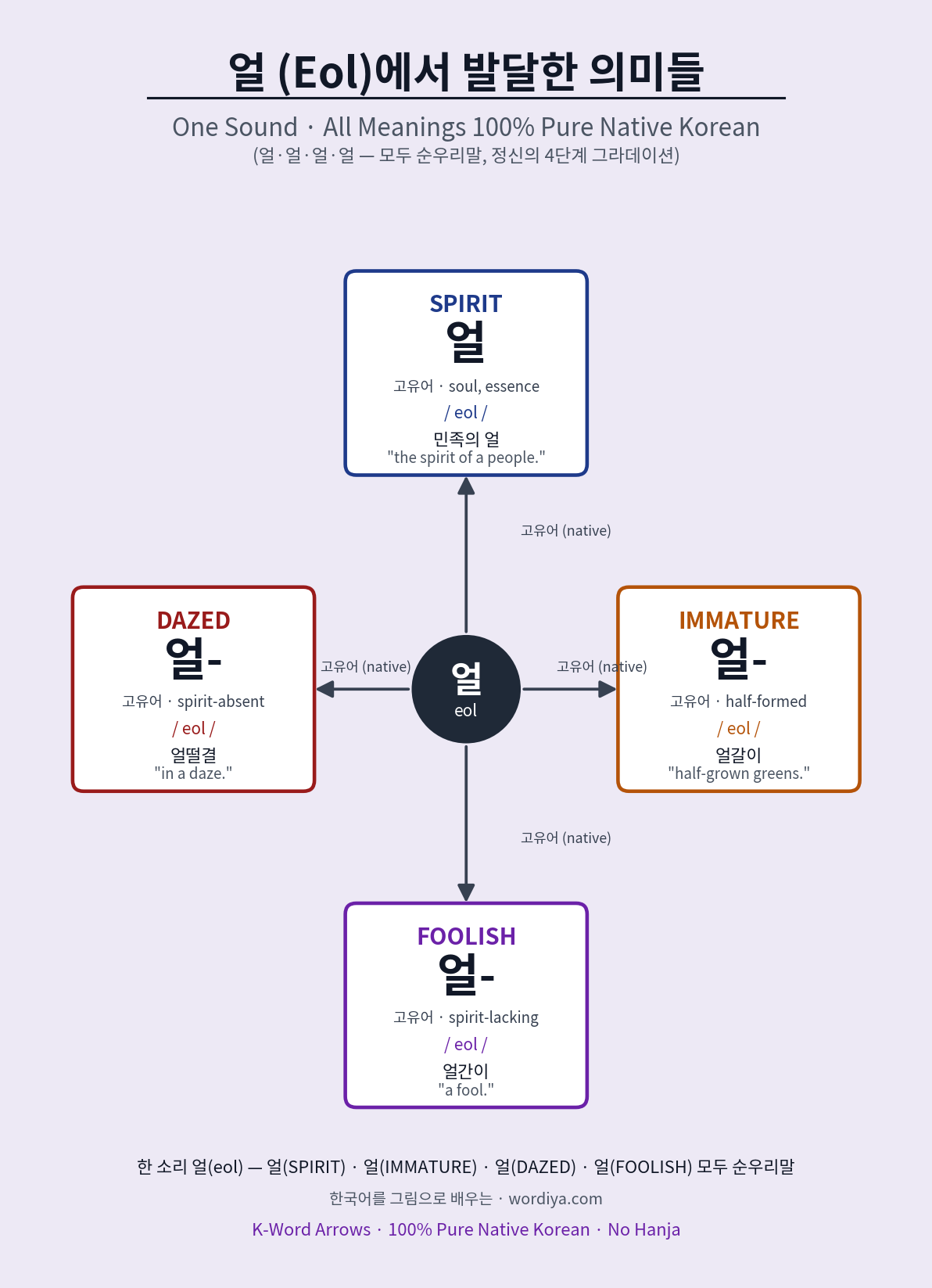
One Korean sound holds the complete spirit, the still-forming, the temporarily absent, and the permanently deficient — all together. When Koreans say "민족의 얼" (the spirit of a people), they mean the essential soul or consciousness itself. When they say "얼갈이" (half-grown greens), the same syllable marks something still in the process of forming. When they say "얼떨결" (in a daze), the same sound names a state where the spirit is temporarily absent. And when they say "얼간이" (a fool), the same word names a person whose spirit is permanently deficient. One Korean syllable, four stages of the same gradient — complete spirit, forming spirit, absent spirit, missing spirit. Every meaning is pure native Korean (고유어), zero Hanja anywhere. This chapter reveals how Korean unifies the entire spectrum of consciousness through one primordial sound.
① SPIRIT — 얼 (eol) · pure native Korean
The first meaning of 얼 is the complete spirit — the soul, consciousness, or essential essence of a person, people, or thing. Korean uses 얼 to name the vital inner force that gives something its identity. This is the core meaning from which all other meanings extend. Pure native Korean, one of the deepest philosophical words in the language.
Related pure native Korean expressions:
• 얼 eol spirit, soul, essence
• 민족의 얼 min-jok-ui eol the spirit of a people
• 얼이 빠지다 eol-i ppa-ji-da to be spirit-lost / dumbstruck
• 얼을 담다 eol-eul dam-da to hold one's spirit
• 얼이 살아있다 eol-i sal-a-it-da the spirit is alive
• 얼빠진 eol-ppa-jin spirit-lost, dazed
Example sentences:
▪ 우리 민족의 얼을 지켜야 한다. U-ri min-jok-ui eol-eul ji-kyeo-ya han-da. We must preserve the spirit of our people.
▪ 놀라서 얼이 완전히 빠져버렸다. Nol-la-seo eol-i wan-jeon-hi ppa-jyeo-beo-ryeoss-da. I was so shocked that my spirit was completely gone.
▪ 이 작품에는 작가의 얼이 담겨 있다. I jak-pum-e-neun jak-ga-ui eol-i dam-gyeo it-da. This work holds the artist's spirit within it.
② IMMATURE — 얼- (eol) · pure native Korean
The second meaning is 얼- as a prefix indicating something still in the process of forming — half-grown, not yet fully developed, immature. The metaphor is precise: something whose spirit has not yet fully arrived. The most common compound is 얼갈이 (half-grown greens picked early). Korean farmers use this term for spring cabbage harvested before reaching full maturity. Pure native Korean.
Related pure native Korean expressions:
• 얼갈이 eol-ga-ri half-grown greens
• 얼갈이 배추 eol-ga-ri bae-chu half-grown cabbage
• 얼치기 eol-chi-gi a half-baked person or thing
• 얼결 eol-gyeol in the moment of forming
• 얼치기 실력 eol-chi-gi sil-lyeok half-formed skill
• 얼치기 지식 eol-chi-gi ji-sik half-baked knowledge
Example sentences:
▪ 봄에는 얼갈이 김치가 정말 맛있다. Bom-e-neun eol-ga-ri kim-chi-ga jeong-mal mas-it-da. In spring, half-grown kimchi is really delicious.
▪ 그의 실력은 아직 얼치기 수준이다. Geu-ui sil-lyeok-eun a-jik eol-chi-gi su-jun-i-da. His skills are still at a half-baked level.
▪ 얼치기 지식으로 발표하지 마. Eol-chi-gi ji-sik-eu-ro bal-pyo-ha-ji ma. Don't present with half-baked knowledge.
③ DAZED — 얼- (eol) · pure native Korean
The third meaning is 얼- as a prefix indicating a temporary state where the spirit is absent — dazed, stunned, in a rush of confusion. Korean uses this beautifully: when something surprising happens, the spirit briefly leaves the body. The most common compound is 얼떨결 (in a daze / in the rush of the moment). This is essential K-drama vocabulary for shocking or overwhelming scenes. Pure native Korean.
Related pure native Korean expressions:
• 얼떨결 eol-tteol-gyeol in a daze / in the rush
• 얼떨하다 eol-tteol-ha-da to be dazed
• 얼얼하다 eol-eol-ha-da to be numb / tingling
• 얼떨결에 eol-tteol-gyeol-e in the rush of the moment
• 얼떨떨하다 eol-tteol-tteol-ha-da to be quite dazed
• 얼빠지다 eol-ppa-ji-da to be spirit-lost, stunned
Example sentences:
▪ 얼떨결에 그의 손을 잡았다. Eol-tteol-gyeol-e geu-ui son-eul jab-at-da. In the rush of the moment, I grabbed his hand.
▪ 놀라서 얼떨떨한 표정을 지었다. Nol-la-seo eol-tteol-tteol-han pyo-jeong-eul ji-eoss-da. I made a dazed expression from surprise.
▪ 매운 음식을 먹고 입이 얼얼했다. Mae-un eum-sik-eul meok-go ib-i eol-eol-haess-da. After eating spicy food, my mouth was numb.
④ FOOLISH — 얼- (eol) · pure native Korean
The fourth meaning is 얼- as a prefix indicating a permanent lack of spirit — foolish, silly, naive, empty-headed. Where DAZED is temporary spirit-absence, FOOLISH is chronic spirit-deficiency. The most common compound is 얼간이 (a fool). Korean folklore and storytelling use these terms constantly for characters who lack good judgment. Pure native Korean, essential everyday vocabulary.
Related pure native Korean expressions:
• 얼간이 eol-gan-i a fool
• 얼뜨다 eol-tteu-da to be dumb / naive
• 얼뜬 eol-tteun dumb, naive (adjective)
• 얼빠진 사람 eol-ppa-jin sa-ram a spirit-lost person / fool
• 얼간이 짓 eol-gan-i jit foolish behavior
• 얼간이 같은 eol-gan-i gat-eun fool-like
Example sentences:
▪ 그런 얼간이 짓은 하지 마. Geu-reon eol-gan-i jit-eun ha-ji ma. Don't do such foolish things.
▪ 그는 얼뜬 표정으로 서 있었다. Geu-neun eol-tteun pyo-jeong-eu-ro seo iss-eoss-da. He stood there with a dumb expression.
▪ 완전히 얼빠진 사람처럼 보였다. Wan-jeon-hi eol-ppa-jin sa-ram-cheo-reom bo-yeoss-da. He looked like a completely spirit-lost person.
Bonus ① — The Unified Etymology of 얼: One Root, Four Stages of Spirit
Alexander Vovin (CNRS) and Korean historical linguists reconstruct 얼 as Proto-Koreanic *ər-, meaning "the essential inner consciousness or vital force." This single root branched into four surface meanings while preserving a beautiful gradient: (1) complete spirit — the full presence of consciousness, (2) forming spirit — the process of consciousness developing (immature), (3) temporarily absent spirit — the state of being dazed or stunned, (4) permanently deficient spirit — the state of being foolish. All four are stages on a single continuum of consciousness. Korean captured a profound observation: the spirit can be complete, forming, briefly absent, or chronically missing. Only Korean unifies these four stages under one native root, with zero Hanja layer. This is Korean philosophy embedded in Korean vocabulary.
Bonus ② — 얼굴 (eol-gul): The Face as the Cave of Spirit
One of the most beautiful pure native Korean compounds is 얼굴 (eol-gul) — literally "spirit's cave" or "spirit's hollow." Korean did not borrow a Chinese word for face; instead it built a native metaphor. The face is the physical opening through which the inner spirit becomes visible to others. When Koreans say "얼굴에 그의 얼이 담겨 있다" (his spirit is contained in his face), they are speaking a philosophical observation embedded in everyday vocabulary. The etymology 얼 (spirit) + 굴 (cave, hollow) predates Chinese influence on Korean language. This is Korean cosmology in its purest form: the face is not just a body part but the cavity where the spirit resides and becomes visible. When you say 얼굴 in Korean, you are speaking the ancient language that saw consciousness as an inhabiting force in a bodily hollow.
Bonus ③ — 민족의 얼: How 얼 Became Korea's National Vocabulary
The phrase 민족의 얼 (min-jok-ui eol) — "the spirit of a people" — became a foundational term of Korean national identity during the 20th century. From the Japanese colonial period through the modern era, Korean intellectuals used 얼 to name what could not be colonized or erased: the essential inner spirit of the Korean people. This word choice was deliberate. Korean could have used Sino-Korean terms like 정신 (jeong-sin, mind/spirit) or 혼 (hon, soul), but chose 얼 — the pure native word — precisely because it was untouched by Chinese influence and represented the deepest Korean consciousness. Today, when Koreans preserve traditional culture, teach language to children, or write about national identity, they invoke 얼. The word 얼 is not just vocabulary; it is Korean self-understanding. When you learn 얼 in Korean, you learn how Korea has understood itself for thousands of years.
What makes 얼 remarkable is that it holds the complete spirit, the still-forming, the temporarily absent, and the permanently deficient together in one native Korean sound. From the philosophical essence of a people's identity to the half-grown cabbage in spring, from the dazed rush of a startling moment to the foolish behavior of a naive person — Korean recognizes all as stages of the same primordial concept: the presence or absence of inner consciousness. This is Korean vocabulary carrying Korean cosmology — pre-Hanja, pre-modern grammar — a self-sufficient language that named soul, formation, absence, and deficiency in one sound. When you say 얼 in Korean, you speak the ancient language that saw a single philosophical truth uniting complete spirit, forming spirit, absent spirit, and missing spirit — the language whose word for the essential soul is the same as its word for the half-grown, its word for the dazed, and its word for the foolish, because all four share the deep image of consciousness at different stages of presence.
K-Word Arrows: Korean Homonyms Visualized · ⓒ wordiya.com
'K-Word Arrows: Korean Homonyms Visualize' 카테고리의 다른 글
| 결 (Gyeol) — Grain · Wave · Moment · Temper (0) | 2026.07.08 |
|---|---|
| 줄 (Jul) - Rope · Row · Decrease · Know-How (0) | 2026.07.07 |
| 턱 (Teok) - Chin · Ledge · Treat · Unreasonable (0) | 2026.07.07 |
| 꿈(Kkum): Dream · Ambition · Fantasy · Unimagined (0) | 2026.07.06 |
| 바람 (baram)— Wind, Wish, Affair, and Rush of State (0) | 2026.07.06 |


