터 (Teo) — Site · Foundation · Intention · Burst
One Sound · All Pure Native Korean Meanings — Site, Foundation, Intention, and Burst
[※ 도식: teo_color_diagram.png]
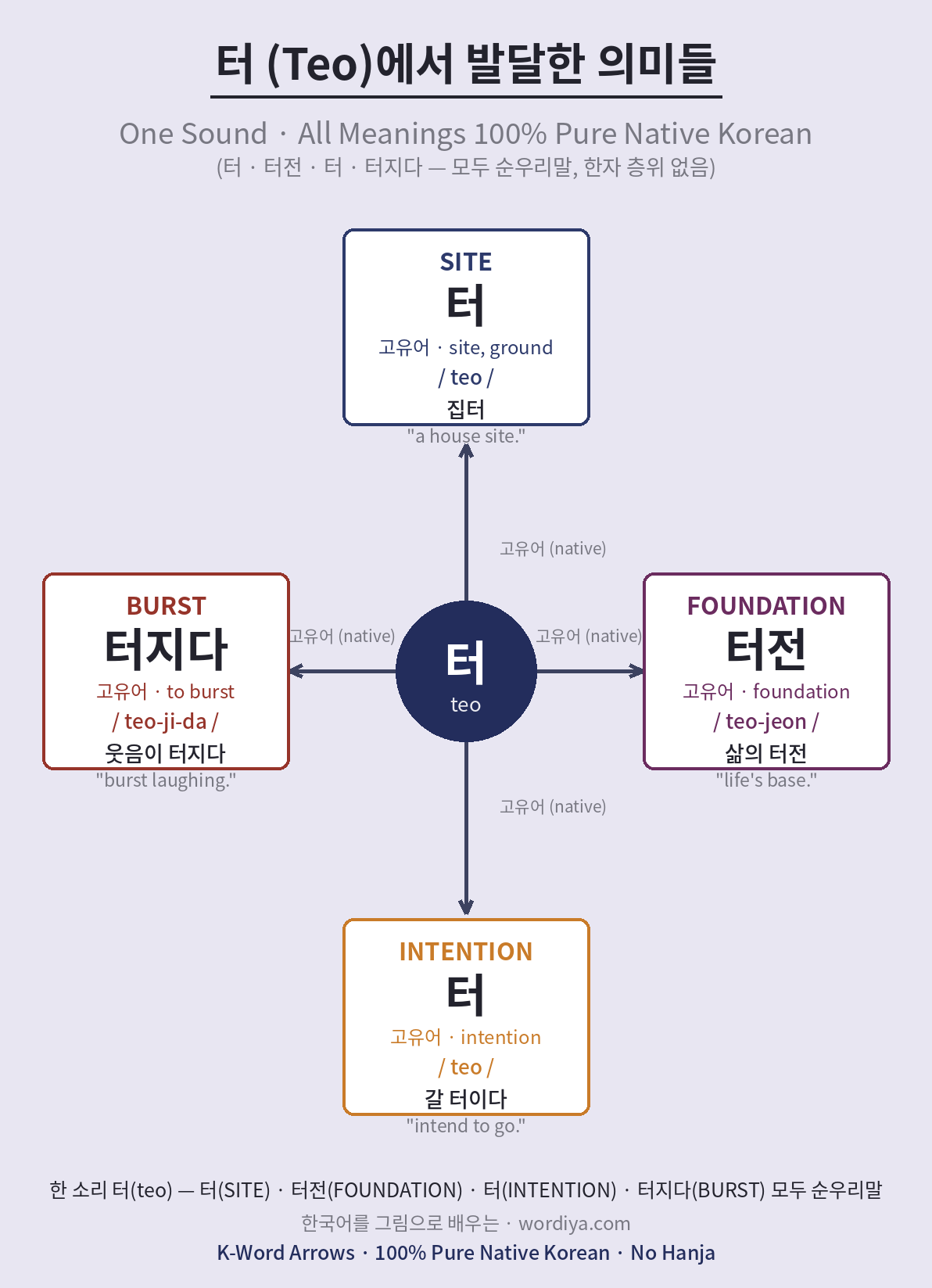
One Korean sound holds the plot of ground where something stands, the foundation of a life, the settled intention of what will be, and the sudden bursting-forth — all together. When Koreans say "집터" (a house site), they mean the physical ground on which something is built. When they say "삶의 터전" (the foundation of life), the same syllable names the base a life rests on. When they say "갈 터이다" (I intend to go), the same sound marks a settled expectation. And when they say "웃음이 터지다" (to burst out laughing), the same root names something breaking suddenly open. One Korean syllable, four completely different domains — ground, foundation, intention, and bursting. Every meaning is pure native Korean (고유어), zero Hanja anywhere.
· · ·
① SITE — 터 (teo) · pure native Korean
The first meaning of 터 is a site — the plot of ground where something stands or happens. From a house lot to a workplace to a playground, all belong to the single native Korean category 터. This is the concrete, physical meaning from which every other meaning extends: the ground beneath a thing. Pure native Korean.
Related pure native Korean expressions:
- 터 (teo, site/ground) — 무엇이 있는 자리
- 집터 (jip-teo, house site) — 집이 있던 자리
- 일터 (il-teo, workplace) — 일하는 자리
- 놀이터 (nol-i-teo, playground) — 노는 자리
- 빈터 (bin-teo, empty lot) — 비어 있는 땅
- 터를 닦다 (teo-reul dak-da, prepare the ground) — 기초를 다지다
Example sentences:
- 옛 집터에 새 건물이 섰다. (Yet jip-teo-e sae geon-mul-i seot-da. — A new building rose on the old house site.)
- 아이들이 놀이터에서 논다. (A-i-deul-i nol-i-teo-e-seo non-da. — The children play at the playground.)
- 공사를 위해 터를 닦았다. (Gong-sa-reul wi-hae teo-reul dakk-at-da. — They leveled the ground for construction.)
· · ·
② FOUNDATION — 터전 (teo-jeon) · pure native Korean
The second meaning is 터 as the foundation of a life — the base one lives and thrives on, most often in the compound 터전. The metaphor extends from physical ground to the ground of existence: home, livelihood, the place where a life is rooted. Pure native Korean.
Related pure native Korean expressions:
- 터전 (teo-jeon, foundation/base) — 삶의 바탕이 되는 자리
- 삶의 터전 (salm-ui teo-jeon) — 살아가는 근거지
- 터를 잡다 (teo-reul jap-da, to settle) — 자리를 잡다
- 텃밭 (teot-bat, home garden) — 집 곁의 밭
- 텃세 (teot-se, territorial pushiness) — 먼저 자리 잡은 자의 텃세
- 보금자리 (bo-geum-ja-ri, cozy home) — 따뜻한 터전
Example sentences:
- 이 마을이 우리 삶의 터전이다. (I ma-eul-i u-ri salm-ui teo-jeon-i-da. — This village is the foundation of our life.)
- 그는 서울에 터를 잡았다. (Geu-neun Seo-ul-e teo-reul jab-at-da. — He settled down in Seoul.)
- 텃밭에 상추를 심었다. (Teot-bat-e sang-chu-reul sim-eot-da. — I planted lettuce in the home garden.)
· · ·
③ INTENTION — 터 (teo) · pure native Korean
The third meaning is 터 as a settled intention or expectation, used as a bound noun in "-ㄹ 터이다 / 터인데 / 테니." The metaphor is subtle: an intention is the "ground" on which a future action is already set to stand. This is the hidden third face of 터 — essential grammatical Korean. Pure native Korean.
Related pure native Korean expressions:
- -ㄹ 터이다 (-l teo-i-da, intend to / will) — 할 작정이다
- -ㄹ 텐데 (-l ten-de, it would be that) — 그럴 것인데
- -ㄹ 테니 (-l te-ni, so I will) — 할 것이니
- 갈 터이다 (gal teo-i-da, intend to go) — 갈 작정이다
- 그럴 터이지 (geu-reol teo-i-ji) — 그럴 것이지
- 어찌할 터인가 (eo-jji-hal teo-in-ga) — 어떻게 할 셈인가
Example sentences:
- 내일은 꼭 갈 터이다. (Nae-il-eun kkok gal teo-i-da. — I fully intend to go tomorrow.)
- 곧 도착할 텐데 왜 안 오지? (Got do-chak-hal ten-de wae an o-ji? — He should arrive soon, so why isn't he here?)
- 내가 도울 테니 걱정 마. (Nae-ga do-ul te-ni geok-jeong ma. — I'll help you, so don't worry.)
· · ·
④ BURST — 터지다 (teo-ji-da) · pure native Korean
The fourth meaning is the verb 터지다 — to burst, to break open, to explode. From a bursting balloon to bursting laughter to a scandal breaking out, Korean uses the same root: something suddenly breaking open from within. Its transitive form 터뜨리다 means "to burst (something)." Pure native Korean.
Related pure native Korean expressions:
- 터지다 (teo-ji-da, to burst) — 갑자기 벌어지다
- 터뜨리다 (teo-tteu-ri-da, to burst something) — 터지게 하다
- 웃음이 터지다 (us-eum-i teo-ji-da) — 웃음이 갑자기 나다
- 사고가 터지다 (sa-go-ga teo-ji-da) — 사고가 벌어지다
- 봇물이 터지다 (bot-mul-i teo-ji-da) — 봇물처럼 쏟아지다
- 울음이 터지다 (ul-eum-i teo-ji-da) — 울음이 갑자기 나다
Example sentences:
- 갑자기 웃음이 터졌다. (Gap-ja-gi us-eum-i teo-jyeot-da. — Laughter suddenly burst out.)
- 큰 사고가 터졌다. (Keun sa-go-ga teo-jyeot-da. — A big accident broke out.)
- 풍선을 터뜨렸다. (Pung-seon-eul teo-tteu-ryeot-da. — I burst the balloon.)
· · ·
Bonus ① — The Unified Etymology of 터: One Root, Four Grounds
Korean historical linguists reconstruct 터 as a native root meaning "the ground where something is set or breaks open." This single root branched into four surface meanings while preserving the deep image of ground: (1) site — the physical ground a thing stands on, (2) foundation — the ground a life rests on, (3) intention — the ground on which a future action is already set, (4) burst — something breaking open from that ground. All four are dimensions of the same primordial concept: the ground of things. Only Korean unifies these under one native root, with zero Hanja layer.
Bonus ② — 터전·텃밭·텃세: The Ground We Claim
Some of the most vivid pure native Korean words grow from 터. 터전(teo-jeon) is the foundation of a life — home and livelihood together. 텃밭(teot-bat) is the small garden beside a home, the ground that feeds a family. And 텃세(teot-se) is the territorial pushiness of those who settled first. Korean did not borrow Chinese words for these; it built native metaphors on the single idea of claimed ground. To have a 터 is to belong somewhere; to lack one is to be adrift.
Bonus ③ — 터지다: When the Ground Breaks Open
The verb 터지다 gives Korean some of its most explosive expressions. Joy 터진다(웃음이 터지다), sorrow 터진다(울음이 터지다), scandals 터진다(사고가 터지다), and long-held feelings pour out like a broken dam(봇물이 터지다). The image is always the same: pressure builds beneath the surface until the ground itself breaks open. Where SITE and FOUNDATION are the ground that holds, BURST is the ground that gives way.
· · ·
What makes 터 remarkable is that it holds the site of a building, the foundation of a life, the settled intention of what will be, and the sudden bursting-forth together in one native Korean sound. From the empty lot where a house will rise to the homeland a family is rooted in, from the quiet certainty of "갈 터이다" to the explosion of laughter that breaks a silence — Korean recognizes all as the same primordial image: the ground where things are set and break open. When you say 터 in Korean, you speak the ancient language that saw a single ground beneath the house, the life, the will, and the burst.
K-Word Arrows: Korean Homonyms Visualized · ⓒ wordiya.com
'K-Word Arrows: Korean Homonyms Visualize' 카테고리의 다른 글
| 참 (Cham) — True · Genuine · While · Endure (0) | 2026.07.08 |
|---|---|
| 목 (Mok) — Neck · Junction · Voice · Thirst (0) | 2026.07.08 |
| 결 (Gyeol) — Grain · Wave · Moment · Temper (0) | 2026.07.08 |
| 줄 (Jul) - Rope · Row · Decrease · Know-How (0) | 2026.07.07 |
| 얼 (Eol) - Spirit · Immature · Dazed · Foolish (0) | 2026.07.07 |


