턱 (Teok) - Chin · Ledge · Treat · Unreasonable
One Sound · All Pure Native Korean Meanings — Chin, Ledge, Treat, and Unreasonable
[※ 도식: teok_color_diagram.png]
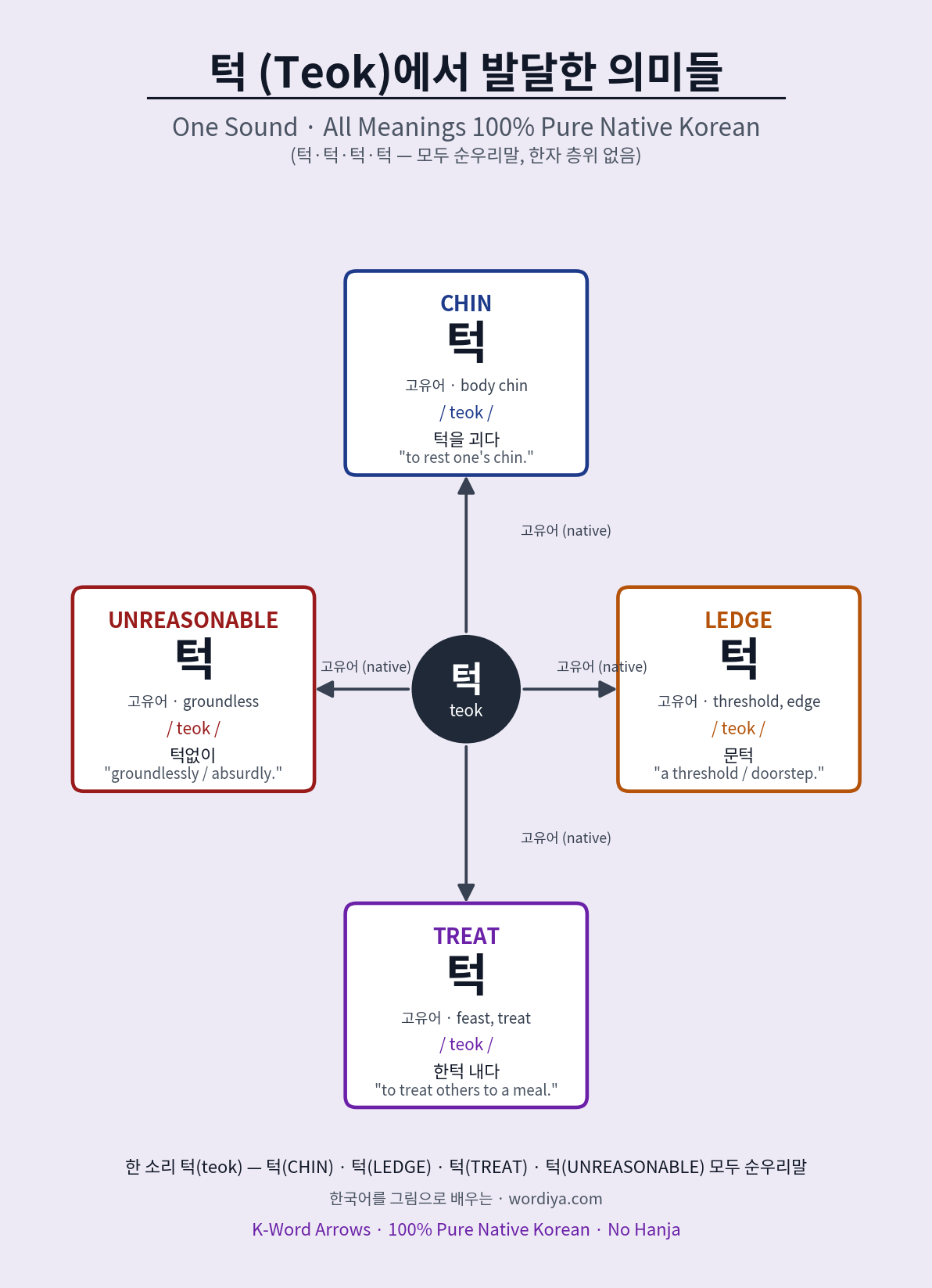
One Korean sound holds the body's chin, the doorway threshold, the celebratory feast, and the absurdly groundless — all together. When Koreans say "턱을 괴다" (to rest one's chin), they mean the physical body part. When they say "문턱" (threshold), the same syllable names the raised edge at a doorway — the door's chin. When they say "한턱 내다" (to treat), the same word marks a cultural act of feeding others to share good fortune. And when they say "턱없이" (groundlessly), the same sound names something without any reasonable basis. One Korean syllable, four completely different worlds — the body, architecture, social culture, and the state of being absurd. Every meaning is pure native Korean (고유어), zero Hanja anywhere. This chapter reveals how Korean unifies four unrelated domains through one primordial sound.
① CHIN — 턱 (teok) · pure native Korean
The first meaning of 턱 is the chin — the lower part of the face below the mouth. Korean uses 턱 for both the chin and the jaw. This is the primal, physical meaning that all other meanings of 턱 metaphorically extend from. Pure native Korean, one of the oldest body-part words.
Related pure native Korean expressions:
• 턱 teok chin, jaw
• 턱을 괴다 teok-eul goe-da to rest one's chin
• 이중턱 i-jung-teok double chin
• 턱수염 teok-su-yeom chin beard
• 아래턱 a-rae-teok lower jaw
• 턱 밑 teok mit under the chin
Example sentences:
▪ 그녀는 손으로 턱을 괴고 앉아 있었다. Geu-nyeo-neun son-eu-ro teok-eul goe-go anj-a iss-eoss-da. She sat resting her chin on her hand.
▪ 아기의 턱이 정말 귀엽다. A-gi-ui teok-i jeong-mal gwi-yeop-da. The baby's chin is really cute.
▪ 나이가 들면서 이중턱이 생겼어. Na-i-ga deul-myeon-seo i-jung-teok-i saeng-gyeoss-eo. As I got older, I developed a double chin.
② LEDGE — 턱 (teok) · pure native Korean
The second meaning is 턱 as an architectural ledge — the raised edge or protruding step at a doorway, staircase, or window sill. The metaphor is direct: like the chin protrudes from the face, an architectural edge protrudes from a flat surface. The most common compound is 문턱 (door-chin), the threshold. This word appears constantly in K-drama scenes of characters standing at the boundary of a home. Pure native Korean.
Related pure native Korean expressions:
• 턱 teok ledge, threshold, raised edge
• 문턱 mun-teok doorway threshold (lit. door-chin)
• 계단 턱 gye-dan teok step edge
• 창문턱 chang-mun-teok window sill
• 턱을 넘다 teok-eul neom-da to cross over the ledge
• 문턱이 높다 mun-teok-i nop-da the threshold is high (hard to enter)
Example sentences:
▪ 그는 문턱을 넘어 집으로 들어왔다. Geu-neun mun-teok-eul neom-eo jib-eu-ro deul-eo-wat-da. He crossed the threshold and entered the house.
▪ 이 대학은 문턱이 아주 높다. I dae-hak-eun mun-teok-i a-ju nop-da. This university has a very high threshold (hard to get into).
▪ 계단 턱에 걸려 넘어질 뻔했다. Gye-dan teok-e geol-lyeo neom-eo-jil ppeon-haess-da. I almost tripped over the step edge.
③ TREAT — 턱 (teok) · pure native Korean
The third meaning is 턱 as a treat — a feast or meal that one person provides for others to celebrate good fortune. This is a deeply K-cultural practice: when a Korean gets a promotion, passes an exam, buys a new house, has a baby, or receives any good news, they "turn a 턱" — 한턱 내다 (to make a treat). Refusing to reciprocate this practice is considered stingy and unfriendly. Pure native Korean, essential K-social vocabulary.
Related pure native Korean expressions:
• 턱 teok a treat, a celebratory meal
• 한턱 내다 han-teok nae-da to treat someone to a meal
• 승진 턱 seung-jin teok promotion treat
• 결혼 턱 gyeol-hon teok wedding treat
• 턱을 내다 teok-eul nae-da to provide a treat
• 한턱 쏘다 han-teok sso-da to shoot a treat (informal)
Example sentences:
▪ 승진했으니 한턱 쏴야지! Seung-jin-haess-eu-ni han-teok sswa-ya-ji! You got promoted, so you'd better treat us!
▪ 결혼 턱으로 저녁 식사를 대접했다. Gyeol-hon teok-eu-ro jeo-nyeok sik-sa-reul dae-jeop-haess-da. She treated everyone to dinner as a wedding treat.
▪ 첫 월급 받으면 부모님께 한턱 내는 게 전통이다. Cheot wol-geup bad-eu-myeon bu-mo-nim-kke han-teok nae-neun ge jeon-tong-i-da. It's tradition to treat your parents when you get your first paycheck.
④ UNREASONABLE — 턱 (teok) · pure native Korean
The fourth meaning is 턱 as the state of being groundless or absurd — used in the pattern 턱없이 (groundlessly) or 턱없다 (unreasonable). The metaphor: something that has no chin has nothing to rest on, nothing to hold it up — hence unfounded, absurd. Korean uses this pattern constantly in everyday speech to dismiss impossibility. This is the hidden fourth face of 턱, essential for natural K-Korean expression.
Related pure native Korean expressions:
• 턱없이 teok-eops-i groundlessly, unreasonably
• 턱없다 teok-eop-da to be unreasonable, absurd
• 턱없이 비싸다 teok-eops-i bi-ssa-da unreasonably expensive
• 턱없는 소리 teok-eom-neun so-ri nonsensical talk
• 그럴 턱이 없다 geu-reol teok-i eop-da there's no way that's true
• 턱도 없이 teok-do eops-i without any basis at all
Example sentences:
▪ 이 가방은 턱없이 비싸다. I ga-bang-eun teok-eops-i bi-ssa-da. This bag is unreasonably expensive.
▪ 그럴 턱이 없어. 말도 안 돼. Geu-reol teok-i eops-eo. Mal-do an dwae. There's no way that's true. It makes no sense.
▪ 턱없는 소리 하지 마. Teok-eom-neun so-ri ha-ji ma. Don't talk nonsense.
Bonus ① — The Unified Etymology of 턱: One Root, Four Extending Meanings
Alexander Vovin (CNRS) and Korean historical linguists trace 턱 to Proto-Koreanic *tʌrk-, meaning "a protruding edge or supporting base." This single root branched into four surface meanings while preserving the deep concept: (1) chin — the protruding lower edge of the face, (2) ledge — the protruding edge of a doorway or step, (3) treat — the social protrusion of good fortune shared with others, (4) unreasonable — the state of lacking a protruding base to rest on. All four share the deep image of "a supporting protrusion." Korean captured a profound observation: the chin holds up the face, the threshold holds up the doorway, the treat holds up social bonds, and an absurd claim has no protrusion to hold it up. Only Korean unifies these four under one native root, with zero Hanja layer.
Bonus ② — 한턱 내다: The K-Cultural Practice of Sharing Fortune
한턱 내다 (han-teok nae-da) — "to make a treat" — is one of the most distinctive K-cultural practices embedded in the Korean language. When a Korean receives any good news — a job promotion, a wedding, a baby's first birthday, a housewarming, a lottery win, or even a first paycheck — there is an unspoken cultural obligation to "turn a 턱" by treating friends, family, or colleagues to a meal. Refusing to reciprocate this practice is considered stingy, and Koreans may playfully but persistently demand "턱 내!" (treat us!) until the person complies. The practice is so ingrained that K-drama scenes constantly feature 한턱 negotiations. Understanding 한턱 is understanding the K-cultural principle that fortune must be shared to be complete. When you learn 한턱 in Korean, you learn how Korean society itself works.
Bonus ③ — 문턱 (mun-teok): The Threshold as Social Metaphor
문턱 (mun-teok) — literally "door-chin" — is another beautiful pure native Korean compound. It names not just the physical threshold of a doorway but also the metaphorical threshold of any opportunity. When Koreans say "문턱이 높다" (the threshold is high), they mean "this is hard to get into" — whether it's a university, a job, a social circle, or a professional field. When they say "문턱을 낮추다" (to lower the threshold), they mean "to make it more accessible." The metaphor is precise and poetic: the chin of the doorway is the last physical barrier between outside and inside. Modern Korean business language uses 문턱 constantly for market entry, industry access, and social mobility. When you say 문턱 in Korean, you speak the ancient language that saw every barrier as a doorway's chin — a physical protrusion that must be crossed.
What makes 턱 remarkable is that it holds the body's chin, the doorway's threshold, the celebratory treat, and the groundless absurd together in one native Korean sound. From the physical protrusion of the human face to the raised edge of a Korean hanok doorway, from the promotion meal shared with colleagues to the dismissive rejection of an unreasonable claim — Korean recognizes all as expressions of the same primordial pattern: a supporting protrusion. This is Korean vocabulary carrying Korean cosmology — pre-Hanja, pre-modern grammar — a self-sufficient language that named body, architecture, social culture, and logical state in one sound. When you say 턱 in Korean, you speak the ancient language that saw a single geometric truth uniting the face, the doorway, the feast, and the reasonable — the language whose word for chin is the same as its word for threshold, its word for treat, and its word for unreasonable, because all four share the deep image of a protruding base that either supports or fails to support what rests upon it.
K-Word Arrows: Korean Homonyms Visualized · ⓒ wordiya.com
'K-Word Arrows: Korean Homonyms Visualize' 카테고리의 다른 글
| 줄 (Jul) - Rope · Row · Decrease · Know-How (0) | 2026.07.07 |
|---|---|
| 얼 (Eol) - Spirit · Immature · Dazed · Foolish (0) | 2026.07.07 |
| 꿈(Kkum): Dream · Ambition · Fantasy · Unimagined (0) | 2026.07.06 |
| 바람 (baram)— Wind, Wish, Affair, and Rush of State (0) | 2026.07.06 |
| 새 (Sae) — Bird · New · Between · Leak (0) | 2026.07.06 |


