새 (Sae) — Bird · New · Between · Leak
One Sound · All Pure Native Korean Meanings
[※ 도식 이미지 첨부: sae_color_diagram.png]
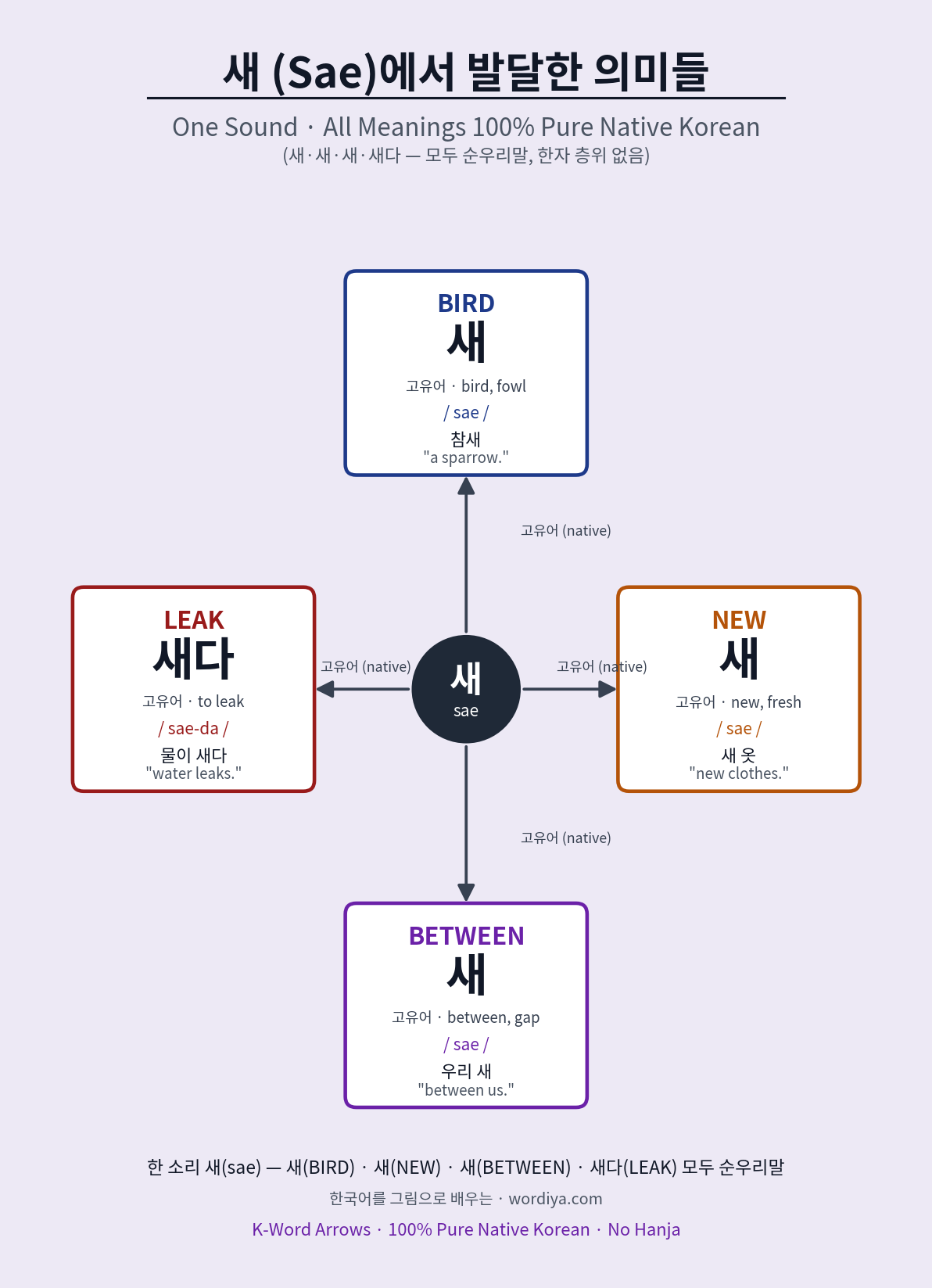
One Korean sound holds the sky, the calendar, the space between people, and the slow outflow of what should stay hidden — all together. When Koreans say "참새" (sparrow), they mean the small creature that passes through the air. When they say "새 옷" (new clothes), they use the same syllable — because newness is what has just passed into being. When they say "우리 새에" (between us), the same word marks the gap through which relationships breathe. And when they say "비밀이 새다" (a secret leaks), they name the act of something slipping through where it shouldn't. One Korean syllable, four completely different domains — flight, freshness, in-betweenness, and outflow. Every meaning is pure native Korean (고유어), zero Hanja anywhere.
① BIRD — 새 (sae) · pure native Korean
The winged creature. From sparrows to magpies, from swallows to eagles, all belong to the single native Korean category 새. Korean did not borrow a Chinese word for this everyday being; the sky-dweller kept its native name.
Related pure native Korean expressions:
- 새 (sae, bird) — 하늘을 나는 짐승
- 참새 (cham-sae, sparrow) — 가장 흔한 작은 새
- 까치 (kka-chi, magpie) — 반가운 소식의 새
- 새장 (sae-jang, birdcage) — 새를 기르는 우리
- 새떼 (sae-tte, flock of birds) — 새들의 무리
- 새소리 (sae-so-ri, birdsong) — 새 우는 소리
Example sentences:
- 아침에 새가 노래한다. (A-chim-e sae-ga no-rae-han-da. — The bird sings in the morning.)
- 참새가 나무에 앉았다. (Cham-sae-ga na-mu-e an-jat-da. — A sparrow perched on the tree.)
- 새떼가 하늘을 날아간다. (Sae-tte-ga ha-neul-eul nal-a-gan-da. — A flock of birds crosses the sky.)
② NEW — 새 (sae) · pure native Korean
The adjective prefix 새 — new, fresh, just-arrived. It attaches directly to nouns: 새 옷, 새 집, 새 해, 새 마음. Korean expresses newness by prefixing 새 to whatever is renewed, without any Hanja borrowing.
Related pure native Korean expressions:
- 새 (sae, new prefix) — 새것의 뜻
- 새 옷 (sae ot, new clothes) — 새로 산 옷
- 새 집 (sae jip, new house) — 새로 지은 집
- 새 해 (sae hae, new year) — 새로운 한 해
- 새로 (sae-ro, newly) — 처음으로 다시
- 새롭다 (sae-rop-da, to be new) — 새 느낌이 있다
Example sentences:
- 새 옷을 샀어. (Sae os-eul sass-eo. — I bought new clothes.)
- 새 해가 밝았다. (Sae hae-ga bal-gat-da. — A new year has dawned.)
- 새 마음으로 시작하자. (Sae ma-eum-eu-ro si-ja-ka-ja. — Let's start with a new heart.)
③ BETWEEN — 새 (sae) · pure native Korean
새 as a contracted form of 사이 — between, gap, interval. In everyday Korean, 사이 shortens to 새 in fixed expressions like 우리 새에, 그새, 밤새, 어느새. This 새 marks temporal or spatial gaps — the quiet space through which things pass.
Related pure native Korean expressions:
- 사이 (sa-i, between/gap) — 두 대상 사이
- 새 (sae, short form of 사이) — 사이의 축약
- 우리 새 (u-ri sae, between us) — 우리 사이
- 그새 (geu-sae, in that short while) — 그 사이
- 밤새 (bam-sae, all night) — 밤 사이 · 밤 내내
- 어느새 (eo-neu-sae, before you know it) — 어느 사이엔가
Example sentences:
- 우리 새에 비밀은 없어. (U-ri sae-e bi-mil-eun eob-seo. — Between us, there are no secrets.)
- 그새 많이 컸구나. (Geu-sae ma-ni keot-gu-na. — You've grown so much in that short time.)
- 밤새 눈이 내렸다. (Bam-sae nun-i nae-ryeot-da. — Snow fell all night.)
④ LEAK — 새다 (sae-da) · pure native Korean
The verb 새다 — to leak, to seep, to slip out. Water leaks, gas leaks, rumors leak, and — most vividly in K-drama — secrets leak. Korean uses the same primal root: something that passes through a gap it shouldn't.
Related pure native Korean expressions:
- 새다 (sae-da, to leak) — 빠져나가다
- 물이 새다 (mul-i sae-da, water leaks) — 물이 흘러나옴
- 비밀이 새다 (bi-mil-i sae-da, a secret leaks) — 비밀이 알려짐
- 소문이 새다 (so-mun-i sae-da, a rumor spreads) — 소문이 퍼짐
- 새어나오다 (sae-eo na-o-da, to leak out) — 밖으로 새어 나옴
- 정보가 새다 (jeong-bo-ga sae-da, information leaks) — 정보 유출
Example sentences:
- 지붕에서 물이 샜다. (Ji-bung-e-seo mul-i saet-da. — Water leaked from the roof.)
- 비밀이 밖으로 새 나갔어. (Bi-mil-i bag-eu-ro sae na-gass-eo. — The secret leaked out.)
- 가스가 새는지 확인해. (Ga-seu-ga sae-neun-ji hwa-gin-hae. — Check whether gas is leaking.)
Bonus ① — The Unified Etymology of 새: One Root, Four Motions of "Passing Through"
Alexander Vovin (CNRS) reconstructs 새 as Proto-Koreanic *say-/*sai-, meaning "to pass through, to slip between." This single root branched into four surface meanings while preserving the deep concept: (1) bird — the creature that passes through the air, (2) new — that which has just passed into being, (3) between — the gap through which things pass, (4) leak — the act of passing through where it shouldn't. All four are dimensions of the same primordial motion: passage. Only Korean unifies these four under one native root, with zero Hanja layer.
Bonus ② — 새 in K-Drama Emotional Layers
K-drama scripts constantly deploy 새 vocabulary in emotional peaks. Character-transformation arcs use "새 사람" (a new person). Time-lapse regret scenes use "그새" — the character discovers that too much has changed in the space of a moment. Worry scenes use "밤새" — the mother who waited, the lover who couldn't sleep. Betrayal-reveal scenes use "비밀이 새다". Nostalgic reflection uses "어느새" — the sudden awareness that time has passed. In dramas like Crash Landing on You, My Mister, and Reply 1988, characters constantly move through 새 — the small gaps of time and space where the deepest emotions accumulate.
Bonus ③ — 새벽: The Word Where All Four Meanings Meet
The Korean word for dawn, 새벽 (sae-byeok), literally means "the new edge" — 새 (new) + 벽 (edge/wall). But inside this single compound, all four meanings of 새 quietly converge. Dawn is the new (새 = new) time; the between-time (새 = between) where night meets day; the moment when birds (새 = bird) sing their first songs; and the moment when the first light leaks (새 = leak) through the window of a sleeping house. No other Korean word carries the full semantic range of a single syllable so beautifully.
What makes 새 remarkable is that it holds flight, freshness, in-betweenness, and outflow together in one native Korean sound. From the sparrow crossing the morning sky to the new year turning at midnight, from the quiet space between two hearts to the secret that slips through the smallest gap — Korean recognizes all as expressions of the same primordial act: passing through. When you say 새 in Korean, you speak the ancient language that unified the wing, the calendar, the gap, and the leak.
K-Word Arrows: Korean Homonyms Visualized ⓒ wordiya.com


