바람 (baram) — Wind, Wish, Affair, and Rush of State
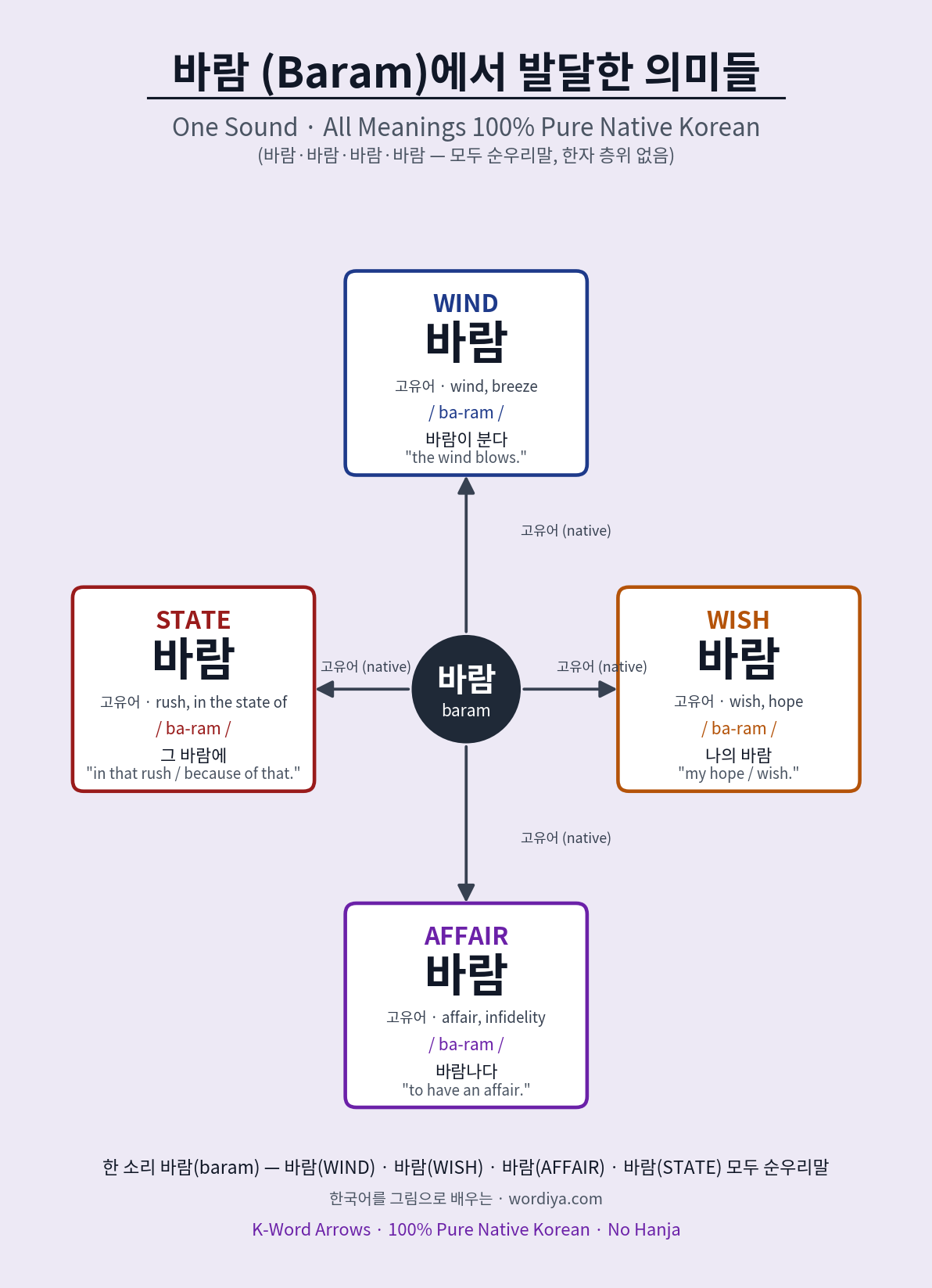
[※ 도식: baram_color_diagram.png]
One Korean sound holds the sky's breath, the heart's longing, the unfaithful romance, and the sudden state of things — all together. When Koreans say "바람이 분다" (the wind blows), they mean the moving air itself. When they say "나의 바람" (my wish), they use the same syllable — because a wish is what the heart releases into the world, like breath. When they say "바람나다" (to have an affair), the same word marks the wandering of the heart outside its commitment. And when they say "그 바람에" (in that rush / because of that), the same sound names the sudden state or momentum that sweeps everything along. One Korean syllable, four completely different domains — atmosphere, longing, betrayal, and momentum. Every meaning is pure native Korean (고유어), zero Hanja anywhere. This chapter reveals how Korean unifies the concept of "moving air" — through the sky, through the heart, through fidelity, and through circumstance — in one primordial sound.
① WIND — 바람 (ba-ram) · pure native Korean
The first meaning of 바람 is the moving air — the wind itself. From the mild breeze of spring to the winter storm, all belong to the single native Korean category 바람. Korean did not borrow a Chinese word for this everyday element; the sky-breather kept its native name. Pure native Korean, one of the oldest content words in the language.
Related pure native Korean expressions:
• 바람 ba-ram wind
• 바람이 분다 ba-ram-i bun-da The wind blows.
• 바람이 불다 ba-ram-i bul-da for the wind to blow
• 산들바람 san-deul-ba-ram a gentle breeze
• 칼바람 kal-ba-ram a sharp cold wind
• 바람 좀 쐬다 ba-ram jom sswe-da to get some fresh air
Example sentences:
▪ 오늘은 바람이 세게 분다. O-neul-eun ba-ram-i se-ge bun-da. The wind is blowing strongly today.
▪ 바람 좀 쐬러 나가자. Ba-ram jom sswe-reo na-ga-ja. Let's go out to get some fresh air.
▪ 칼바람이 얼굴을 스친다. Kal-ba-ram-i eol-gul-eul seu-chin-da. A sharp cold wind grazes my face.
② WISH — 바람 (ba-ram) · pure native Korean
The second meaning is 바람 as a wish, a hope, a longing released from the heart. This is the noun form of the verb 바라다 (ba-ra-da, to hope). Korean conceptualizes hope as something you exhale into the world — literally, a breath sent out. When someone says "나의 바람은…" (my wish is…), they are releasing a piece of their heart into the air. Pure native Korean, essential emotional vocabulary.
Related pure native Korean expressions:
• 바람 ba-ram a wish / a hope
• 바라다 ba-ra-da to hope, to wish
• 나의 바람 na-ui ba-ram my wish
• 간절한 바람 gan-jeol-han ba-ram an earnest wish
• 바람대로 ba-ram-dae-ro as one wishes
• 바랄 것 ba-ral geot something to wish for
Example sentences:
▪ 네가 행복하기를 바란다. Ne-ga haeng-bok-ha-gi-reul ba-ran-da. I hope that you are happy.
▪ 나의 바람은 소박해. Na-ui ba-ram-eun so-bak-hae. My wish is simple.
▪ 모든 것이 네 바람대로 되기를. Mo-deun geot-i ne ba-ram-dae-ro doe-gi-reul. May everything go as you wish.
③ AFFAIR — 바람 (ba-ram) · pure native Korean
The third meaning is the emotionally charged 바람 of romantic infidelity — the affair, the wandering heart. When Koreans say "바람나다" (to have an affair) or "바람둥이" (a philanderer), they use the same syllable. The metaphor is extraordinary: an unfaithful partner's heart has been blown away by the wind — it has left its stable place and drifted. This is one of the most vivid emotional metaphors in K-drama romance vocabulary.
Related pure native Korean expressions:
• 바람나다 ba-ram-na-da to have an affair
• 바람둥이 ba-ram-dung-i a philanderer
• 바람피우다 ba-ram-pi-u-da to cheat on a partner
• 바람 폈다 ba-ram pyeot-da (one) has cheated
• 바람둥이 기질 ba-ram-dung-i gi-jil a philandering nature
• 바람 상대 ba-ram sang-dae an affair partner
Example sentences:
▪ 그 사람 바람났대. Geu sa-ram ba-ram-nat-dae. I heard he's having an affair.
▪ 바람둥이는 결국 혼자가 된다. Ba-ram-dung-i-neun gyeol-guk hon-ja-ga doen-da. A philanderer ends up alone in the end.
▪ 절대 바람피우지 마. Jeol-dae ba-ram-pi-u-ji ma. Don't ever cheat.
④ STATE — 바람 (ba-ram) · pure native Korean
The fourth meaning is 바람 as a sudden state, a rush of circumstance, a momentum. In the fixed pattern "그 바람에" or "~바람에", 바람 means "in that rush" or "because of that sudden movement." Korean uses the same primal root: something that sweeps everything along like wind. This grammatical usage is essential in narrative Korean — the hidden fourth face of 바람.
Related pure native Korean expressions:
• 그 바람에 geu ba-ram-e in that rush / because of that
• 서두르는 바람에 seo-du-reu-neun ba-ram-e in the rush of hurrying
• 웃는 바람에 ut-neun ba-ram-e in the rush of laughter
• 놀라는 바람에 nol-la-neun ba-ram-e in the rush of surprise
• ~바람에 -ba-ram-e because of ~
• 바람에 밀리다 ba-ram-e mil-li-da to be swept by the rush
Example sentences:
▪ 놀라는 바람에 컵을 떨어뜨렸다. Nol-la-neun ba-ram-e keop-eul tteo-reo-tteu-ryeot-da. In the rush of surprise, I dropped the cup.
▪ 서두르는 바람에 지갑을 두고 왔어. Seo-du-reu-neun ba-ram-e ji-gap-eul du-go wass-eo. In the rush of hurrying, I left my wallet behind.
▪ 네가 웃는 바람에 나도 웃었어. Ne-ga ut-neun ba-ram-e na-do us-eoss-eo. Because you laughed, I laughed too.
Bonus ① — The Unified Etymology of 바람: One Root, Four Motions of Air
Alexander Vovin (CNRS) reconstructs 바람 as Proto-Koreanic *param, meaning "moving air, breath released." This single root branched into four surface meanings while preserving the deep concept: (1) atmospheric wind — the sky's breath, (2) wish — the heart's breath released into the world, (3) affair — the heart itself blown from its stable place, (4) state / rush — the momentum that sweeps circumstances along. All four are dimensions of the same primordial motion: air in movement. Korean captured a profound observation: the same word — moving air — describes weather, longing, infidelity, and rushed circumstance. Only Korean unifies these four under one native root, with zero Hanja layer.
Bonus ② — 바람 in K-Drama Romance Vocabulary
K-drama scripts constantly deploy 바람 vocabulary in emotional peaks. Confession scenes use "나의 바람은 너뿐이야" (my only wish is you) — hope as breath. Betrayal-reveal scenes use "바람났대" (he's having an affair) — the shocking discovery that a partner's heart has drifted. Character-flaw scenes use "바람둥이" (philanderer) — a heart that cannot stay in one place. Nostalgic longing scenes use "바람 좀 쐬자" (let's get some air) — physical wind as emotional reset. In K-dramas like Descendants of the Sun, Crash Landing on You, and The World of the Married, characters constantly move through the four 바람 — literal wind, private wish, revealed affair, and the emotional rush that sweeps them into action. Understanding 바람 vocabulary is understanding Korean emotional weather itself.
Bonus ③ — 바람 as Korean Somatic Poetics: Breath = Wish = Heart
Ancient Korean thought treated the human heart as an atmospheric organ. When you exhale, you release breath into the world. When you long for something, you release a wish into the world. When your heart wanders from a partner, it has been carried away by wind. When you rush into action, the momentum of wind sweeps you. All four are motions of the same substance: air passing through the human interior. Modern psychology has recently rediscovered somatic poetics — the idea that emotions and breath are physically linked. Korean captured this insight thousands of years ago in the single word 바람. When a Korean says "바람이 있다" (there is a wish), they are literally saying "there is a wind in me." K-culture preserves this ancient wisdom in daily vocabulary — a somatic poetics that unifies weather, longing, fidelity, and momentum in one native syllable.
What makes 바람 remarkable is that it holds atmospheric wind, personal longing, romantic betrayal, and circumstantial momentum together in one native Korean sound. From the spring breeze on a cherry blossom afternoon to the earnest wish whispered to a shooting star, from the drifting heart of an unfaithful partner to the rushed circumstance that changes everything — Korean recognizes all as expressions of the same primordial motion: air in movement. This is Korean vocabulary carrying Korean cosmology — pre-Hanja, pre-modern grammar — a self-sufficient language that named weather, longing, betrayal, and momentum in one sound. When you say 바람 in Korean, you speak the ancient language that unified the sky, the heart, the wandering, and the rush — the language whose deepest word for wind is the same as its word for wish, because both come from the same place: the primal breath that moves through and beyond the human body.
K-Word Arrows: Korean Homonyms Visualized · ⓒ wordiya.com
'K-Word Arrows: Korean Homonyms Visualize' 카테고리의 다른 글
| 턱 (Teok) - Chin · Ledge · Treat · Unreasonable (0) | 2026.07.07 |
|---|---|
| 꿈(Kkum): Dream · Ambition · Fantasy · Unimagined (0) | 2026.07.06 |
| 새 (Sae) — Bird · New · Between · Leak (0) | 2026.07.06 |
| 속 (Sok) — Inside, Deceived, Deceive, Burning Heart — Four Pure Native Korean Meanings (1) | 2026.07.05 |
| 품 (Pum) — Bosom, Embrace, Style, Effort — Four Pure Native Korean Meanings (0) | 2026.07.05 |


