꿈 (kkum)
One Sound · All Pure Native Korean Meanings — Dream, Ambition, Fantasy, and Unimagined
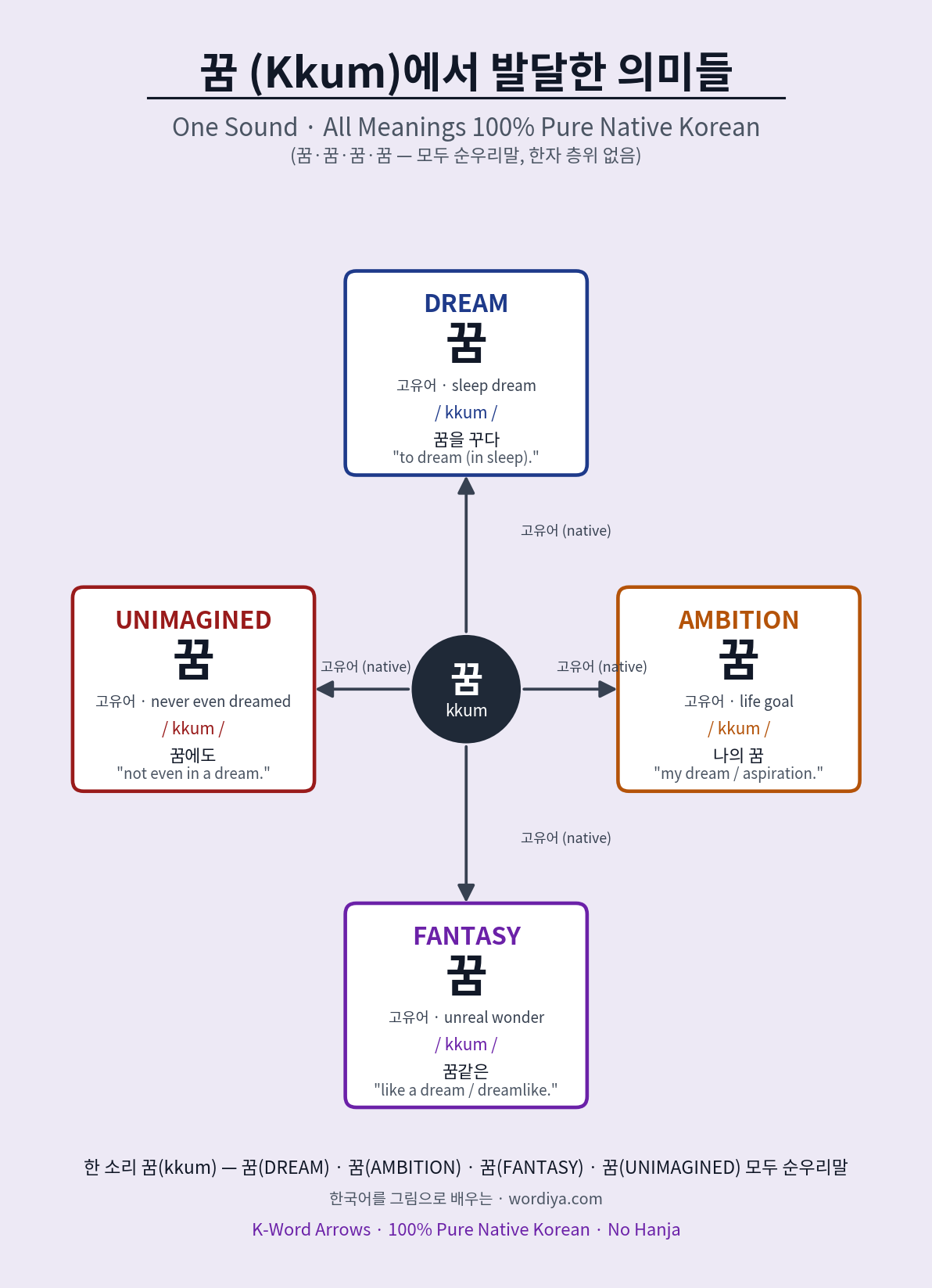
One Korean sound holds the sleeping mind, the life goal, the wondrous unreal, and the far edge of imagination — all together. When Koreans say "꿈을 꾸다" (to dream), they mean the visions that appear in sleep. When they say "나의 꿈" (my dream), they use the same syllable — because a life ambition is also a vision, only projected forward into the future. When they say "꿈같은" (dreamlike), the same word marks something so beautiful or unexpected it feels unreal. And when they say "꿈에도 몰랐다" (I never even dreamed of it), the same sound names the far horizon beyond which not even imagination reaches. One Korean syllable, four completely different domains — sleep, ambition, wonder, and the limit of the imaginable. Every meaning is pure native Korean (고유어), zero Hanja anywhere. This chapter reveals how Korean unifies the concept of "the space of imagination" — through the night, through the future, through wonder, and through the outer edge of what can be pictured — in one primordial sound.
① DREAM — 꿈 (kkum) · pure native Korean
The first meaning of 꿈 is the dream that appears during sleep — the mental images that visit the sleeping mind. Every human culture has such a word, but Korean uses the same primordial sound 꿈 whether the dream is beautiful or terrifying, remembered clearly or forgotten by morning. Pure native Korean, one of the deepest content words in the language.
Related pure native Korean expressions:
• 꿈 kkum a dream (in sleep)
• 꿈을 꾸다 kkum-eul kku-da to have a dream / to dream
• 꿈에 kkum-e in a dream
• 꿈속 kkum-sok inside a dream
• 꿈결 kkum-gyeol in the wake of a dream
• 개꿈 gae-kkum a nonsense dream (lit. dog-dream)
Example sentences:
▪ 어젯밤에 이상한 꿈을 꿨어. Eo-jet-bam-e i-sang-han kkum-eul kkwoss-eo. I had a strange dream last night.
▪ 꿈속에서 어릴 적 집에 갔다. Kkum-sok-e-seo eo-ril jeok jib-e gat-da. In my dream I went to the house of my childhood.
▪ 그 얘기는 개꿈이니 잊어버려. Geu yae-gi-neun gae-kkum-i-ni ij-eo-beo-ryeo. That's just a nonsense dream — forget about it.
② AMBITION — 꿈 (kkum) · pure native Korean
The second meaning is 꿈 as a life ambition — a goal, an aspiration, what one hopes to become or achieve. Korean uses the same syllable as the sleep-dream, because a life ambition is also a vision — only projected forward in time rather than seen at night. When a Korean child is asked "너의 꿈이 뭐야?" (what is your dream?), they answer with their future self. Pure native Korean, essential emotional vocabulary in K-culture.
Related pure native Korean expressions:
• 꿈 kkum a dream / an ambition
• 나의 꿈 na-ui kkum my dream (aspiration)
• 꿈이 있다 kkum-i it-da to have a dream
• 꿈을 이루다 kkum-eul i-ru-da to achieve one's dream
• 꿈을 키우다 kkum-eul ki-u-da to nurture one's dream
• 꿈나무 kkum-na-mu a promising youth (lit. dream-tree)
Example sentences:
▪ 나의 꿈은 화가가 되는 것이야. Na-ui kkum-eun hwa-ga-ga doe-neun geot-i-ya. My dream is to become a painter.
▪ 꿈이 있는 사람은 흔들리지 않는다. Kkum-i it-neun sa-ram-eun heun-deul-li-ji an-neun-da. A person with a dream does not waver.
▪ 드디어 꿈을 이루었다. Deu-di-eo kkum-eul i-ru-eot-da. At last I have achieved my dream.
③ FANTASY — 꿈 (kkum) · pure native Korean
The third meaning is 꿈 as the wondrous unreal — something so beautiful, so unexpected, or so extraordinary that it feels as if it cannot belong to waking life. When Koreans say "꿈같은 하루였어" (it was a dreamlike day), they mean the day was too good to be real. This is one of the most romantic uses of 꿈 in K-drama love confessions, wedding scenes, and reunion moments. Pure native Korean.
Related pure native Korean expressions:
• 꿈같은 kkum-ga-teun dreamlike
• 꿈만 같은 kkum-man ga-teun as if only a dream
• 꿈속의 kkum-sok-ui of the dream / in the dream
• 꿈처럼 kkum-cheo-reom like a dream
• 꿈이야 생시야 kkum-i-ya saeng-si-ya is it a dream or reality?
• 꿈같은 밤 kkum-ga-teun bam a dreamlike night
Example sentences:
▪ 너를 다시 만나다니 꿈만 같아. Neo-reul da-si man-na-da-ni kkum-man gat-a. Meeting you again feels just like a dream.
▪ 어제는 정말 꿈같은 하루였어. Eo-je-neun jeong-mal kkum-ga-teun ha-ru-yeoss-eo. Yesterday was truly a dreamlike day.
▪ 이게 꿈이야 생시야? I-ge kkum-i-ya saeng-si-ya? Is this a dream or reality?
④ UNIMAGINED — 꿈 (kkum) · pure native Korean
The fourth meaning is 꿈 as the far edge of imagination — used in the pattern "꿈에도" (even in a dream) to describe something so unexpected that it was not present even in the deepest reaches of one's inner world. This is the hidden fourth face of 꿈 — the negative frontier that marks the outermost boundary of what a person could ever have pictured. Pure native Korean, essential K-drama narrative vocabulary for plot twists and shocking revelations.
Related pure native Korean expressions:
• 꿈에도 kkum-e-do even in a dream
• 꿈에도 몰랐다 kkum-e-do mol-lat-da I never even dreamed of it
• 꿈에도 생각 못 한 kkum-e-do saeng-gak mot han never even imagined
• 꿈꾼 적 없다 kkum-kkun jeok eop-da have never dreamed of
• 꿈에서라도 kkum-e-seo-ra-do even if only in a dream
• 꿈도 못 꿀 kkum-do mot kkul cannot even dream of
Example sentences:
▪ 이런 일이 생길 줄은 꿈에도 몰랐다. I-reon il-i saeng-gil jul-eun kkum-e-do mol-lat-da. I never even dreamed such a thing would happen.
▪ 네가 나를 배신할 줄은 꿈에도 생각 못 했어. Ne-ga na-reul bae-sin-hal jul-eun kkum-e-do saeng-gak mot haess-eo. I never once imagined you would betray me.
▪ 그런 인생은 꿈도 못 꿀 일이었지. Geu-reon in-saeng-eun kkum-do mot kkul il-i-eot-ji. Such a life was something I could not even dream of.
Bonus ① — The Unified Etymology of 꿈: One Root, Four Layers of Imagination
Alexander Vovin (CNRS) reconstructs 꿈 as Proto-Koreanic *kkum-, meaning "the mental image, the vision-space of the mind." This single root branched into four surface meanings while preserving the deep concept: (1) sleep dream — the vision seen at night, (2) life ambition — the vision projected forward into the future, (3) fantasy — the vision so bright it seems to escape waking reality, (4) the unimagined — the far edge beyond which even inner vision does not reach. All four are dimensions of the same primordial concept: the space of imagination. Korean captured a profound observation: the same word — the mind's vision — describes sleep, ambition, wonder, and the outer boundary of the imaginable. Only Korean unifies these four under one native root, with zero Hanja layer.
Bonus ② — 꿈 in K-Drama Emotional Depth
K-drama scripts constantly deploy 꿈 vocabulary in emotional peaks. Love confession scenes use "꿈만 같아" (it feels just like a dream) — happiness so intense it seems unreal. Reunion scenes use "꿈이야 생시야?" (is this a dream or reality?) — the moment of doubt when reality exceeds expectation. Betrayal scenes use "꿈에도 몰랐다" (I never even dreamed) — the shock that pierces beyond preparation. Life-turning-point scenes use "꿈을 이루다" (to achieve one's dream) — the arrival at a long-projected vision. And sleep scenes use "꿈속에서" (in the dream) as narrative devices for symbolic meaning. In dramas like Goblin, Descendants of the Sun, and Twenty-Five Twenty-One, characters constantly move through the four 꿈 — the night vision, the projected goal, the wondrous unreal, and the shock beyond imagination. Understanding 꿈 vocabulary is understanding Korean narrative time itself.
Bonus ③ — 꿈나무: The Beautiful Korean Metaphor of a Growing Dream
One of the most touching pure native Korean compounds is 꿈나무 (kkum-na-mu) — literally "dream-tree." It means a young person full of promise, whose ambition is still growing. Korean did not borrow a Chinese phrase for this concept; instead it built a native metaphor by combining 꿈 (dream) + 나무 (tree). The image is precise and beautiful: a child's ambition is not fixed but slowly growing tall, sending down roots, extending branches. This same root shows up in 꿈을 키우다 (to nurture a dream) — the verb of caring for something living. Korean thought treats ambition as an organism, not a possession. When you say 꿈나무 in Korean, you are calling a person a living tree whose fruit has not yet ripened. This is Korean cultural poetics preserved in daily vocabulary — the somatic sense that dreams are alive and grow like plants in the soil of the human heart.
What makes 꿈 remarkable is that it holds sleep vision, life ambition, wondrous unreality, and the far horizon of imagination together in one native Korean sound. From the strange images that visit a sleeping mind to the future self a child projects into the world, from the moment when reality feels too bright to be true to the shock that pierces beyond the outer edge of expectation — Korean recognizes all as expressions of the same primordial concept: the space of imagination. This is Korean vocabulary carrying Korean cosmology — pre-Hanja, pre-modern grammar — a self-sufficient language that named night vision, projected goal, wondrous unreality, and the outer boundary of the imaginable in one sound. When you say 꿈 in Korean, you speak the ancient language that unified sleep, ambition, wonder, and the unimagined — the language whose deepest word for a night vision is the same as its word for a lifetime's aspiration, because both come from the same place: the vision-space at the heart of the human interior.
K-Word Arrows: Korean Homonyms Visualized · ⓒ wordiya.com
'K-Word Arrows: Korean Homonyms Visualize' 카테고리의 다른 글
| 얼 (Eol) - Spirit · Immature · Dazed · Foolish (0) | 2026.07.07 |
|---|---|
| 턱 (Teok) - Chin · Ledge · Treat · Unreasonable (0) | 2026.07.07 |
| 바람 (baram)— Wind, Wish, Affair, and Rush of State (0) | 2026.07.06 |
| 새 (Sae) — Bird · New · Between · Leak (0) | 2026.07.06 |
| 속 (Sok) — Inside, Deceived, Deceive, Burning Heart — Four Pure Native Korean Meanings (1) | 2026.07.05 |


