사 (Sa) — The Korean Sound Where Buying, Counting, Dying, and Thinking All Share One Pronunciation
When a Korean child first learns the sound 사 (sa), they pick it up from the verb 사다 (sa-da, to buy). But within a few years, the same single syllable will mean four completely different things to them: a number (4), the act of dying, and the philosophical idea of thought. Three of those four meanings entered Korean from Chinese, while one — the verb 사다 — is purely native Korean. This is the magic of Korean: one sound, many origins. Let's untangle the four branches that grow from this single root sound.
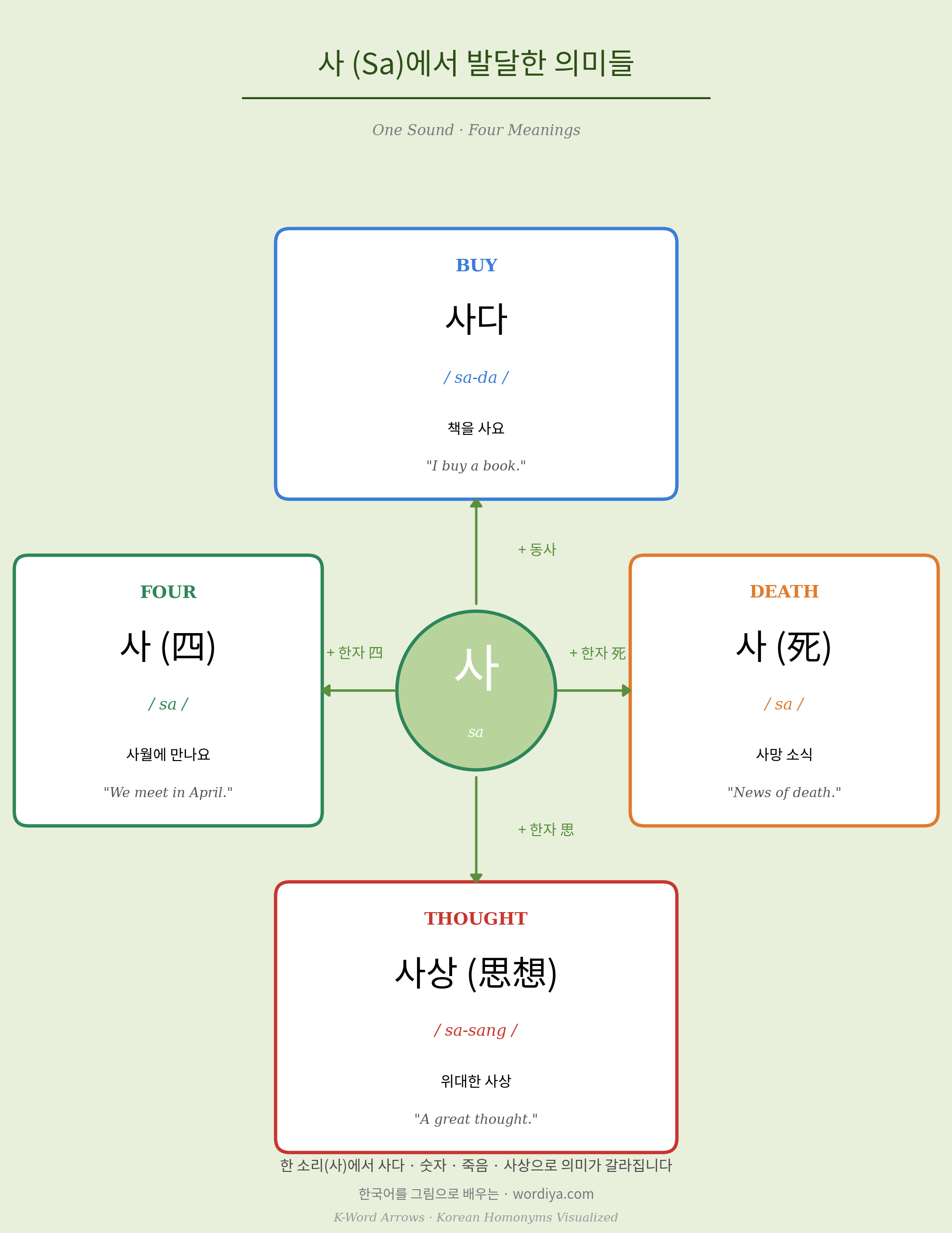
The Four Branches
⬆️ 사다 (sa-da) — to buy
This is the native Korean verb for the act of purchasing something. It is the most everyday meaning of 사 (sa) that Koreans use dozens of times a day — at convenience stores, online, or grocery markets. Unlike the other three branches, there is no Chinese character behind this one. It is a pure-Korean verb root, conjugated like any native verb: 사다 (sa-da) → 사요 (sa-yo) → 샀어요 (sat-eo-yo) → 살 거예요 (sal geo-ye-yo).
- 책을 사요. (Chaek-eul sa-yo. — I buy a book.)
- 어제 새 신발을 샀어요. (Eo-je sae sin-bal-eul sat-eo-yo. — I bought new shoes yesterday.)
- 뭐 사 줄까? (Mwo sa jul-kka? — What should I buy you?)
Common collocations: 옷을 사다 (ot-eul sa-da, to buy clothes), 표를 사다 (pyo-reul sa-da, to buy a ticket), 선물을 사다 (seon-mul-eul sa-da, to buy a gift). Korean learners often confuse 사다 (sa-da, to buy) with its antonym 팔다 (pal-da, to sell) — the two sides of every Korean transaction.
⬅️ 사 (四) — four
This is the number 4, written 四 in Chinese characters. It appears in nearly every Korean number expression: 사월 (sa-wol, April, the 4th month), 사층 (sa-cheung, the 4th floor), 사촌 (sa-chon, cousin — literally "fourth-degree relative"), 사계절 (sa-gye-jeol, the four seasons), 사방 (sa-bang, the four directions).
- 사월에 만나요. (Sa-wo-re man-na-yo. — Let's meet in April.)
- 사인방이 모두 모였어요. (Sa-in-bang-i mo-du mo-yeo-sseo-yo. — The Gang of Four has all gathered.)
- 사방팔방으로 뛰어다녔어요. (Sa-bang-pal-bang-eu-ro ttwi-eo-da-nyeot-seo-yo. — I ran around in every direction.)
Same Chinese character family: 사각형 (sa-gak-hyeong, square — "four-cornered shape"), 사해 (sa-hae, the four seas — meaning the whole world).
➡️ 사 (死) — death
This is the Chinese root 死, meaning death or dying. You rarely see this 사 (sa) standing alone, but it shows up in many compound words around death, illness, and emergency: 사망 (sa-mang, death — used in formal/official contexts), 사고사 (sa-go-sa, accidental death), 사후 (sa-hu, after death), 결사 (gyeol-sa, "resolved-to-die," as in 결사반대 gyeol-sa-ban-dae — "I oppose this to the death").
- 사망 소식을 들었어요. (Sa-mang so-sik-eul deul-eo-sseo-yo. — I heard the news of death.)
- 그는 사고로 사망했어요. (Geu-neun sa-go-ro sa-mang-haet-seo-yo. — He died in an accident.)
- 우리는 사생결단으로 싸웠어요. (U-ri-neun sa-saeng-gyeol-dan-eu-ro ssa-wo-sseo-yo. — We fought with life-or-death determination.)
⚠️ Cultural note: Because 死 (sa, death) and 四 (sa, four) share the exact same pronunciation, the number 4 carries a strong taboo in Korean culture — just as in Chinese and Japanese. Many Korean buildings skip the 4th floor or label it "F" instead. Hospitals especially avoid the number. So when you see an elevator panel jumping from 3 to 5, or labeled 1-2-3-F-5, you are witnessing this homophone tension at work.
⬇️ 사상 (思想, sa-sang) — thought, ideology
This 사 (sa) comes from the Chinese character 思, meaning to think or to consider. It almost never appears alone — instead it builds compound words about thinking, philosophy, and ideology: 사상 (sa-sang, thought / ideology), 사고 (sa-go, thinking / reasoning), 사색 (sa-saek, contemplation), 의사 (ui-sa, intention / will).
- 그는 위대한 사상가예요. (Geu-neun wi-dae-han sa-sang-ga-ye-yo. — He is a great thinker.)
- 동양 사상을 공부해요. (Dong-yang sa-sang-eul gong-bu-hae-yo. — I study Eastern thought.)
- 사상의 자유가 중요해요. (Sa-sang-ui ja-yu-ga jung-yo-hae-yo. — Freedom of thought is important.)
Famous phrase: 사필귀정 (sa-pil-gwi-jeong, 思必歸正) — "thought must return to what is right" — a classic four-character idiom meaning truth will always prevail in the end.
Memory Anchor
Picture a Korean department store on the 4th floor — except the elevator panel labels it "F" because of the death taboo. You buy (사다, sa-da) a book of philosophy about Eastern thought (사상, sa-sang) on the fourth (四, sa) floor that doesn't officially exist because of the death (死, sa) connection. Four meanings, one syllable, one elevator ride that takes you past the floor that isn't there.
Quick Check
Read each sentence and identify which 사 (sa) is being used:
- 새 컴퓨터를 사고 싶어요. (Sae keom-pyu-teo-reul sa-go sip-eo-yo.) → 사다 (Buy) — I want to buy a new computer.
- 사월부터 더워져요. (Sa-wol-bu-teo deo-wo-jyeo-yo.) → 四 (Four) — It gets hotter from April.
- 사고사 신고는 즉시 해야 해요. (Sa-go-sa sin-go-neun jeuk-si hae-ya hae-yo.) → 死 (Death) — Accidental-death reports must be filed immediately.
- 한국 현대 사상의 역사를 공부해요. (Han-guk hyeon-dae sa-sang-ui yeok-sa-reul gong-bu-hae-yo.) → 思 (Thought) — I study the history of modern Korean thought.
Pronunciation Tip
All four are pronounced exactly the same: /sa/ — short, flat, with no rising tone. But the context tells you which one. If 사 (sa) is followed by 다 (da) → it's the verb (to buy). If followed by 월 (wol) / 층 (cheung) / 촌 (chon) / 방 (bang) → it's the number 4 (四). If followed by 망 (mang) / 후 (hu) / 형 (hyeong) → it's death (死). If followed by 상 (sang) / 고 (go) / 색 (saek) → it's thought (思).
This is the fundamental trick of Korean homonyms: the syllable after 사 unlocks its meaning. Train your ear to listen for what comes next.
K-Word Arrows: Korean Homonyms Visualized
ⓒ wordiya.com


