시 (Si) — One Sound, Four Different Origins: From a Native Korean In-Law Prefix to Three HanJa Roots for Poem, Time, and Sight
When a Korean child first hears the sound 시 (si), they hear it from countless homonyms — words about marriage, poetry, time, and vision. This single syllable carries one purely native Korean prefix and three distinct Chinese characters, each unlocking a completely different layer of meaning. Three of the four meanings entered Korean from Chinese, while one — the prefix 시- (si-) used for in-laws — is purely native Korean. One sound, many origins. Let's untangle the four branches that grow from this single root sound.
(👆 컬러 다이어그램 위치)
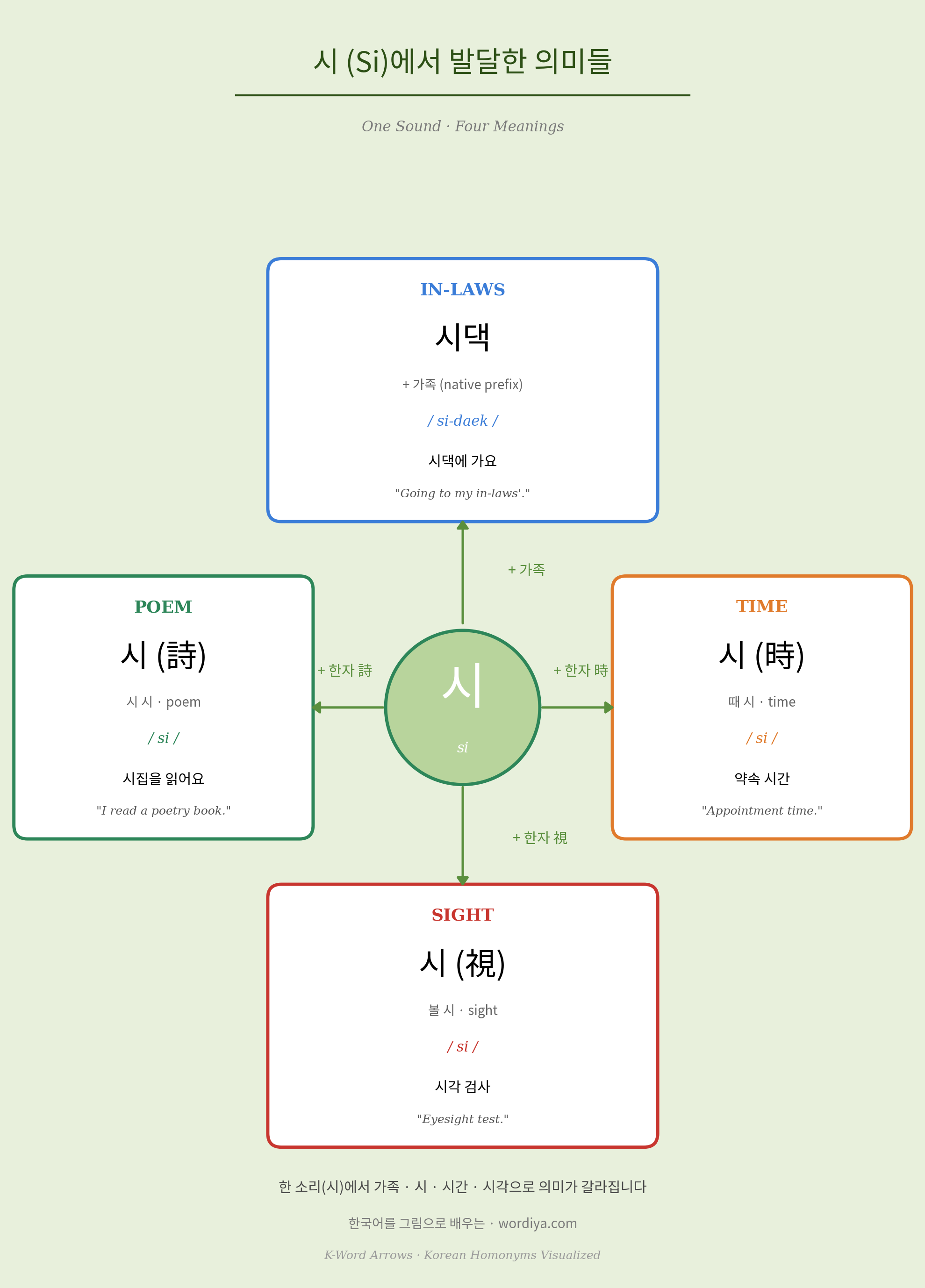
The Four Branches
⬆️ 시댁 (si-daek) — in-laws / spouse's family
This is the native Korean prefix 시- (si-) attached to nearly every word about a married woman's relationship to her husband's family. Unlike the other three branches, there is no Chinese character behind this 시. It is a pure-Korean grammatical prefix, deeply rooted in Korean kinship terminology.
- 시댁 (si-daek, 媤宅 — sometimes written with Hanja, but the prefix itself is native): in-laws' household
- 시어머니 (si-eo-meo-ni): mother-in-law
- 시아버지 (si-a-beo-ji): father-in-law
- 시동생 (si-dong-saeng): husband's younger sibling
- 시누이 (si-nu-i): husband's sister
This prefix is used only by married women referring to their husband's family — a uniquely Korean kinship distinction. A husband's family is 시-, while a wife's family uses 처가 (cheo-ga, 妻家). The very existence of two completely separate vocabulary sets for "in-laws" reveals how deeply Korean culture distinguishes the two family lines.
- 시댁에 가요. (Si-daek-e ga-yo. — I'm going to my in-laws' house.)
- 시어머니께 인사드렸어요. (Si-eo-meo-ni-kke in-sa-deu-ryeo-sseo-yo. — I greeted my mother-in-law.)
- 시댁 식구들이 모였어요. (Si-daek sik-gu-deul-i mo-yeo-sseo-yo. — The in-laws' family gathered.)
Cultural note: K-dramas are filled with 시댁 (si-daek) tension — the relationship between a Korean wife and her husband's family is one of the most dramatized themes in Korean popular culture. The word 시집살이 (si-jip-sa-ri, "life in the in-laws' house") carries centuries of cultural weight, referring to the traditional difficulty of a young bride adapting to her husband's family.
⬅️ 시 (詩, si si — 시 시 · poem) — poetry
The Hanja 詩 (시 시, poem) means "poem" or "poetry." It builds compound words across Korean literature, art, and education: 시집 (si-jip, poetry book), 시인 (si-in, poet), 시조 (si-jo, Korean traditional poetry form), 동시 (dong-si, children's poem).
Common phrases: 시집 (si-jip, 詩集, poetry book) · 시인 (si-in, 詩人, poet) · 시조 (si-jo, 時調, traditional Korean poem) · 한시 (han-si, 漢詩, classical Chinese poem).
Korean literature: Korean poetry has a millennium-old tradition, from 향가 (hyang-ga, ancient Silla poems) to 시조 (si-jo, the most refined classical form) to modern 자유시 (ja-yu-si, free verse). The Hanja 詩 (시 시) appears wherever Koreans speak of art that moves the heart through few words.
- 시집을 읽어요. (Si-jip-eul il-geo-yo. — I am reading a poetry book.)
- 그는 유명한 시인이에요. (Geu-neun yu-myeong-han si-in-i-e-yo. — He is a famous poet.)
➡️ 시 (時, 때 시 — 때 시 · time) — time, hour
The Hanja 時 (때 시, time) means "time" or "hour." It is one of the most frequently used Hanja in daily Korean: 시간 (si-gan, time), 시계 (si-gye, clock/watch), 시기 (si-gi, period), 당시 (dang-si, at that time).
Common phrases: 시간 (si-gan, 時間, time) · 시계 (si-gye, 時計, clock/watch) · 시기 (si-gi, 時期, period) · 당시 (dang-si, 當時, at that time) · 잠시 (jam-si, 暫時, for a short time) · 시대 (si-dae, 時代, era/age).
Korean daily life: Every Korean appointment, meeting, schedule, and history book uses 時. 약속 시간 (yak-sok si-gan, appointment time), 점심 시간 (jeom-sim si-gan, lunch time), 시대정신 (si-dae-jeong-sin, spirit of the times) — this 시 is everywhere.
- 약속 시간이 늦어요. (Yak-sok si-gan-i neuj-eo-yo. — The appointment time is late.)
- 지금 몇 시예요? (Ji-geum myeot si-ye-yo? — What time is it now?)
⬇️ 시 (視, 볼 시 — 볼 시 · sight) — vision, to see
The Hanja 視 (볼 시, to see) means "sight" or "to look upon." It anchors a family of words about vision, perception, and observation: 시각 (si-gak, sight), 시력 (si-ryeok, eyesight), 시청 (si-cheong, viewing), 무시 (mu-si, ignoring/disregarding).
Common phrases: 시각 (si-gak, 視覺, sight/visual) · 시력 (si-ryeok, 視力, eyesight) · 시청 (si-cheong, 視聽, viewing/audience) · 무시 (mu-si, 無視, ignoring) · 감시 (gam-si, 監視, surveillance) · 주시 (ju-si, 注視, watching closely).
Korean media and health: Every Korean eye exam uses 시력 (si-ryeok, eyesight). Every Korean broadcast schedule lists 시청률 (si-cheong-nyul, viewership rating). And every social criticism uses 무시 (mu-si, ignoring) when someone is treated as invisible.
- 시각 검사를 받았어요. (Si-gak geom-sa-reul bad-a-sseo-yo. — I had an eyesight test.)
- 그를 무시하지 마세요. (Geu-reul mu-si-ha-ji ma-se-yo. — Don't ignore him.)
Memory Anchor
Picture a Korean wedding scene. A young bride arrives at her 시댁 (si-daek, in-laws' house) for the first time. Her 시어머니 (si-eo-meo-ni, mother-in-law) hands her a 시집 (si-jip, 詩集, poetry book) — an old poem about family. At a specific 시간 (si-gan, 時間, time) of the evening, the 시아버지 (si-a-beo-ji, father-in-law) watches her closely — his 시선 (si-seon, 視線, gaze) full of expectation. Four meanings, one syllable, one bride's first night under one roof.
Quick Check
Read each sentence and identify which 시 (si) is being used:
- 시어머니께서 한복을 입으셨어요. (Si-eo-meo-ni-kke-seo han-bok-eul ib-eu-syeo-sseo-yo.) → 시- (In-laws) — Mother-in-law wore a hanbok.
- 한국의 시조는 짧지만 깊어요. (Han-guk-ui si-jo-neun jjalb-ji-man gip-eo-yo.) → 詩 (Poem) — Korean sijo is short but deep.
- 일곱 시에 만나요. (Il-gop si-e man-na-yo.) → 時 (Time) — Let's meet at seven o'clock.
- 시력이 좋아졌어요. (Si-ryeok-i joh-a-jyeo-sseo-yo.) → 視 (Sight) — My eyesight has improved.
Pronunciation Tip
All four are pronounced exactly the same: /si/ — short, flat, no rising tone. But the context tells you which one. If 시 (si) is followed by 댁 (daek), 어머니 (eo-meo-ni), 아버지 (a-beo-ji), 동생 (dong-saeng) → it's the in-laws prefix (시-). If followed by 집 (jip, poetry book), 인 (in, poet), 조 (jo, sijo) → it's the poem character (詩). If followed by 간 (gan), 계 (gye), 대 (dae) → it's the time character (時). If followed by 각 (gak), 력 (ryeok), 청 (cheong) → it's the sight character (視).
This is the fundamental trick of Korean homonyms: the syllable after 시 unlocks its meaning. Train your ear to listen for what comes next.
K-Word Arrows: Korean Homonyms Visualized
ⓒ wordiya.com


