If you're learning Korean, the single syllable 정 (jeong) is a perfect example of why Korean homonyms can feel like a maze. One sound, written exactly the same way in Hangul — 정 — splits into completely different meanings depending on the Chinese character (Hanja) hiding behind it. And one of those meanings is a word so deeply Korean that English has no real translation for it. Let's follow the arrows.
The branches of 정
One syllable, four directions. Here's each one.
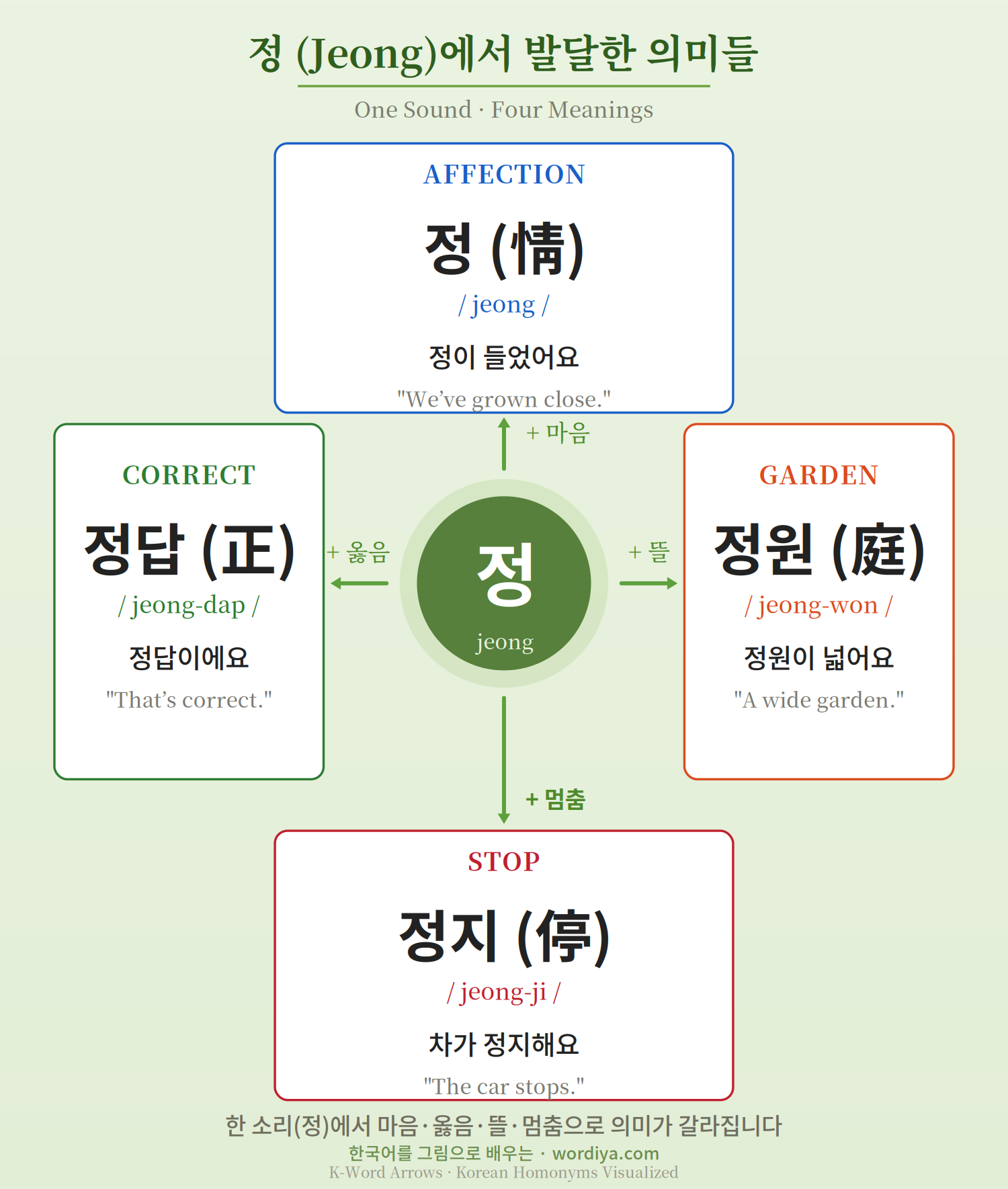
① 情 — affection, deep bond ("jeong")
This is the big one. 情 (정) means a warm emotional bond between people — but that translation barely scratches the surface. Jeong is the slow-built attachment that forms between family, old friends, neighbors, even a regular customer and a shop owner. It's why a Korean restaurant ajumma gives you extra side dishes "service" (for free), and why leaving a long-time job or neighborhood can feel quietly heartbreaking.
There is no single English word for it. "Affection," "attachment," "warmth," "loyalty," "connection" — jeong is all of these tangled together and built up over time.
- 우리 사이에 정이 들었어요. → We've grown close (jeong has formed between us).
- 정 때문에 못 떠나겠어요. → I can't leave — because of the jeong (the bond).
② 正 — right, correct, upright
Flip to 正 (정) and you get the idea of correctness and straightness. This character runs through a huge family of everyday Korean words.
- 정답 (正答) → the correct answer
- 정직 (正直) → honesty (literally "upright + straight")
- 정문 (正門) → the main (front) gate
- 정확 (正確) → accuracy
If something is 正, it is proper, true, and aligned the way it should be.
③ 庭 — garden, courtyard
庭 (정) points to an outdoor space within a home — a garden or courtyard.
- 정원 (庭園) → a garden
- 가정 (家庭) → a household / family ("house + courtyard")
Notice how 가정 ("family/household") quietly carries the image of a home with a courtyard — the physical space where a family lives together.
④ 釘 — nail (metal)
The most concrete of the four: 釘 (정) is simply a nail, the metal kind you hammer into wood. It's less common in daily vocabulary but shows just how far apart these same-sounding words can land — from the deepest human emotion (情) to a literal piece of hardware (釘).
Why this matters for learners
Here's the trap: in Hangul, all four are written 정, pronounced identically. A Korean reader instantly knows which meaning is intended from context and from the Hanja-based words around it. A learner who only memorizes "정 = something" will keep getting lost. The fix is exactly what these arrows show — don't memorize the sound, memorize the branch. Once you tie each meaning to its Hanja root, 정답 (correct answer) and 정원 (garden) and 정 (the bond) stop blurring together.
⚡ One-line takeaway
The Korean syllable 정 (jeong) branches into 情 (affection), 正 (correct), 庭 (garden), and 釘 (nail) — and its most famous branch, jeong, is one of the most beautifully untranslatable words in any language: a bond that forms slowly, and refuses to leave.
K-Word Arrows: Korean Homonyms Visualized ⓒ wordiya.com


