만 (Man) — One Sound, Four Different Meanings
Among the most frequently heard syllables in everyday Korean is 만 (man). You meet (만나다) a friend, you make (만들다) kimchi, you pay 만 원 (10,000 won), and you whisper "only you" (너만). One short syllable carries two native Korean verbs, one Hanja-based number, and a grammatical particle — a perfect window into Korean's layered structure.
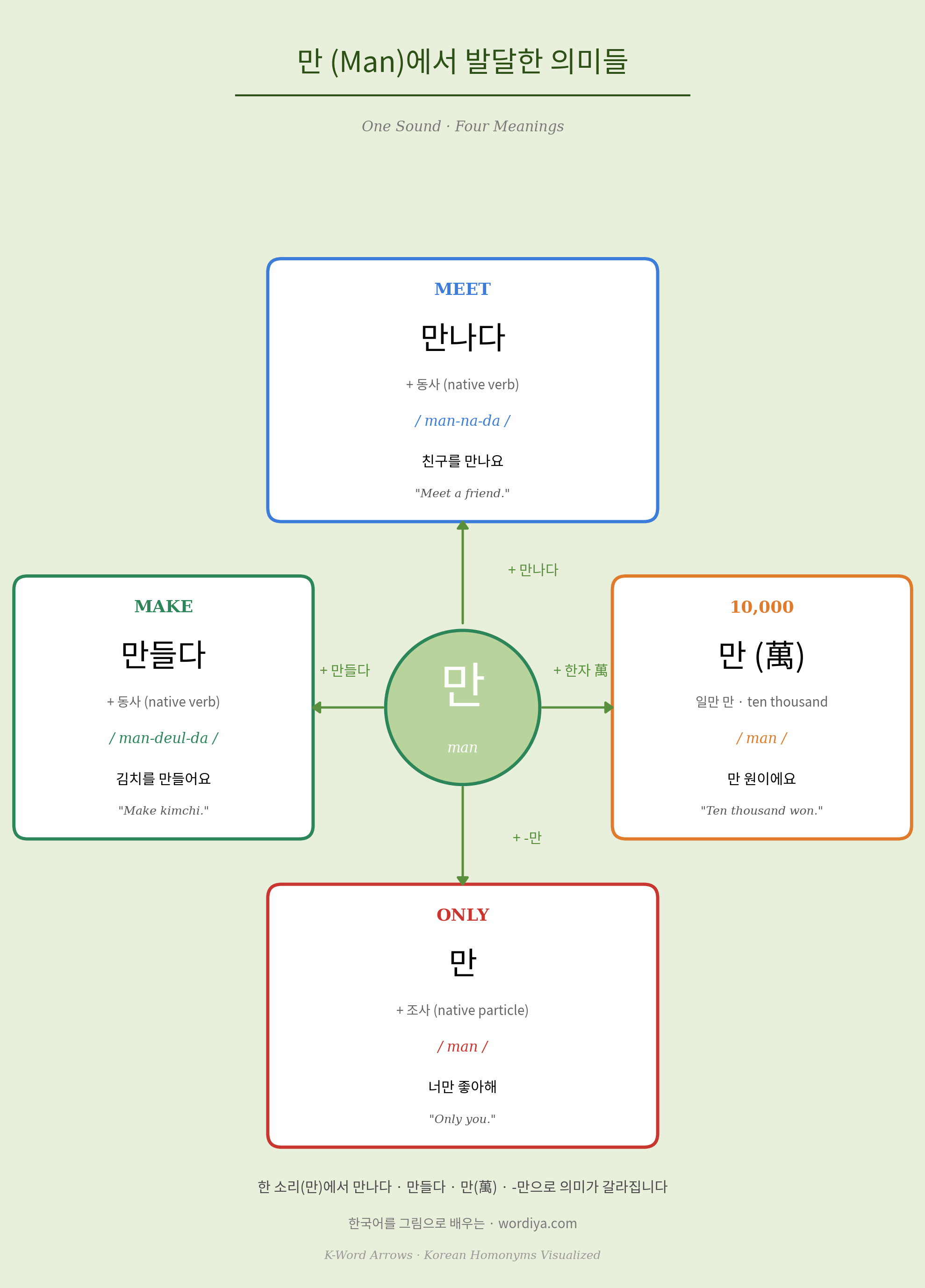
🌿 The Four Branches
① MEET — 만나다 (man-na-da) · Native Korean Verb
The verb 만나다 (man-na-da, to meet) is purely native Korean — no Hanja behind it. It is one of the most-used verbs in daily Korean speech, applied to friends, lovers, chance encounters, and destined meetings alike.
- 친구를 만나다 (chin-gu-reul man-na-da, to meet a friend)
- 처음 만나다 (cheo-eum man-na-da, to meet for the first time)
- 우연히 만나다 (u-yeon-hi man-na-da, to meet by chance)
- 만남 (man-nam, an encounter — noun form)
Korean cultural note: 인연 (in-yeon, 因緣, destined connection) — the Korean belief that every meeting is fated. The phrase 우리의 만남은 인연이에요 (u-ri-ui man-nam-eun in-yeon-i-e-yo, "Our meeting is destiny") is one of the most quintessentially Korean expressions.
Example: 내일 친구를 만나요. (Nae-il chin-gu-reul man-na-yo. — "I'm meeting a friend tomorrow.")
② MAKE — 만들다 (man-deul-da) · Native Korean Verb
The verb 만들다 (man-deul-da, to make/create) is another purely native Korean verb. It covers making food, crafting objects, building friendships, and creating memories — any act of creation.
- 김치를 만들다 (gim-chi-reul man-deul-da, to make kimchi)
- 음식을 만들다 (eum-sig-eul man-deul-da, to make food)
- 친구를 만들다 (chin-gu-reul man-deul-da, to make a friend)
- 추억을 만들다 (chu-eog-eul man-deul-da, to make memories)
- 만들기 (man-deul-gi, the act of making / crafts — noun form)
Korean food culture: 김장 (gim-jang) — the yearly family event of making kimchi together — is at the heart of Korean cuisine. The verb 만들다 is not just an action but a ritual that binds families and communities.
Example: 어머니가 맛있는 김치를 만들어요. (Eo-meo-ni-ga ma-si-tneun gim-chi-reul man-deul-eo-yo. — "My mother makes delicious kimchi.")
③ TEN THOUSAND — 만 (萬, man) · Hanja 萬 (일만 만, 'ten thousand')
The Sino-Korean number 만 (man, 10,000) comes from the Hanja 萬 (man, 일만 만, 'ten thousand'). Korean — like other East Asian languages — counts large numbers in units of 만 (10,000) rather than thousands. This is one of the most important number facts for any learner of Korean.
- 만 원 (man won, 10,000 won, ≈ $7 USD)
- 일만 (il-man, 10,000)
- 십만 (sip-man, 100,000)
- 백만 (baek-man, 1,000,000)
- 만세 (man-se, 萬歲, "ten thousand years!" — cheer of triumph)
- 만점 (man-jeom, 滿點, perfect score)
Learner's challenge: 100,000 in English is "one hundred thousand," but in Korean it is 십만 ("ten ten-thousands"). Foreign learners must pause and rebuild large numbers in 만 units — a mental shift that takes practice.
Example: 이거 만 원이에요. (I-geo man won-i-e-yo. — "This is ten thousand won.")
④ ONLY — 만 (man) · Native Korean Particle
The particle 만 (man, only/just) is a uniquely Korean grammatical word. Attached to a noun or verb, it restricts meaning to "only this, nothing else." It is a native Korean particle — completely separate from the Hanja 萬 (10,000). Same sound, entirely different word category.
- 너만 (neo-man, only you)
- 한 번만 (han-beon-man, just one time)
- 그것만 (geu-geot-man, only that)
- 오늘만 (o-neul-man, only today)
- 보기만 하다 (bo-gi-man ha-da, only look, don't touch)
Korean grammar tip: The famous K-drama line 너만 사랑해 (neo-man sa-rang-hae, "I love only you") gets its emotional weight from this single particle. Remove -만, and the exclusive force collapses.
Example: 너만 와요. (Neo-man wa-yo. — "Only you come.")
🧠 Memory Anchor — Four Meanings in One Scene
Picture a Korean couple at a Seoul café. They 만나요 (man-na-yo, meet) for the afternoon. The wife brings homemade cookies she 만든 (man-deun, made) that morning. The bill comes to 만 (man, 10,000) won. The husband leans over and whispers, "내 마음엔 너만 (neo-man, only you) 있어" ("In my heart, only you exist"). One syllable, four meanings, one Korean love story.
✅ Quick Check — Which 만 (man) is this?
- 친구를 만났어요. (Chin-gu-reul man-na-sseo-yo. — "I met a friend.")
- 김치를 만들어요. (Gim-chi-reul man-deul-eo-yo. — "I'm making kimchi.")
- 이건 만 원이에요. (I-geon man won-i-e-yo. — "This is ten thousand won.")
- 너만 오면 돼요. (Neo-man o-myeon dwae-yo. — "Only you need to come.")
Answers:
- MEET — 만나다 (man-na-da) — native Korean verb
- MAKE — 만들다 (man-deul-da) — native Korean verb
- TEN THOUSAND — 만 (萬, man) — Hanja 萬 (일만 만)
- ONLY — 만 (man) — native Korean particle
🔊 Pronunciation Tip — How to Tell Them Apart
All four meanings share the same /man/ sound. The differentiator is always context — what comes after 만 (man).
- 만 (man) + 나다 / 남 / 났어요 → MEET (native verb 만나다)
- 만 (man) + 들다 / 들기 / 들었어요 → MAKE (native verb 만들다)
- 만 (man) + 원 / 세 / 점 / 일·십·백- → TEN THOUSAND (Hanja 萬, 일만 만)
- noun + 만 (man) attached as suffix → ONLY (particle)
💡 Bonus ① — Why Korean Counts in 만 (10,000), Not Thousands
Korean — along with Japanese and Chinese-speaking regions — uses 만 (萬, 10,000) as the fundamental large-number unit, unlike English's 1,000. This means Korean must rebuild numbers above 10,000 differently: 100,000 = 십만 (sip-man, "ten ten-thousands"), 1,000,000 = 백만 (baek-man, "hundred ten-thousands"), 100,000,000 = 일억 (il-eok, 億). Many foreign learners stumble at large numbers because of this fundamental shift. Even Korean accountants and financial professionals must mentally translate when communicating with Western counterparts.
💡 Bonus ② — 만세 (萬歲) — Korea's Cry of Triumph and Independence
The phrase 만세 (man-se, 萬歲, "ten thousand years!") is the Korean equivalent of "Hurrah!" — but with far deeper political meaning. Originally an ancient royal blessing meaning "May the king live ten thousand years," it became the rallying cry of Korean independence during the March 1st Movement of 1919. Two million Koreans took to the streets shouting 대한 독립 만세 (dae-han dok-rip man-se, "Long live Korean independence!") against Japanese colonial rule. Today, 만세 is shouted at sports victories, weddings, and triumphs — but every Korean knows its sacred political origin.
💡 Bonus ③ — The Korean Particle -만 — One Syllable of Pure Restriction
The Korean grammatical particle -만 (man, only) is one of the most economical words in any language. Attached to any noun, it instantly restricts meaning: 책만 (chaek-man, only the book), 너만 (neo-man, only you), 한 번만 (han-beon-man, just once). English requires multiple words (only, just, merely, nothing but) to express what Korean does with a single attached syllable. This grammatical efficiency is why K-drama dialogue packs so much feeling into so few words.
🎯 Wrap-Up
One sound — 만 (man) — carries two native Korean verbs (만나다 to meet, 만들다 to make), one Hanja-based number (萬 ten thousand), and one grammatical particle (-만 only). Learning Korean is not about memorizing isolated words; it is about training your ear to read these layered patterns. When you hear /man/, the words that follow tell you which of the four worlds you have entered.
K-Word Arrows: Korean Homonyms Visualized
ⓒ wordiya.com


