One Sound, Four Connected Worlds
The Korean syllable 벌 (beol) opens up four completely different worlds — nature, geography, daily objects, and law. From a buzzing bee to a wide open field, from a suit of clothes to a punishment received, 벌 carries Korean life across four very different domains.
Meaning Korean Origin
| Bee | 벌 | native Korean |
| Open field / plain | 벌 / 벌판 | native Korean |
| Counter (clothing, set) | 한 벌 | native Korean |
| Punishment | 벌 (罰) | Sino-Korean |
For Korean learners, 벌 is a perfect window into how Korean uses a single sound to cover insects, geography, daily counters, and legal vocabulary.
Let's untangle this — visually.
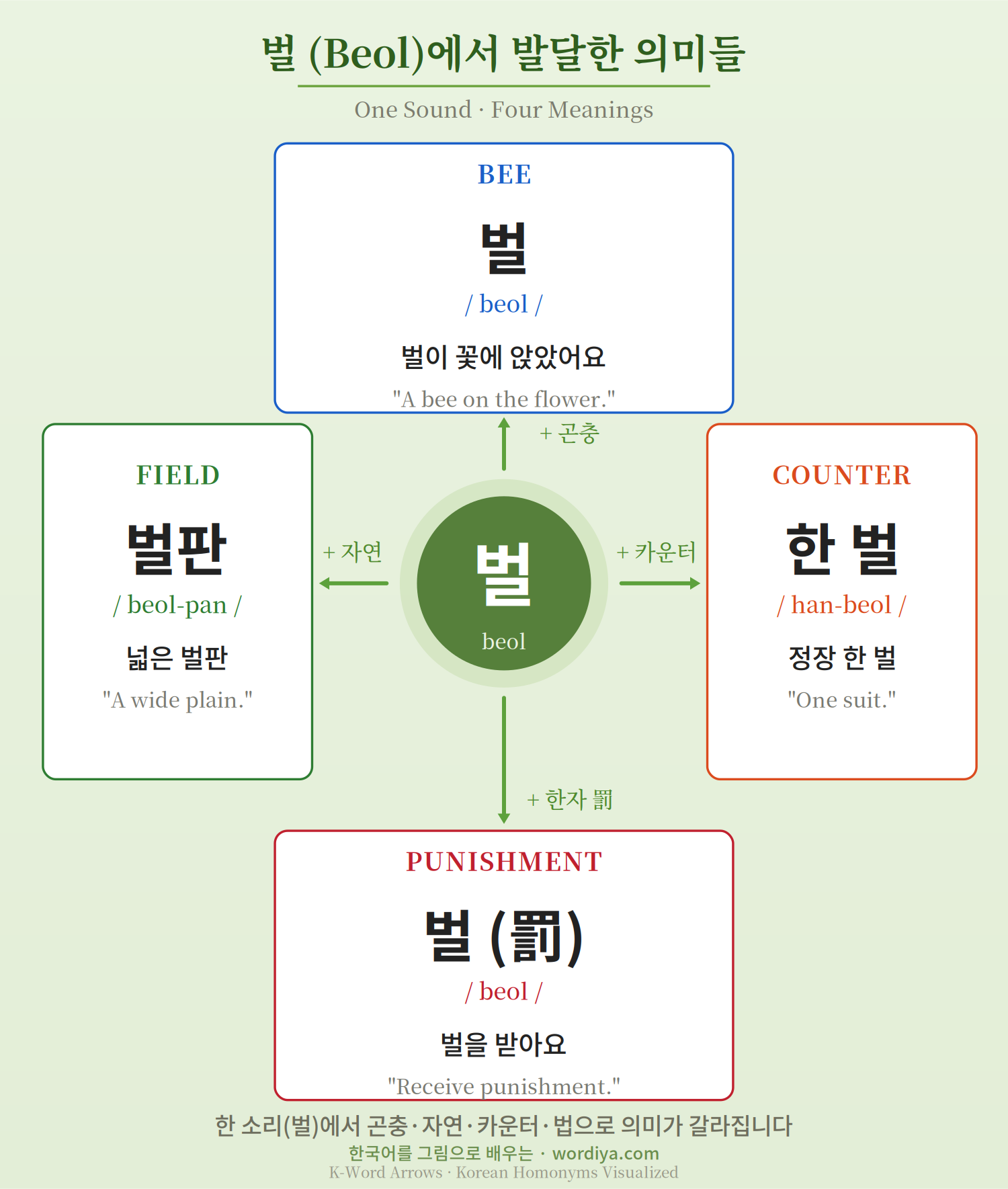
벌 — Four Directions, Four Meanings
Direction Meaning Korean Romanization
| ↑ Up | bee | 벌 | beol |
| → Right | counter (clothing) | 한 벌 | han-beol |
| ← Left | field / plain | 벌판 | beol-pan |
| ↓ Down | punishment | 벌 (罰) | beol |
One sound. Four meanings. One picture.
↑ Up — 벌 (beol): Bee
벌이 꽃에 앉았어요. Beol-i kkoch-e an-ja-sseo-yo. A bee landed on the flower.
The noun 벌 (beol) means bee — one of the most basic Korean insect words. This is a pure native Korean word.
Common phrases:
- 꿀벌 (kkul-beol) — honeybee
- 말벌 (mal-beol) — hornet (literally "horse bee" — large)
- 여왕벌 (yeo-wang-beol) — queen bee
- 일벌 (il-beol) — worker bee
- 벌집 (beol-jip) — beehive
- 벌침 (beol-chim) — bee sting
- 벌에 쏘이다 (beol-e sso-i-da) — to get stung by a bee
- 벌이 윙윙거리다 (beol-i wing-wing-geo-ri-da) — bees buzzing
Korean nature culture: Korean traditional beekeeping (양봉, yang-bong) has thousands of years of history. Mountain temples often kept hives for honey production. The phrase "꿀벌처럼 부지런하다 (kkul-beol-cheo-reom bu-ji-reon-ha-da)" — "diligent as a honeybee" — is a common Korean compliment for hard workers.
K-drama connection: The Korean idiom "벌집을 건드리다 (beol-jip-eul geon-deu-ri-da)" — "to touch a beehive" — means to start a serious problem you can't control. K-dramas use this for office politics and family conflicts: 그건 벌집을 건드리는 일이야 (geu-geon beol-jip-eul geon-deu-ri-neun i-ri-ya, "That's touching a beehive").
→ Right — 한 벌 (han-beol): Counter for Clothing & Sets
정장 한 벌 주세요. Jeong-jang han-beol ju-se-yo. One suit, please.
The counter 벌 (beol) is used for counting suits of clothes, sets of dishes, or matched pairs. This is a pure native Korean counter — one of the most useful for daily Korean life.
Common phrases:
- 한 벌 (han-beol) — one set / one suit
- 두 벌 (du-beol) — two sets
- 정장 한 벌 (jeong-jang han-beol) — one business suit
- 한복 한 벌 (han-bok han-beol) — one hanbok (Korean traditional clothing)
- 잠옷 한 벌 (jam-ot han-beol) — one set of pajamas
- 그릇 한 벌 (geu-reut han-beol) — one set of dishes
- 수저 한 벌 (su-jeo han-beol) — one spoon-and-chopsticks set
- 옷 한 벌 (ot han-beol) — one outfit (full set)
Korean counters explained: Korean uses different counters for different objects:
Counter Used for
| 개 (gae) | general objects |
| 명 (myeong) | people |
| 마리 (ma-ri) | animals |
| 권 (gwon) | books |
| 잔 (jan) | drinks |
| 벌 (beol) | clothing sets, dish sets, matched pairs |
| 켤레 (kyeol-le) | pairs of shoes/socks |
Korean clothing culture: When Koreans buy hanbok (한복), they always count it in 벌 — never in 개. The same applies to formal suits, traditional sets, and wedding outfits. Saying "한복 한 개" would sound wrong to Korean ears; "한복 한 벌" is correct.
← Left — 벌 / 벌판 (beol / beol-pan): Open Field, Plain
넓은 벌판이 펼쳐져 있어요. Neolb-eun beol-pan-i pyeol-chyeo-jyeo i-sseo-yo. A wide plain stretches out.
The noun 벌 (beol) — usually as 벌판 (beol-pan) in modern Korean — means a wide open field or plain. This is a pure native Korean word, often appearing in literature, place names, and traditional songs.
Common phrases:
- 벌판 (beol-pan) — open plain / field
- 넓은 벌판 (neolb-eun beol-pan) — wide plain
- 황량한 벌판 (hwang-ryang-han beol-pan) — desolate plain
- 모래벌판 (mo-rae-beol-pan) — sandy plain / desert
- 갈대 벌판 (gal-dae beol-pan) — reed plain
- 만주 벌판 (man-ju beol-pan) — Manchurian plains
Korean place names with 벌: Many Korean cities are named after the 벌 syllable, signaling their origins as open agricultural plains:
Place Korean Meaning
| Seoul | 서울 (from 서라벌, Seo-ra-beol) | Silla Kingdom capital plain |
| Gimhae | 김해 (from 김벌) | Kim plain |
| Gyeongju area | 경주벌 | Gyeongju plain |
| Mt. Halla area | 한라벌 | Halla plain |
Historical depth: The word 서라벌 (Seo-ra-beol) — the ancient name of Silla's capital that became modern "서울 (Seoul)" — literally contains 벌, meaning "Seo-ra plain." So the name Seoul itself carries the syllable 벌 in its etymology.
↓ Down — 벌 (beol, 罰): Punishment
잘못하면 벌을 받아요. Jal-mot-ha-myeon beol-eul ba-da-yo. If you do wrong, you receive punishment.
The noun 벌 (beol), written with the Hanja 罰, means punishment or penalty. This is a Sino-Korean word and one of the most important Korean legal terms.
Common phrases:
- 벌을 받다 (beol-eul bad-da) — to be punished
- 벌을 주다 (beol-eul ju-da) — to give punishment
- 벌금 (beol-geum, 罰金) — fine, monetary penalty
- 벌점 (beol-jeom, 罰點) — penalty points
- 처벌 (cheo-beol, 處罰) — punishment (formal)
- 형벌 (hyeong-beol, 刑罰) — criminal punishment
- 체벌 (che-beol, 體罰) — corporal punishment
- 천벌 (cheon-beol, 天罰) — heavenly punishment / divine retribution
Chinese character origin: 罰 (beol) = punishment, penalty
Korean legal vocabulary: 벌 appears throughout Korean law and daily life:
Korean English
| 벌금 (beol-geum) | Fine |
| 벌점 (beol-jeom) | Penalty points (driving) |
| 처벌 (cheo-beol) | Punishment (legal) |
| 형벌 (hyeong-beol) | Criminal sentence |
| 징벌 (jing-beol) | Disciplinary action |
| 상벌 (sang-beol) | Reward and punishment |
Korean culture — 상벌 (reward and punishment): The Korean concept 상벌 (sang-beol) — combining 상 (reward) and 벌 (punishment) — is fundamental to Korean education, workplaces, and family discipline. Korean schools have 상벌 제도 (sang-beol je-do, "reward and punishment system") to balance encouragement and consequences.
K-drama trope: Historical dramas (사극) constantly use 천벌 (cheon-beol, "heavenly punishment") — characters cursing villains: 천벌을 받을 거야! (cheon-beol-eul ba-deul geo-ya, "You will receive heavenly punishment!").
How to Tell Them Apart
Context decides which 벌 you hear. Here's how to decode:
Look for... Meaning
| Flower, sting, hive | bee (벌) |
| Number + 벌 (clothing, set) | counter (한 벌) |
| Wide, open, plain | field (벌판) |
| Receive, give, 금/점/처- | punishment (벌, 罰) |
Try It Yourself
Can you guess which 벌 is used in each sentence?
Sentence bee / counter / field / punishment?
| 1. 한복 두 벌 사고 싶어요. | ? |
| 2. 벌에 쏘여서 약을 발랐어요. | ? |
| 3. 그 선수는 벌점 5점을 받았어요. | ? |
| 4. 만주 벌판은 끝없이 넓어요. | ? |
Answers:
- counter (han-bok du beol sa-go si-peo-yo, "I want to buy two hanboks")
- bee (beol-e sso-yeo-seo yak-eul bal-ra-sseo-yo, "I was stung by a bee and applied medicine")
- punishment (geu seon-su-neun beol-jeom 5jeom-eul ba-da-sseo-yo, "That athlete received 5 penalty points")
- field (man-ju beol-pan-eun kkeut-eop-si neolb-eo-yo, "The Manchurian plains are endlessly wide")
Key Takeaway
벌 (beol) is one syllable with four distinct meanings — bee, counter (clothing/set), open field, and punishment. Three are pure Korean (bee, counter, field); one is Sino-Korean (punishment, 罰). Context — insects, numbers, geography, or legal terms — makes them clear. One sound covers Korean nature, daily life, geography, and law. Once mapped visually, the confusion disappears.
Pronunciation Tip
All four meanings are pronounced exactly the same: beol (sounds like "bohl" with a soft 'l'). The Korean ㅓ vowel is between English "uh" and "oh" — closer to the British "bird" without the r.
- beol (with bug words) → bee (벌)
- number + beol → counter (한 벌)
- beol (with wide, open, 판) → field (벌판)
- beol (with 금, 점, 처-) → punishment (벌, 罰)
Bonus — Why Seoul's Name Contains "벌"
The name 서울 (Seoul) comes from the ancient Silla Kingdom capital 서라벌 (Seo-ra-beol) — literally "Seo-ra Plain." When you say "서울" today, you are carrying a 2,000-year-old word for "open plain."
Historical name Period Meaning
| 서라벌 (Seo-ra-beol) | Silla, BC 57~AD 935 | Capital plain |
| 동경 (Dong-gyeong) | Goryeo | Eastern capital |
| 한양 (Han-yang) | Joseon | Han River sunny side |
| 경성 (Gyeong-seong) | Japanese colonial | Capital city |
| 서울 (Seoul) | Modern | Capital (preserves 벌) |
The syllable 벌 survived 2,000 years of language change to become part of Korea's most famous place name.
Bonus — Korean Counters: Why "한 벌" Matters
If you ever shop for traditional Korean clothing or formal wear in Korea, you must use 벌 as the counter — not 개:
What you're counting Counter Example
| Hanbok | 벌 | 한복 한 벌 |
| Suit | 벌 | 정장 한 벌 |
| Wedding dress | 벌 | 웨딩드레스 한 벌 |
| Pajamas | 벌 | 잠옷 한 벌 |
| Matching dish set | 벌 | 그릇 한 벌 |
| Single shirt | 개 / 장 | 셔츠 한 장 (not 벌) |
| Single sock | 짝 | 양말 한 짝 |
| Pair of shoes | 켤레 | 신발 한 켤레 |
The rule: 벌 = full matched set. A single piece is not 한 벌; only a complete outfit or matching collection is.
Bonus — 상벌 (Reward and Punishment) in Korean Culture
Korean educational and corporate culture is deeply structured around 상벌 (sang-beol) — the system of rewards and punishments:
Setting 상벌 form
| School | 상장 (certificates) + 벌점 (penalty points) |
| Workplace | 포상 (bonuses) + 징계 (discipline) |
| Driving | 무사고 보너스 + 벌금 (fines) |
| Sports | 트로피 + 자격정지 (suspension) |
| Family | Praise + grounding |
The Korean saying "상벌이 분명해야 한다 (sang-beol-i bun-myeong-hae-ya han-da)" — "rewards and punishments must be clear" — captures a core principle of Korean management and parenting. A good leader, parent, or teacher is one who applies 상 and 벌 with consistency.
출처: wordiya.com — K-Word Arrows series


