One Sound, Four Connected Meanings
The Korean syllable 다리 (da-ri) is a fascinating homonym that connects body, architecture, furniture, and human relationships — all through one core idea: "something that supports or connects."
Meaning Korean Context
| Leg (body) | 다리 | Human body |
| Bridge | 다리 | Architecture |
| Table/desk leg | 책상 다리 | Furniture |
| Making a connection | 다리 놓다 | Social relationships |
For Korean learners, 다리 reveals how Korean uses one word to express the universal concept of "support" or "connection" — whether physical (legs, bridges, furniture) or social (introducing people).
Let's untangle this — visually.
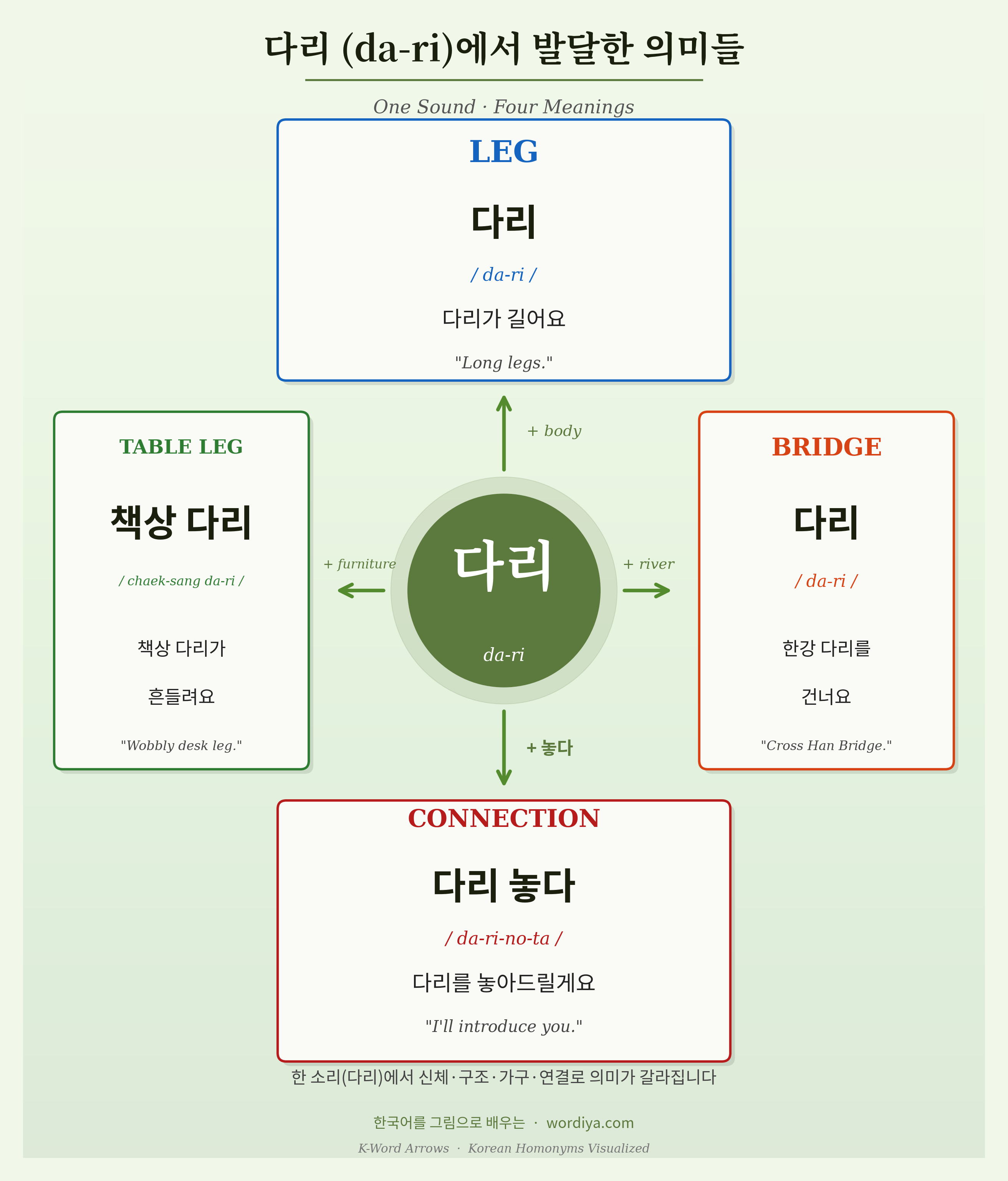
다리 — Four Directions, Four Meanings
Direction Meaning Korean Romanization
| ↑ Up | leg | 다리 | da-ri |
| → Right | bridge | 다리 | da-ri |
| ← Left | table leg | 책상 다리 | chaek-sang da-ri |
| ↓ Down | making a connection | 다리 놓다 | da-ri no-ta |
One sound. Four meanings. One picture.
↑ Up — 다리 (da-ri): Leg
다리가 너무 길어요. Da-ri-ga neo-mu gil-eo-yo. Your legs are so long.
The noun 다리 (da-ri) means leg — the primary meaning, used for human and animal legs.
Common phrases:
- 다리가 길다 (da-ri-ga gil-da) — long legs
- 다리가 짧다 (da-ri-ga jjal-da) — short legs
- 다리가 아프다 (da-ri-ga a-peu-da) — legs hurt
- 다리를 뻗다 (da-ri-reul ppeot-da) — to stretch legs
- 한 다리 (han da-ri) — one leg
- 두 다리 (du da-ri) — two legs
- 외다리 (oe-da-ri) — one-legged
- 다리 운동 (da-ri un-dong) — leg exercise
Korean idioms with 다리:
- 다리가 짧다 (da-ri-ga jjal-da) — literally "short legs" = arrived late after food is gone
- 다리가 풀리다 (da-ri-ga pul-li-da) — "legs loosen" = legs give way from shock
- 다리에 힘이 빠지다 (da-ri-e him-i ppa-ji-da) — "no strength in legs" = exhausted
- 다리를 떨다 (da-ri-reul tteol-da) — "shaking legs" = bringing bad luck (superstition)
Korean superstition: "다리 떨면 복 나간다 (da-ri tteol-myeon bok na-gan-da)" — "If you shake your legs, fortune leaves." Korean elders often scold children for unconsciously shaking their legs while sitting.
→ Right — 다리 (da-ri): Bridge
한강 다리를 건너요. Han-gang da-ri-reul geon-neo-yo. Crossing a Han River bridge.
The noun 다리 (da-ri) also means bridge — central to Korean geography and culture, especially in Seoul.
Common phrases:
- 한강 다리 (han-gang da-ri) — Han River bridge
- 다리를 건너다 (da-ri-reul geon-neo-da) — to cross a bridge
- 무지개 다리 (mu-ji-gae da-ri) — rainbow bridge
- 다리 위 (da-ri wi) — on the bridge
- 다리 아래 (da-ri a-rae) — under the bridge
- 강 다리 (gang da-ri) — river bridge
- 육교 (yuk-gyo) — overpass (formal: 陸橋)
- 다리 공사 (da-ri gong-sa) — bridge construction
Korean bridge culture — Seoul Han River:
Seoul has 31 bridges crossing the Han River — each with its own personality and culture.
Bridge Korean Famous for
| Banpo Bridge | 반포대교 | Rainbow fountain shows |
| Seongsu Bridge | 성수대교 | 1994 tragic collapse |
| Hangang Bridge | 한강대교 | Oldest (1917) |
| Mapo Bridge | 마포대교 | "Bridge of Life" suicide prevention |
| Banghwa Bridge | 방화대교 | West Seoul gateway |
| Jamsil Bridge | 잠실대교 | East Seoul, Lotte World |
K-drama bridges: Korean dramas constantly feature Han River bridges as romantic, dramatic, or contemplative settings — couples kissing at sunset, characters contemplating life, friends drinking by the river.
← Left — 책상 다리 (chaek-sang da-ri): Table/Desk Leg
책상 다리가 흔들려요. Chaek-sang da-ri-ga heun-deul-lyeo-yo. The desk leg is wobbly.
The noun 다리 (da-ri) also refers to furniture legs — table legs, chair legs, desk legs.
Common phrases:
- 책상 다리 (chaek-sang da-ri) — desk leg
- 의자 다리 (eui-ja da-ri) — chair leg
- 식탁 다리 (sik-tak da-ri) — dining table leg
- 침대 다리 (chim-dae da-ri) — bed leg
- 네 다리 (ne da-ri) — four legs (of a table)
- 다리가 흔들리다 (da-ri-ga heun-deul-li-da) — wobbly leg
- 다리가 부러지다 (da-ri-ga bu-reo-ji-da) — broken leg
Korean traditional furniture:
Traditional Korean soban (소반, small low table) has 3 legs in a tripod design — perfect for stability on uneven floors of traditional Korean houses (한옥).
Korean furniture English
| 소반 (so-ban) | Small low table |
| 밥상 (bap-sang) | Dining table |
| 책상 (chaek-sang) | Desk |
| 다과상 (da-gwa-sang) | Tea table |
Korean sitting culture: "양반다리 (yang-ban da-ri)" literally means "yangban (aristocrat) legs" = sitting cross-legged. This is the traditional Korean sitting position used in tatami-style rooms.
↓ Down — 다리 놓다 (da-ri no-ta): Making a Connection
다리를 놓아드릴게요. Da-ri-reul no-a-deu-ril-ge-yo. I'll introduce you. / I'll make the connection.
The phrase 다리(를) 놓다 (da-ri no-ta) literally means "to place a bridge" but figuratively means "to introduce people," "to make a connection," "to act as a mediator".
Common phrases:
- 다리(를) 놓다 (da-ri no-ta) — to introduce/connect people
- 다리 역할 (da-ri yeok-hal) — bridge role (mediator)
- 다리가 되어주다 (da-ri-ga doe-eo-ju-da) — to be a bridge
- 다리 놓아드릴까요? (da-ri no-a-deu-ril-kka-yo?) — Shall I introduce you?
- 인맥 다리 (in-maek da-ri) — connection bridge (networking)
- 양국 다리 (yang-guk da-ri) — bridge between two countries
Korean business culture:
In Korean business, having someone "다리를 놓아주다" (make a bridge for you) is essential. Korean business culture values inmaek (인맥, personal network) highly, and having a respected person introduce you opens doors that cold calls cannot.
Korean business connection English
| 인맥 (in-maek) | Personal network |
| 소개 (so-gae) | Introduction |
| 추천 (chu-cheon) | Recommendation |
| 다리 놓다 | Making the connection |
| 네트워킹 (ne-teu-wo-king) | Networking (English loan) |
International diplomacy: "다리 역할 (da-ri yeok-hal)" is often used in international relations — "Korea plays a bridge role between East and West" describes Korea's diplomatic position.
How to Tell Them Apart
Context decides which 다리 you hear. Here's how to decode:
Look for... Meaning
| Body verbs (길다, 아프다, 뻗다) | leg (다리) |
| River/water context | bridge (다리) |
| 책상/의자/식탁 + 다리 | furniture leg |
| 놓다/역할 | making a connection |
Try It Yourself
Can you guess which 다리 is used in each sentence?
Sentence leg / bridge / furniture / connection?
| 1. 식탁 다리가 흔들리는데 고쳐줘. | ? |
| 2. 다리 놓아주신 분이 회장님이세요. | ? |
| 3. 다리가 길어서 모델 같아요. | ? |
| 4. 잠실 다리 건너서 우회전 하세요. | ? |
Answers:
- furniture leg (The dining table leg is wobbly. Fix it.)
- connection (The chairman is the one who introduced us)
- body leg (Your legs are so long. You look like a model.)
- bridge (Cross Jamsil bridge and turn right.)
Key Takeaway
다리 (da-ri) is one syllable with four connected meanings — leg, bridge, table leg, and making a connection. All share the core concept of "support" or "connection." Context decides whether you mean a body part, a river crossing, furniture, or a social introduction. One sound covers human body, architecture, furniture, and Korean networking culture.
Pronunciation Tip
All meanings are pronounced exactly the same: da-ri (sounds like "dah-ree" with a soft 'r'). The Korean 'ㄹ' between vowels sounds like a gentle 'r' — neither English 'r' nor 'l'.
Bonus — Korean Body Idioms with 다리
Korean has rich idioms using 다리 (leg):
Korean idiom Literal Meaning
| 다리가 길다 | Long legs | Arrived in time for food |
| 다리가 짧다 | Short legs | Arrived too late |
| 다리가 풀리다 | Legs loosen | Legs give way from shock |
| 다리를 떨다 | Shaking legs | Bringing bad luck |
| 양반다리 | Yangban legs | Sitting cross-legged |
| 외다리 | One leg | One-legged person |
Bonus — Han River Bridges in K-Drama
Han River bridges are iconic K-drama settings:
K-drama Bridge scene
| Goblin (도깨비) | Romantic bridge scenes |
| My Love from the Star (별에서 온 그대) | Bridge meetings |
| Reply 1988 (응답하라 1988) | Friends drinking by Han River |
| It's Okay to Not Be Okay (사이코지만 괜찮아) | Healing bridge walks |
| Crash Landing on You (사랑의 불시착) | Cross-border connections |
The "Mapo Bridge of Life": Mapo Bridge (마포대교) has special signs and sensors installed for suicide prevention. The bridge features encouraging messages, emergency phones, and surveillance cameras. The Seoul government calls it the "Bridge of Life (생명의 다리)."
Bonus — Korean Networking Culture
Understanding "다리 놓다" is essential for foreign business people in Korea:
Concept Korean Importance
| First introduction | 첫 소개 | Critical |
| Respected introducer | 존경받는 추천인 | Opens doors |
| University alumni | 학연 (hak-yeon) | Strong network |
| Regional connection | 지연 (ji-yeon) | Strong network |
| Work connection | 직장 인맥 | Important |
| Cold call success | 콜드콜 성공 | Very low |
In Korea, getting someone to "다리를 놓아주다 (make a bridge for you)" is often the difference between success and failure.
Coming Next — 벌 (beol)
Next we map another Korean homonym: 벌 (beol) — meaning bee, punishment, suit of clothes, and plain/field. Four meanings, one sound, covering insects, justice, fashion, and geography.
도움이 되셨다면 구독, 공감 한 번 부탁드립니다. (Thank you for reading!)
K-Word Arrows: Korean Homonyms Visualized ⓒ wordiya.com


