One Sound, Four Different Worlds
The Korean syllable 발 (bal) opens up four different worlds — body, traditional Korean interior, counter words for arrows/bullets, and language learning itself.
Meaning Korean Hanja
| Foot | 발 | 足 (족) |
| Bamboo curtain | 발 | 簾 (렴) |
| Shot/round counter | 한 발 | 發 (발) |
| Pronunciation | 발음 | 發音 |
This makes 발 special — it covers both everyday body vocabulary and the most important word for Korean learners themselves (pronunciation).
Let's untangle this — visually.
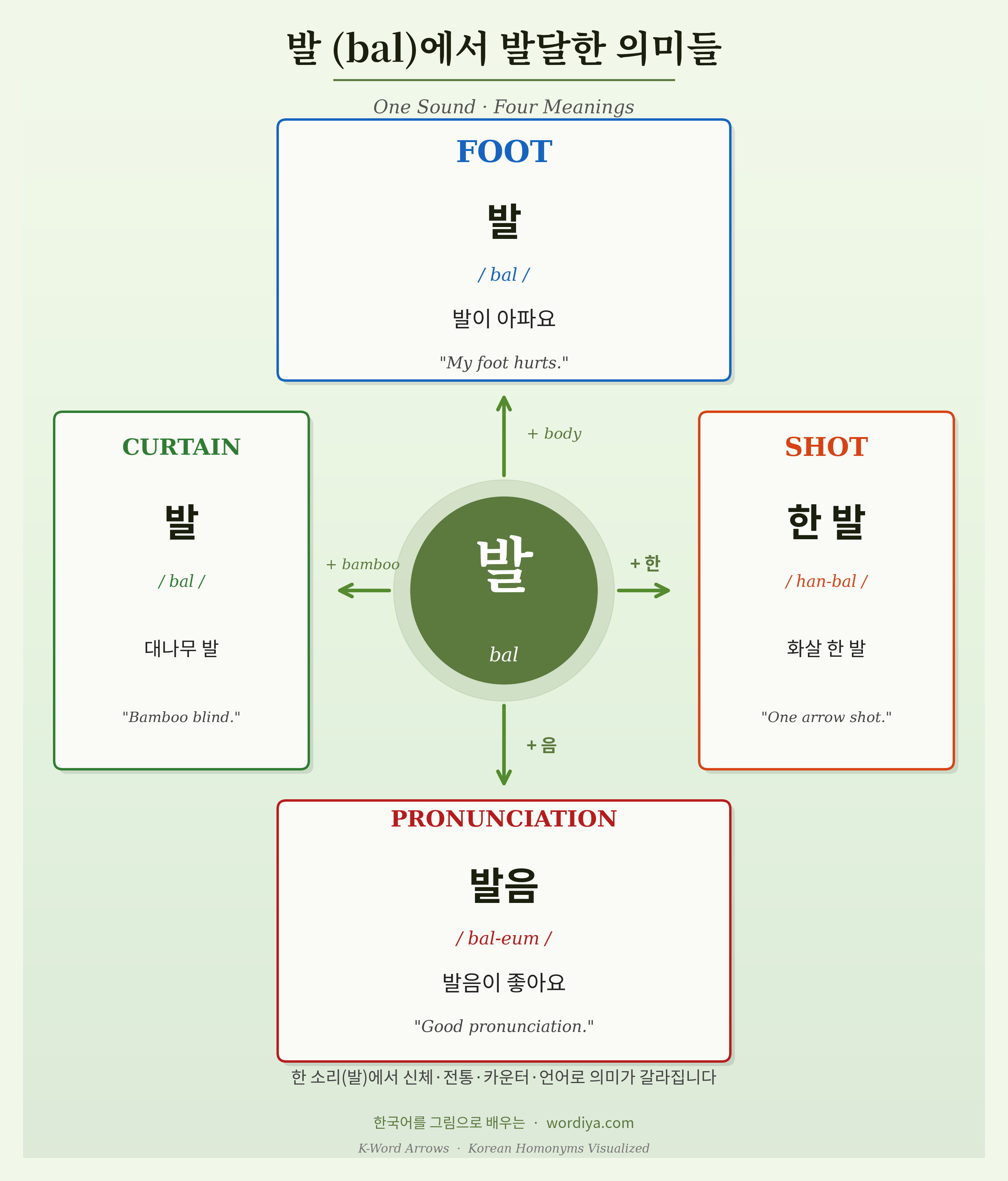
발 — Four Directions, Four Meanings
Direction Meaning Korean Romanization
| ↑ Up | foot | 발 | bal |
| → Right | shot/arrow counter | 한 발 | han-bal |
| ← Left | bamboo curtain | 발 | bal |
| ↓ Down | pronunciation | 발음 | bal-eum |
One sound. Four meanings. One picture.
↑ Up — 발 (bal): Foot
발이 너무 아파요. Bal-i neo-mu a-pa-yo. My feet hurt so much.
The noun 발 (bal) means foot — one of the most basic Korean body words.
Common phrases:
- 발이 아프다 (bal-i a-peu-da) — feet hurt
- 발을 씻다 (bal-eul ssit-da) — to wash feet
- 발가락 (bal-ga-rak) — toe
- 발바닥 (bal-ba-dak) — sole of foot
- 발목 (bal-mok) — ankle
- 발자국 (bal-ja-guk) — footprint
- 발걸음 (bal-geol-eum) — footstep
- 맨발 (maen-bal) — barefoot
- 신발 (sin-bal) — shoes (literally "thing for feet")
Chinese character origin: 足 (족) = foot
Korean idioms with 발:
- 발이 넓다 (bal-i neolp-da) — "wide feet" = to know many people, well-connected
- 발이 빠르다 (bal-i ppa-reu-da) — "fast feet" = quick to act
- 발이 묶이다 (bal-i muk-ki-da) — "feet tied" = unable to move/travel
- 한 발 늦다 (han-bal neut-da) — "one foot late" = one step too late
- 발을 동동 구르다 (bal-eul dong-dong gu-reu-da) — to stomp feet anxiously
K-drama trope: "발이 넓다" is often used to describe well-connected business people or successful socialites in K-dramas.
→ Right — 한 발 (han-bal): Shot/Round Counter
화살 한 발을 쏘았어요. Hwa-sal han-bal-eul sso-a-sseo-yo. I shot one arrow.
The counter 발 (bal) is used for counting shots, bullets, arrows, or rounds.
Common phrases:
- 한 발 (han-bal) — one shot/round
- 두 발 (du-bal) — two shots
- 세 발 (se-bal) — three shots
- 총 한 발 (chong han-bal) — one gunshot
- 화살 한 발 (hwa-sal han-bal) — one arrow
- 미사일 한 발 (mi-sa-il han-bal) — one missile
- 폭죽 한 발 (pok-juk han-bal) — one firework
Chinese character origin: 發 (발) = to shoot, to issue
Korean counters explained: Korean uses different counter words for different objects:
Counter Used for
| 개 (gae) | general objects (one apple, one car) |
| 명 (myeong) | people (one person) |
| 마리 (ma-ri) | animals (one dog) |
| 권 (gwon) | books (one book) |
| 잔 (jan) | drinks (one cup) |
| 장 (jang) | flat sheets (one paper) |
| 발 (bal) | shots, bullets, arrows |
News context: You'll hear "발" constantly in Korean news:
- "미사일 두 발 발사" (mi-sa-il du-bal bal-sa) — "Two missiles launched"
- "총성 세 발" (chong-seong se-bal) — "Three gunshots"
- "폭죽 100 발" (pok-juk baek-bal) — "100 fireworks"
← Left — 발 (bal): Bamboo Curtain
대나무 발이 멋져요. Dae-na-mu bal-i meot-jyeo-yo. The bamboo blind is beautiful.
The noun 발 (bal) also means bamboo blind or curtain — a traditional Korean interior element.
Common phrases:
- 대나무 발 (dae-na-mu bal) — bamboo blind
- 발을 치다 (bal-eul chi-da) — to hang a blind
- 발을 걷다 (bal-eul geot-da) — to roll up a blind
- 한옥 발 (han-ok bal) — bamboo blind in a traditional Korean house
Chinese character origin: 簾 (렴) = bamboo blind, curtain
Traditional Korean culture: Bamboo 발 (bal) has been a cornerstone of Korean traditional architecture for centuries. In 한옥 (han-ok, traditional Korean houses), bamboo blinds served multiple purposes:
Purpose Function
| Privacy | Visual barrier without blocking air |
| Cooling | Block sunlight, allow breeze |
| Beauty | Aesthetic interior element |
| Status | Type of bamboo showed family rank |
Modern Korean interior: Even today, bamboo 발 appears in:
- Traditional Korean restaurants (한정식, han-jeong-sik)
- Temple stays (템플스테이, tem-peul-seu-te-i)
- Hanok B&Bs (한옥 게스트하우스)
- Modern minimalist Korean design
K-drama scenes: Saeguk (사극, historical K-dramas) constantly show palace scenes with elegant bamboo 발 separating rooms — symbolizing status, secrecy, and Korean aesthetic refinement.
↓ Down — 발음 (bal-eum): Pronunciation
한국어 발음이 정말 좋아요. Han-gu-geo bal-eum-i jeong-mal jo-a-yo. Your Korean pronunciation is really good.
The noun 발음 (bal-eum) means pronunciation — the most important word for any Korean learner.
Common phrases:
- 발음이 좋다 (bal-eum-i jot-da) — to have good pronunciation
- 발음이 어렵다 (bal-eum-i eo-ryeop-da) — pronunciation is difficult
- 발음 연습 (bal-eum yeon-seup) — pronunciation practice
- 발음 교정 (bal-eum gyo-jeong) — pronunciation correction
- 표준 발음 (pyo-jun bal-eum) — standard pronunciation
- 외국인 발음 (oe-guk-in bal-eum) — foreigner's pronunciation
- 자음 발음 (ja-eum bal-eum) — consonant pronunciation
- 모음 발음 (mo-eum bal-eum) — vowel pronunciation
Chinese character origin: 發音 — 發 (to issue) + 音 (sound)
Why 발음 matters: Korean has some unique pronunciation challenges for English speakers:
Korean sound Difficulty
| ㄱ vs ㅋ vs ㄲ | Three g/k sounds |
| ㅂ vs ㅍ vs ㅃ | Three b/p sounds |
| ㅓ vs ㅗ | Eo vs O distinction |
| ㅡ | The "eu" sound (no English equivalent) |
Korean praise phrase: "발음이 좋아요" is one of the highest compliments a Korean can give a foreign learner. If a Korean tells you this — it's a real achievement.
How to Tell Them Apart
Context decides which 발 you hear. Here's how to decode:
Look for... Meaning
| Body verbs (아프다, 씻다) | foot (발) |
| Number + 발 (한 발, 두 발) | shot counter |
| Bamboo, interior, hanok | curtain (발) |
| 음 added → 발음 | pronunciation |
Try It Yourself
Can you guess which 발 is used in each sentence?
Sentence foot / shot / curtain / pronunciation?
| 1. 내 발음 어때요? | ? |
| 2. 화살 세 발 더 주세요. | ? |
| 3. 발에 모래가 들어갔어. | ? |
| 4. 한옥에 대나무 발이 있어요. | ? |
Answers:
- pronunciation (How is my pronunciation?)
- shot counter (Please give me three more arrows)
- foot (Sand got into my foot)
- bamboo curtain (There's a bamboo blind in the hanok)
Key Takeaway
발 (bal) is one syllable with four distinct meanings — foot, shot/arrow counter, bamboo curtain, and pronunciation. Each comes from a different origin: 足 (foot), 發 (shoot), 簾 (curtain), 發音 (issued sound). Context, particles, and compound words make them clear. One sound covers body, traditional Korean interior, military/sport counters, and the very thing Korean learners care about most — pronunciation itself. Once mapped visually, the confusion disappears.
Pronunciation Tip
All four meanings start with the same sound: bal (rhymes with "doll" in English). With compounds:
- 발 = bal (foot, curtain)
- 한 발 = han-bal (one shot)
- 발음 = bal-eum (pronunciation)
The "ㄹ" (l/r sound) is softer than English "l" — like a gentle tap of the tongue.
Bonus — Korean Counters Deep Dive
Korean counter words confuse most learners. Here's why 발 (shot counter) is special:
Counter Examples
| 발 for shots | 총 한 발, 화살 두 발, 미사일 세 발 |
| 개 for general | 사과 한 개, 책 두 개 |
| 명 for people | 사람 한 명, 학생 두 명 |
| 마리 for animals | 개 한 마리, 고양이 두 마리 |
Why "발" for shots? The verb 발사하다 (bal-sa-ha-da) means "to fire/launch." So "한 발" literally means "one fired/launched thing." This connects to:
- 발사 (bal-sa) — launch
- 폭발 (pok-bal) — explosion
- 출발 (chul-bal) — departure (literally "going out fire")
All share the 發 (bal) = "to issue/release" character.
Bonus — Korean Hanok and 발
If you visit a traditional Korean 한옥 (han-ok) house, you'll see:
Element Korean
| Sliding door | 미닫이문 (mi-da-ji-mun) |
| Floor heating | 온돌 (on-dol) |
| Paper window | 창호지 (chang-ho-ji) |
| Bamboo curtain | 발 (bal) |
| Wooden veranda | 마루 (ma-ru) |
The bamboo 발 is often the most distinctive aesthetic element — visible immediately as you enter a hanok.
Bonus — "발음이 좋아요" — The Korean Praise
If a Korean tells you "발음이 좋아요!" (Your pronunciation is good!), they really mean it. Koreans rarely give pronunciation compliments unless they're genuinely impressed.
Why? Because Korean has:
- 5 vowels English doesn't have (ㅓ, ㅗ, ㅡ, ㅢ, ㅔ-ㅐ distinction)
- 3-tier consonants (ㄱㅋㄲ, ㄷㅌㄸ, ㅂㅍㅃ)
- Final consonant rules
- Pitch and intonation patterns
If you master Korean 발음, you've mastered something difficult. Be proud.
Coming Next — 차 (cha)
Next we map another Korean homonym: 차 (cha) — meaning car, tea, kick, and difference. Four meanings, one sound, useful for daily Korean conversation.
도움이 되셨다면 구독, 공감 한 번 부탁드립니다. (Thank you for reading!)
K-Word Arrows: Korean Homonyms Visualized ⓒ wordiya.com
Tags: Korean homonyms, 발 bal four meanings, Korean foot 발, 발음 bal-eum pronunciation, Korean counter words 발, bamboo curtain hanok, Korean hospitality interior, K-Word Arrows, learn Korean fast, Korean for beginners


