살 (Sal) — Flesh, Arrow, Age, Live — Four Pure Native Korean Meanings, No Hanja Anywhere
If 눈, 달, and 날 formed a trio of pure-native Korean triumphs, 살 (sal) completes the quartet — the fourth pure native chapter in K-Word Arrows, and perhaps the most philosophically resonant. Four meanings, all pure native Korean, no Hanja anywhere: the flesh of the body (몸의 살), the arrow of the hunter (화살), the year of one's age (한 살), and the verb of existence itself (살다). One Korean sound carrying body, weapon, time, and being.
The Four Branches — Body, Weapon, Time, and Being
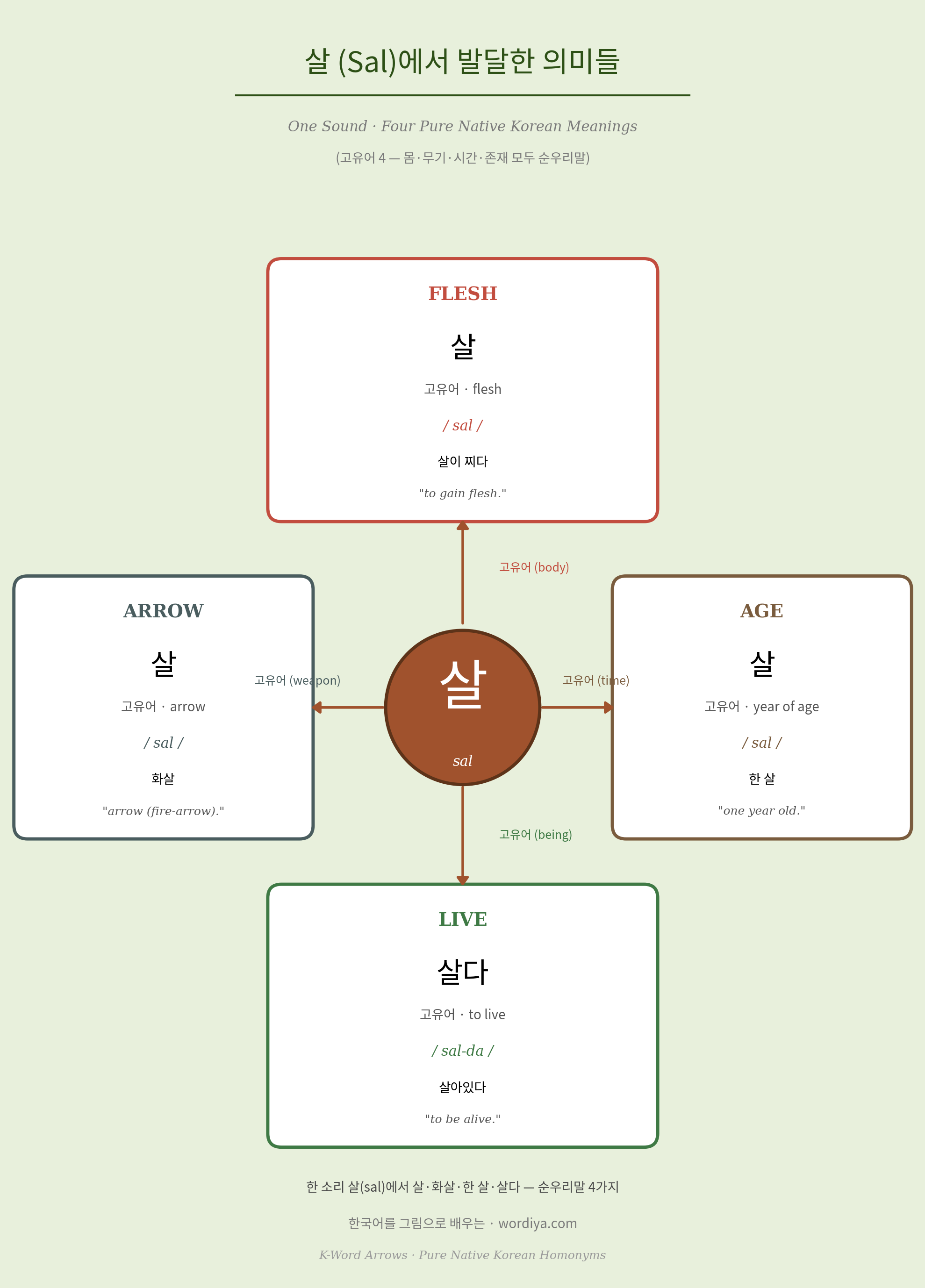
① FLESH — 살 (sal) · pure native Korean
The Korean word 살 (sal, flesh) is pure native Korean — one of Korea's most ancient body vocabulary items, traceable to Old Korean.
Common phrases:
- 살 (flesh)
- 살이 찌다 (to gain flesh / put on weight)
- 살이 빠지다 (to lose flesh / lose weight)
- 뼈와 살 (bone and flesh)
- 살결 (skin texture)
- 살빛 (skin color)
- 살을 붙이다 (to elaborate — "to add flesh")
Korean cultural depth: 뼈와 살 (bone and flesh) is a Korean idiom for family — the closest bond, sharing flesh and bone. 살결 (skin texture) and 살빛 (skin tone) anchor K-beauty vocabulary — modern K-beauty brands (Sulwhasoo, Laneige, Innisfree) build product descriptions around this ancient Korean anatomy. K-beauty's glass skin ideal (유리 살결) — luminous, translucent, hydrated — emerges from this vocabulary.
Example: 요즘 살이 좀 쪘어. ("I've gained some flesh lately.")
② ARROW — 살 (sal) · pure native Korean
The Korean word 살 (sal, arrow) is also pure native Korean — the shaft of an arrow. Ancient weapon vocabulary preserved from Korean neolithic and bronze ages.
Common phrases:
- 살 (arrow / arrow shaft)
- 화살 (fire-arrow — common word for arrow, 火+살)
- 화살촉 (arrowhead)
- 화살통 (quiver)
- 활과 살 (bow and arrow)
- 살을 쏘다 (to shoot an arrow)
- 살바람 (piercing wind — 살 metaphorical extension)
Korean cultural depth: Korea's archery tradition is 5,000 years old — Goguryeo warriors were legendary archers, Joseon dynasty made archery primary military training, and modern South Korea has won 27 Olympic archery gold medals as of 2024, more than any other country. The word 화살 (fire-arrow) literally combines 火 (fire, Hanja) + 살 (shaft, native) — meaning the pure native 살 predates Hanja arrival in Korea. Ancient Koreans had arrows before Chinese cultural influence. Legendary Goguryeo founder 주몽 (Jumong) — his name meaning "skilled archer."
Example: 화살을 쏘다. ("To shoot an arrow.")
③ AGE — 살 (sal) · pure native Korean
The Korean word 살 (sal, year of age) is also pure native Korean — the traditional Korean way to count years. Korean has two counting systems: native 살 (casual) and Hanja 세 (歲) (formal).
Common phrases:
- 한 살 (one year old)
- 두 살 (two years old)
- 서른 살 (thirty years old)
- 몇 살이세요? (How old are you? — polite)
- 동갑 (same age — critical social category)
- 나이 (age — general native term)
- 연세 (age — honorific for elders)
Korean cultural depth: Korean age has profound social significance — Korean grammar itself requires age awareness to determine honorifics and address forms. K-Drama's first-meeting scenes almost always feature "몇 살이세요?" South Korea officially adopted international age counting in 2023, but native 살 persists in daily conversation. Threshold: casual/personal → 살, formal/ceremonial → 세.
Example: 저는 서른 살이에요. ("I am thirty years old.")
④ LIVE — 살다 (sal-da) · pure native Korean
The Korean verb 살다 (sal-da, to live / exist / reside) is pure native Korean — one of the most fundamental verbs in the language. The verb of existence itself.
Common phrases:
- 살다 (to live / exist / reside)
- 살아있다 (to be alive)
- 살아남다 (to survive — trauma, war, hardship)
- 살아가다 (to go on living)
- 잘 살다 (to live well)
- 살림 (livelihood / household)
- 삶 (life — noun form)
- 살길 (livelihood, way of life)
Korean cultural depth: 살다 is Korea's verb of existence. 잘 살다 (to live well) is Korea's greatest wish — Korean parents' most common farewell to grown children: "잘 살아라" (live well). 살아남다 (to survive) resonates deeply in Korean historical consciousness — Japanese colonial period, Korean War, IMF crisis, all revolve around this verb: how a people survived. The noun 삶 (life) is one of Korean literature's most philosophically weighty words.
Example: 서울에서 삽니다. ("I live in Seoul.")
🧠 Memory Anchor — A Goguryeo Warrior's Existence
Picture a Goguryeo warrior 2,000 years ago. He is a man of flesh (살), his body built through years of practice. His weapon: a 화살 (arrow) — the ancient Korean word 살 itself is his instrument. He is thirty years old (서른 살), counting his years by the native Korean word. And above all, he is alive — he 살다 (lives) — the ancient Korean verb of existence flowing through his blood. Four meanings of 살 — the flesh that houses him, the arrow that arms him, the years that measure him, and the verb that names his being — all in one ancient Korean warrior on the peninsula's northern plains.
✅ Quick Check — Which 살 (sal) is this?
- 요즘 살이 좀 쪘어. ("I've gained some flesh lately.")
- 화살을 쏘다. ("To shoot an arrow.")
- 저는 서른 살이에요. ("I am thirty years old.")
- 서울에서 삽니다. ("I live in Seoul.")
Answers:
- FLESH — 살 (native, noun)
- ARROW — 살 (native, noun)
- AGE — 살 (native, counter)
- LIVE — 살다 (native, verb)
All four pure native Korean — no Hanja anywhere.
🔊 Pronunciation Tip
- 몸 / 뼈 / 찌다 → FLESH (native noun)
- 활 / 화 / 쏘다 → ARROW (native noun)
- 나이 / 한 / 몇 → AGE (native counter)
- ~에 살다 / 삶 / 살아 → LIVE (native verb)
💡 Bonus ① — 살 (Flesh) and K-Beauty Vocabulary
K-beauty industry vocabulary — 살결 (skin texture), 살빛 (skin tone), 투명한 살빛 (translucent skin), 깨끗한 살결 (clean skin), 촉촉한 살결 (dewy skin) — anchors K-beauty's global appeal. Glass skin (유리 살결) — luminous, translucent, hydrated — emerges from this ancient Korean vocabulary.
💡 Bonus ② — 살 (Arrow) and Korean Archery Legacy
Korea's 5,000-year archery tradition: Goguryeo warriors, 주몽 (Jumong, "skilled archer"), Joseon dynasty archery training, modern South Korea's 27 Olympic archery gold medals — most of any country. The word 살 in 화살 predates Hanja arrival, meaning ancient Koreans had arrows before Chinese cultural influence.
💡 Bonus ③ — 살 (Age) and Korean Social Hierarchy
Korean age vocabulary shapes social interaction: 살 (casual), 세 (歲) (formal), 나이 (general native), 연세 (honorific for elders). Korean grammar itself requires age awareness — K-Drama's first-meeting scenes always feature "몇 살이세요?" South Korea officially adopted international age counting in 2023, but native 살 persists in daily conversation.
💡 Bonus ④ — 살다 and Korean Philosophy of Existence
The verb 살다 anchors Korean philosophical vocabulary: 살아남다 (survive), 살아가다 (go on living), 살림 (livelihood), 삶 (life), 잘 살다 (live well), 살 만하다 (livable). Korean historical consciousness — Japanese colonial period, Korean War, IMF crisis — all revolve around 살아남다. The noun 삶 appears in Korean literature's most weighty moments.
💡 Bonus ⑤ — The Philosophical Coordinates of 살
What makes 살 the most philosophically resonant K-Word Arrows chapter is that its four meanings map the fundamental coordinates of human existence:
- 살 flesh = what we are made of (body)
- 살 arrow = what we fight with (weapon)
- 살 age = how long we last (time)
- 살다 live = the fact that we are (being)
Body + weapon + time + existence — these four coordinates define every human life across all cultures. Korean holds all four in one native syllable — pure native, no Hanja, ancient beyond writing. Alongside 눈, 달, 날, 살 completes the quartet of Korea's pure-native masterpieces. But 살 goes beyond the others in philosophical resonance — the other chapters describe things in the world (moon, day, blade), but 살 describes the human condition itself: we are flesh, we fight, we age, we exist. Korean at its most philosophical.
🎯 Wrap-Up
One sound — 살 (sal) — carries the substance of Korean bodies (살 flesh, pure native), the reach of Korean weapons (화살 arrow, pure native), the counting of Korean years (한 살 one year, pure native), and the very fact of Korean existence (살다 to live, pure native). Four pure native Korean meanings, no Hanja, no borrowing — the deepest layer of Korean linguistic heritage. Body + arrow + age + life — the four coordinates of every human existence, all held in a single Korean syllable. Pure Korean, pure ancient, pure elemental — Korean at its most philosophical.
K-Word Arrows: Korean Homonyms Visualized — ⓒ wordiya.com


