돌 (Dol) — Stone, First Birthday, Turn, Breakthrough (突) — Three Native + One Hanja in Ancient-and-Sudden Balance
If 달 (dal) was Korean's masterpiece of four pure native meanings, 돌 (dol) is its earthbound cousin — three deep native meanings anchored to Korea's most beloved cultural ritual, plus one Hanja meaning that punches through as a breakthrough. Three meanings from the deepest native layer: the stone at your feet (돌), the first birthday celebration (돌잔치), and the action of turning (돌다). One Hanja meaning for the boldest human forward motion: sudden burst, breakthrough (돌 突).
The Four Branches — Nature, Ritual, Motion, and Breakthrough
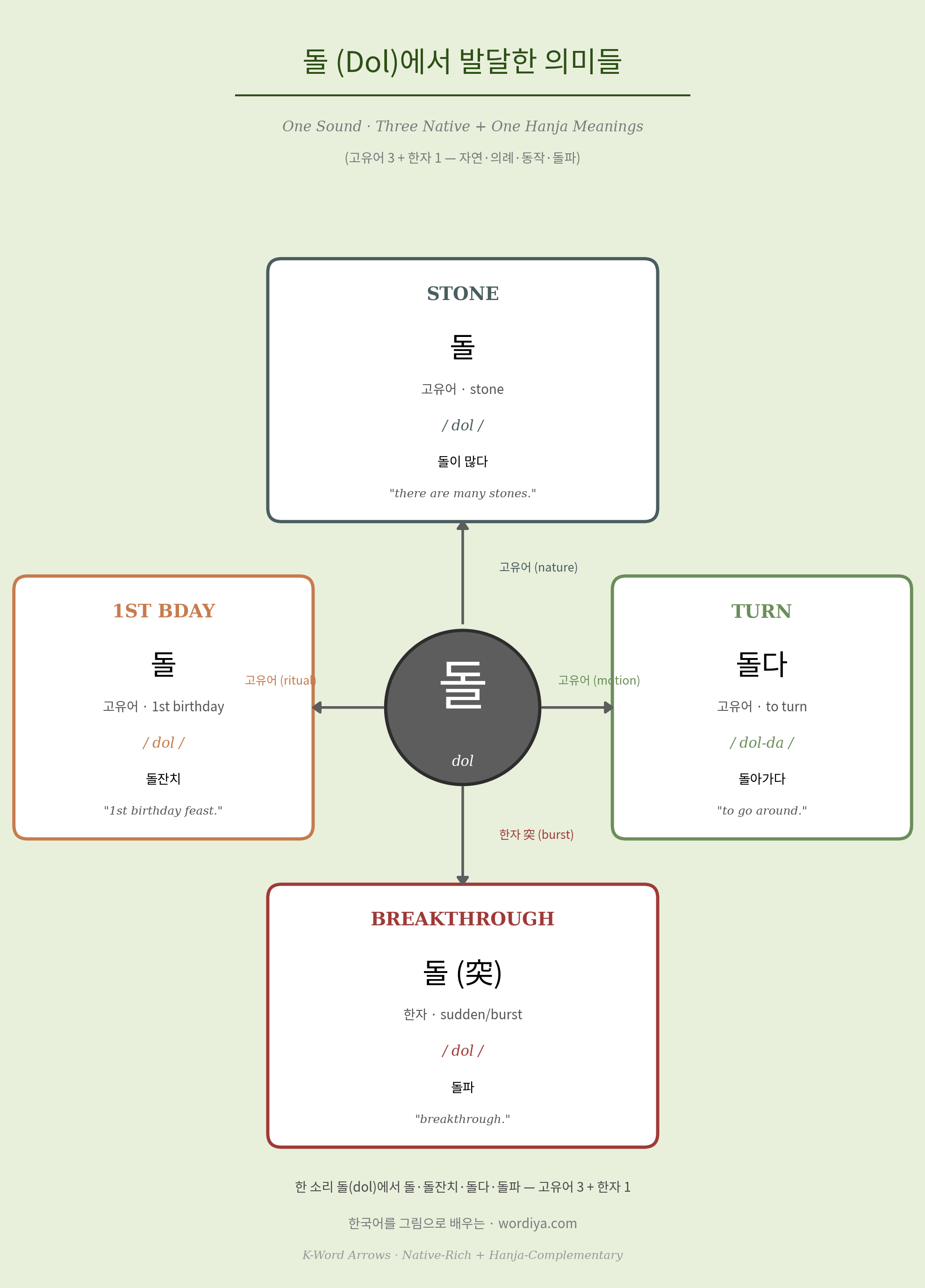
① STONE — 돌 (dol) · pure native Korean
The Korean word 돌 (dol, stone) is pure native Korean — traceable to Old Korean, connecting modern speakers to their neolithic ancestors.
Common phrases:
- 돌 (dol, stone)
- 돌멩이 (small stone/pebble)
- 바위 (large rock)
- 돌담 (stone wall)
- 돌하르방 (Jeju stone grandfather statues)
- 돌부처 (stone Buddha statues)
Korean cultural depth: 돌하르방 (Jeju stone grandfather statues) are Korea's iconic volcanic guardians — 1-3 meter volcanic rock figures at Jeju Island entrances. 제주 돌담 (Jeju stone walls) are UNESCO-recognized cultural heritage. Korea has the world's highest concentration of prehistoric dolmens (고인돌) — over 30,000 megalithic tombs across the peninsula. Korean identity is quite literally engraved in stone.
Example: 돌이 많다. ("There are many stones.")
② FIRST BIRTHDAY — 돌 (dol) · pure native Korean
The Korean word 돌 (dol, first birthday) is also pure native Korean — Korea's most beloved traditional life-cycle ritual.
Common phrases:
- 돌 (dol, first birthday)
- 돌잔치 (first birthday feast)
- 첫돌 (the very first birthday)
- 돌잡이 (grabbing ceremony)
- 돌복 (first birthday hanbok)
- 돌떡 (first birthday rice cake)
- 돌반지 (gold ring gift)
Korean cultural depth: In traditional Korea, surviving to the first birthday was a major milestone due to high infant mortality. The 돌잡이 (grabbing ceremony) has the baby choose from items predicting the future — 책 (book) = scholar, 돈 (money) = wealth, 실 (thread) = long life, 마이크 (microphone) = K-pop star, 청진기 (stethoscope) = doctor. K-Drama family scenes and Instagram of Korean expat families worldwide feature 돌잔치 as a cornerstone of Korean identity.
Example: 아기 돌잔치에 초대받았어요. ("I was invited to the first birthday feast.")
③ TURN — 돌다 (dol-da) · pure native Korean
The Korean verb 돌다 (dol-da, to turn / go around) is pure native Korean — a fundamental motion verb. Related to the same root as 돌 (first birthday, one full turn of the year).
Common phrases:
- 돌다 (to turn / spin / go around)
- 돌리다 (to rotate something)
- 돌아가다 (to go back / return; euphemism for "to pass away")
- 돌아오다 (to come back)
- 소문이 돌다 (rumors go around)
- 머리가 돌다 (to feel dizzy)
Korean cultural depth: 돌다 captures Korea's cyclic worldview. 돌아가시다 (honorific for death) literally means "to go around back to the cycle" — reflecting Buddhist/Confucian views of life as circular. Korean traditional dances (살풀이), games (팽이돌리기 spinning tops), drum ceremonies (사물놀이) all embody circular motion. Even 돌 (first birthday) comes from the same root — "one complete turn of the year."
Example: 지구가 돌아요. ("The Earth turns.")
④ BREAKTHROUGH — 돌 (突) · Hanja-based
The Korean morpheme 돌 (dol, sudden burst / breakthrough) comes from Hanja 突. The backbone of Korean vocabulary for sudden events and breakthroughs.
Common phrases:
- 돌 (dol, 突 — sudden / burst)
- 돌파 (breakthrough — 突破)
- 돌발 (sudden occurrence — 突發)
- 돌격 (charge / assault — 突擊)
- 돌진 (rushing forward — 突進)
- 충돌 (collision — 衝突)
- 돌풍 (sudden gust — 突風)
- 돌연 (suddenly — 突然)
Korean cultural depth: 기술 돌파구 (technological breakthrough) is K-semiconductor industry vocabulary. 매출 돌파 (revenue breakthrough) is quarterly earnings language. 돌발 상황 (sudden situation) is emergency response vocabulary. This Hanja morpheme captures sudden, decisive, forward-thrusting energy — the perfect counterpart to the three ancient native meanings.
Example: 매출이 목표를 돌파했어요. ("Revenue broke through the target.")
🧠 Memory Anchor — A Korean Family's 돌잔치 Gathering
Picture a Korean family gathering for a 돌잔치 (first birthday feast). Grandparents carry the baby past a traditional 돌담 (dol-dam, stone wall) at the family home. Inside, the baby's first birthday table (돌상) is set. Guests 돌아가면서 (dol-a-ga-myeon-seo, going around) admire the child in traditional hanbok. As the year turns (한 해가 돌아가는 moment), the family celebrates a breakthrough (돌파) — surviving the vulnerable first year of life. Four meanings of 돌 — stone at the family home, first birthday celebration, cyclic return of guests and years, and the breakthrough of infant survival — all in one Korean family gathering.
✅ Quick Check — Which 돌 (dol) is this?
- 돌이 많다. ("There are many stones.")
- 아기 돌잔치에 초대받았어요. ("I was invited to the first birthday feast.")
- 지구가 돌아요. ("The Earth turns.")
- 매출이 목표를 돌파했어요. ("Revenue broke through the target.")
Answers:
- STONE — 돌 (native, noun)
- FIRST BIRTHDAY — 돌 (native, noun)
- TURN — 돌다 (native, verb)
- BREAKTHROUGH — 돌 (Hanja 突)
Three native + one Hanja — ancient earth meets modern breakthrough.
🔊 Pronunciation Tip
- 자연 / 바위 → STONE (native noun)
- 아기 / 잔치 → FIRST BIRTHDAY (native noun)
- 움직임 / 회전 → TURN (native verb)
- 돌파 / 돌발 → BREAKTHROUGH (Hanja 突)
💡 Bonus ① — 돌 (Stone) and Korean Cultural Heritage
Korea has the world's highest concentration of prehistoric dolmens (고인돌) — over 30,000 megalithic tombs across the peninsula, UNESCO World Heritage. Iconic stones: 돌하르방 (Jeju volcanic guardians), 돌담 (Jeju stone walls UNESCO), 돌부처 (cliff Buddha carvings), 돌탑 (stone pagodas at 경주 불국사).
💡 Bonus ② — 돌잔치 and Korean Family Tradition
The 돌잡이 grabbing ceremony has traditional items: 실 (thread) = long life, 책 (book) = scholar, 돈 (money) = wealth, 활 (bow) = warrior. Modern additions: 마이크 (microphone) = K-pop star, 청진기 (stethoscope) = doctor, 골프공 (golf ball) = athlete. Global Korean expats maintain 돌잔치 as a cornerstone of identity abroad.
💡 Bonus ③ — 돌다 and Korean Cyclic Worldview
The word 돌아가시다 (honorific for death) literally means "to go around back to the cycle" — reflecting Buddhist/Confucian views of life as circular rather than linear. The first birthday 돌 itself comes from the same root: "one complete turn of the year."
💡 Bonus ④ — 突 and Korean Industrial Vocabulary
Modern Korean uses 기술 돌파구 (technological breakthrough) as K-semiconductor vocabulary. 매출 돌파 (revenue breakthrough) is quarterly earnings language. K-bio, K-semiconductor, and K-pop industries use 돌파 constantly. The Hanja 突 provides precise vocabulary for sudden industrial achievement.
💡 Bonus ⑤ — The Ancient and the Sudden
돌 captures the balance of three ancient native meanings (stone, first birthday, turn — deeply pre-modern) with one modern-flavored Hanja meaning (breakthrough — dynamic industrial). Korean speakers unconsciously move between the neolithic stone at their feet (돌) and the K-semiconductor breakthrough on the news (돌파) in the same syllable. Ancient identity + modern achievement, in one Korean sound.
🎯 Wrap-Up
One sound — 돌 (dol) — carries the weight of Korean stones (돌 stone, pure native), the joy of Korean first-birthday tradition (돌잔치 1st birthday, pure native), the motion of Korean daily verbs (돌다 to turn, pure native), and the breakthroughs of Korean modern achievement (돌 突 breakthrough, Hanja-based). Three native + one Hanja = the balance that captures Korean identity from neolithic stone tools to K-semiconductor breakthroughs.
K-Word Arrows: Korean Homonyms Visualized — ⓒ wordiya.com


