달 (Dal) — Moon, Month, Sweet, Hang — Four Pure Native Korean Meanings, No Hanja Anywhere
If 눈 (nun) was Korean's masterpiece of four pure native meanings woven into one syllable, 달 (dal) is its cosmic twin. Four meanings, all pure native Korean, no Hanja anywhere: the moon in the sky (달), the passage of months (한 달), the taste of sweetness (달다), and the action of hanging (매달다). One Korean sound, four ancient meanings — all traceable to the deepest pre-Hanja layer of Korean linguistic memory. This is K-Word Arrows at its most primordial.
The Four Branches — Sky, Time, Taste, and Action
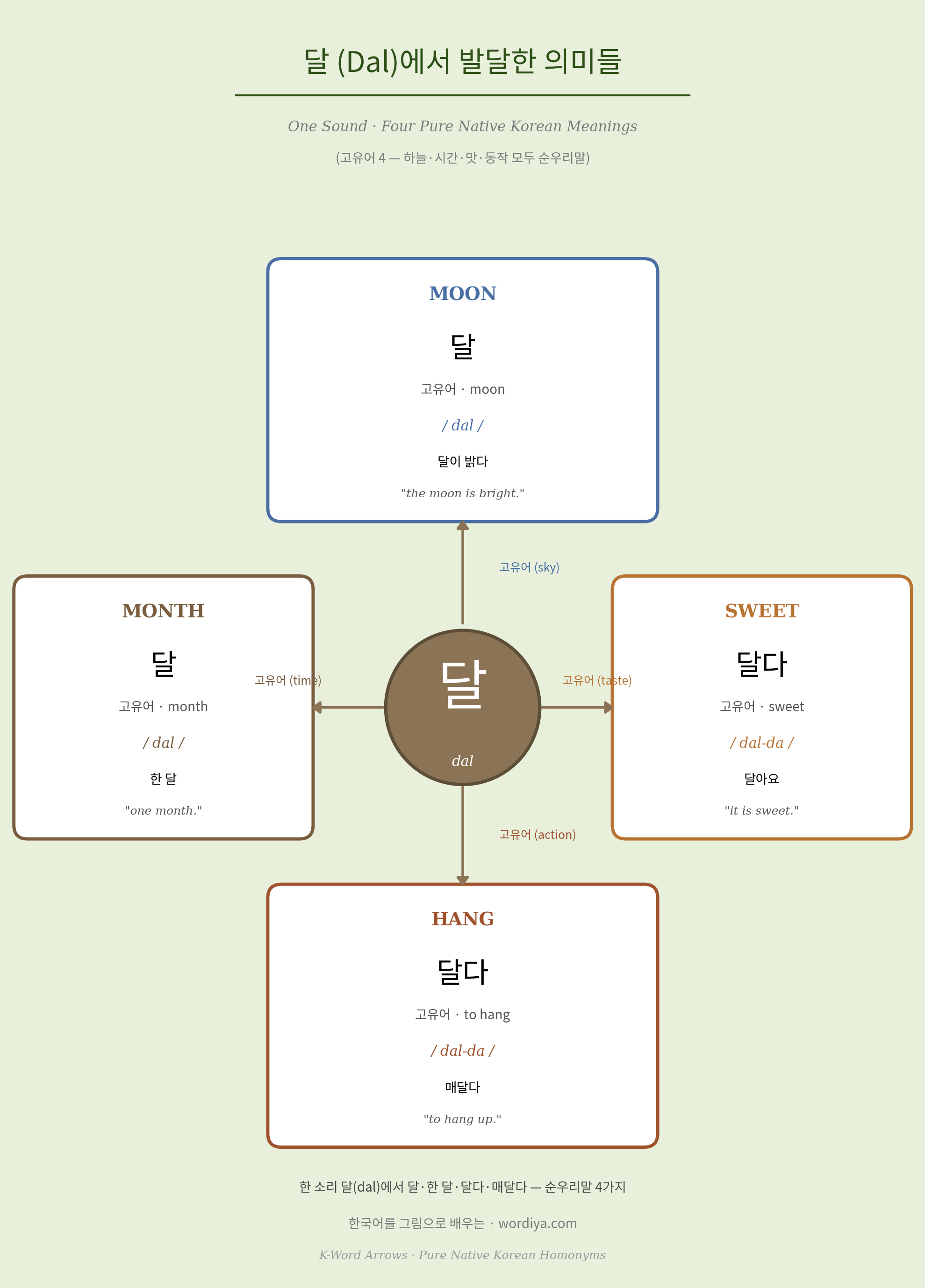
① MOON — 달 (dal) · pure native Korean
The Korean word 달 (dal, moon) is pure native Korean — no Hanja, traceable to Old Korean. One of the most ancient Korean cosmic words alongside 해 (sun), 별 (star), 하늘 (sky).
Common phrases:
- 달 (dal, moon)
- 보름달 (bo-reum-dal, full moon)
- 초승달 (cho-seung-dal, crescent moon)
- 반달 (ban-dal, half moon)
- 달빛 (dal-bit, moonlight)
- 달항아리 (dal-hang-a-ri, moon jar)
Korean cultural depth: 정월대보름 (first full moon of the lunar year) and 한가위/추석 (harvest full moon festival) are Korea's most important lunar celebrations. The 달항아리 (moon jar) — a white porcelain vessel from the Joseon dynasty — is exhibited at the British Museum, Metropolitan Museum, and Musée Guimet as a symbol of Korean aesthetic minimalism.
Example: 달이 밝다. ("The moon is bright.")
② MONTH — 달 (dal) · pure native Korean
The Korean word 달 (dal, month) is also pure native Korean. Korean has two parallel words for "month" — native 달 vs Hanja-based 월 (月).
Common phrases:
- 달 (dal, month)
- 한 달 (han dal, one month)
- 올해 (this year)
- 지난달 / 다음 달 (last month / next month)
- 몇 달 (myeot dal, a few months)
Korean cultural depth: The etymological link between 달 (moon) and 달 (month) mirrors humanity's oldest cross-linguistic pattern — English month ← moon, German Monat ← Mond, Korean 달 = both. The lunar cycle as time's basic unit, preserved in one Korean syllable.
Example: 한 달 잘 지내세요. ("Have a good month.")
③ SWEET — 달다 (dal-da) · pure native Korean
The Korean word 달다 (dal-da, sweet) is pure native Korean — Korean's basic taste vocabulary. Korean has four (or five) basic tastes all native: 달다 (sweet), 쓰다 (bitter), 시다 (sour), 짜다 (salty), 맵다 (spicy).
Common phrases:
- 달다 (dal-da, to be sweet)
- 달콤하다 (dal-kom-ha-da, sweet — romantic)
- 달달하다 (dal-dal-ha-da, sweetish — casual)
- 단맛 (dan-mat, sweet taste)
- 달콤한 사랑 (sweet love)
Korean cultural depth: 달콤하다 extends to romance and life — 달콤한 사랑 (sweet love), 달콤한 꿈 (sweet dream), 달콤한 목소리 (sweet voice). K-Drama love confessions and K-pop lyrics use 달콤 extensively. Korean has richer vocabulary for sweetness than English despite eating less sugar traditionally.
Example: 이 과일이 달아요. ("This fruit is sweet.")
④ HANG — 달다 (dal-da) · pure native Korean
The Korean word 달다 (dal-da, to hang / attach) is also pure native Korean — a homophone of "sweet" but entirely different verb. Same pronunciation, same spelling, different meaning. Context decides.
Common phrases:
- 달다 (dal-da, to hang / attach)
- 매달다 (mae-dal-da, to hang up / suspend)
- 매달리다 (to cling to / depend on — emotional)
- 댓글을 달다 (to post a comment — modern digital)
- 이름표를 달다 (to attach a name tag)
- 훈장을 달다 (to pin a medal)
Korean cultural depth: Korean traditional houses hung dried peppers (붉은 고추), garlic (마늘), corn (옥수수), and persimmons (곶감) from eaves for winter preservation. The action of 매달다 was daily reality. Modern Korean adapts this ancient verb: 댓글을 달다 (posting comments) uses the same verb that once described hanging peppers.
Example: 벽에 그림을 달았어요. ("I hung a picture on the wall.")
🧠 Memory Anchor — A Korean Grandmother's Full Moon Night
Picture a Korean grandmother on a full moon night (보름달). She looks up at the 달 (dal, moon) shining bright. Another 달 (dal, month) has passed — the lunar cycle completing itself. She reaches for the 달다 (dal-da, sweet) persimmon prepared for ancestral rites, and then 매달다 (mae-dal-da, hangs) traditional lanterns from her home's eaves. Four meanings of 달 — moon overhead, months counted, sweetness tasted, lanterns hung — all in one Korean grandmother's full moon night.
✅ Quick Check — Which 달 (dal) is this?
- 달이 밝다. ("The moon is bright.")
- 한 달 잘 지내세요. ("Have a good month.")
- 이 과일이 달아요. ("This fruit is sweet.")
- 벽에 그림을 달았어요. ("I hung a picture on the wall.")
Answers:
- MOON — 달 (native, noun)
- MONTH — 달 (native, noun)
- SWEET — 달다 (native, adjective)
- HANG — 달다 (native, verb)
All four pure native Korean — no Hanja anywhere.
🔊 Pronunciation Tip
- 하늘 / 밝다 / 빛 → MOON (noun)
- 시간 / 한 달 → MONTH (noun)
- 맛 / 달콤하다 → SWEET (adjective)
- 매달다 / 붙이다 → HANG (verb)
💡 Bonus ① — 달 (Moon) and Korean Aesthetic Heritage
The Korean moon has inspired Korea's most iconic art forms: 달항아리 (moon jar — Joseon white porcelain masterpiece, exhibited globally), 보름달 (full moon celebrations 정월대보름·추석), 달빛 (moonlight — 김소월 poetry, K-Drama romance), 달구경 (moon viewing — traditional autumn activity).
💡 Bonus ② — 달 vs 월: Two Korean Words for "Month"
Native 달 (emotional) vs Hanja 월 月 (formal). 한 달 (one month, casual) vs 일 개월 (formal). Dates always use Hanja: 2026년 7월. Same duality as sun/year in 해 (Hae) chapter.
💡 Bonus ③ — Korean Sweetness Vocabulary
Korean's sweetness vocabulary is unusually rich: 달다 (sweet, basic), 달콤하다 (sweet, romantic), 달달하다 (sweetish, casual), 달착지근하다 (subtly sweet), 달큼하다 (mildly sweet). Korean bakes modifiers into the verb itself.
💡 Bonus ④ — 달다 (Hang) in Korean Traditional and Digital Life
From hanging peppers on 처마 (eaves) for winter preservation to posting 댓글 (comments) online — the same verb 달다 connects 5,000 years of Korean life. 매달리다 (to cling to) captures emotional attachment: 그는 그녀에게 매달렸다 (he clung to her).
💡 Bonus ⑤ — Pure Native Korean, No Hanja Anywhere
What makes 달 distinctive is that all four meanings are pure native Korean — no Hanja borrowing whatsoever. Cosmic observation (moon), time measurement (month), taste sensation (sweet), physical action (hang) — the vocabulary categories all human languages developed first, all preserved in one native Korean syllable. This is Korean at its most Korean — a linguistic time capsule connecting modern speakers directly to their neolithic ancestors gazing at the moon, counting lunar months, tasting wild honey, and hanging tools from cave ceilings.
🎯 Wrap-Up
One sound — 달 (dal) — carries the brightness of the Korean night sky (달 moon), the counting of Korean months (달 month), the pleasure of Korean tastebuds (달다 sweet), and the action of Korean hands (매달다 hang). Four pure native Korean meanings, no Hanja, no borrowing — the deepest layer of Korean linguistic heritage in one syllable. Pure Korean, pure ancient, pure elemental.
K-Word Arrows: Korean Homonyms Visualized — ⓒ wordiya.com


