들 (Deul) — Field, Plural Marker, Lift, Enter — Four Pure Native Korean Meanings Plus Grammar Layer
If 눈, 달, 날, and 살 formed a quartet of pure-native Korean triumphs, 들 (deul) opens a new dimension — the first K-Word Arrows chapter to include Korean's grammar itself. Four meanings, all pure native Korean, no Hanja anywhere: the wide field of Korean geography (넓은 들), the plural marker of Korean grammar (사람들), the verb of lifting (가방을 들다), and the verb of entering (잠에 들다). One Korean sound carrying nature, grammar, action, and state — and here's what makes 들 remarkable: one of its meanings is a grammatical particle, the deepest layer of any language, preserved purely in Korean without borrowing.
The Four Branches — Nature, Grammar, Action, and State
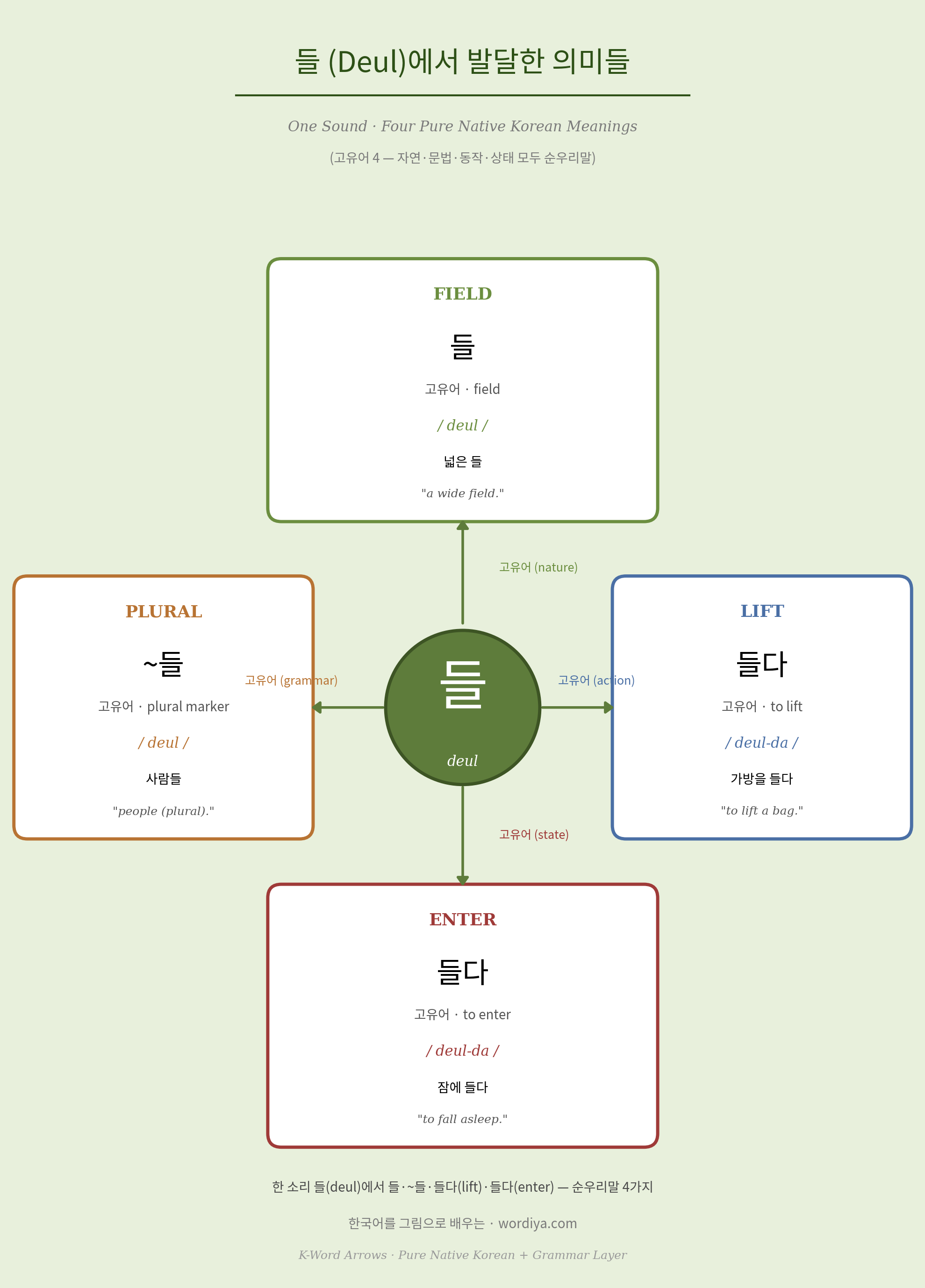
① FIELD — 들 (deul) · pure native Korean
The Korean word 들 (deul, field / plain) is pure native Korean — one of the most ancient Korean geography words, referring to wide, open agricultural or wild plains.
Common phrases:
- 들 (field / plain)
- 들판 (wide open field)
- 들녘 (field / countryside)
- 황금 들녘 (golden field — harvest scene)
- 들꽃 (wildflower)
- 들짐승 (wild beasts)
- 들일 (farm work)
- 들기름 (perilla oil — from 들깨 wild seeds)
Korean cultural depth: 황금 들녘 (golden field) captures Korean autumn harvest scenes — rice fields turning gold before harvest. Kim Sowol's poem 진달래꽃 (Azalea) and Nam-Soo Hwang's 들꽃 (Wildflower) evoke 들녘 as the emotional homeland of Korean rural poetry. The classification 들짐승 vs 집짐승 (wild beasts vs domestic animals) reveals ancient Korean hunter-gatherer worldview preserved in modern language.
Example: 넓은 들이 펼쳐져 있다. ("A wide field stretches out.")
② PLURAL MARKER — ~들 (-deul) · pure native Korean grammar
The Korean plural marker ~들 (-deul) is pure native Korean grammar — a suffix attached to nouns to indicate plurality. Korean's own native plural system, developed within Korean linguistic tradition from its earliest known form.
Common phrases:
- ~들 (plural suffix)
- 사람들 (people)
- 책들 (books)
- 학생들 (students)
- 친구들 (friends)
- 아이들 (children)
- 우리들 (we — emphatic plural)
- 여러분들 (everyone — polite audience)
Korean linguistic depth: Unlike English's obligatory plural, Korean pluralization is context-sensitive and emphatic. You can say 책이 있다 (there is a book / there are books, ambiguous) or 책들이 있다 (there are books, emphatic). ~들 even attaches to adverbs: 빨리들 오세요 (all of you, come quickly). K-Drama dialogue commonly features "여러분들" (everyone, plural) as polite audience address. Grammar particles like ~들, 은/는, 이/가, 을/를, 에서, 하고 form the structural backbone of Korean — and these grammatical elements are all pure native Korean, forming the deepest layer of the language.
Example: 사람들이 모여 있다. ("People are gathered.")
③ LIFT — 들다 (deul-da) · pure native Korean
The Korean verb 들다 (deul-da, to lift / hold / raise) is pure native Korean — a fundamental action verb capturing the physical act of lifting or holding something up.
Common phrases:
- 들다 (to lift / hold / raise)
- 들어올리다 (to lift up)
- 손을 들다 (to raise one's hand)
- 가방을 들다 (to lift / carry a bag)
- 예를 들다 (to give an example — "lift an example")
- 역기 들기 (weightlifting)
- 깃발을 들다 (to raise a flag)
- 무기를 들다 (to take up arms)
Korean cultural depth: 손을 들다 (to raise one's hand) is Korea's classroom vocabulary — every Korean student learns this action from kindergarten. 예를 들다 (to give an example — literally "to lift an example") is a beautiful Korean metaphor: examples are lifted from a mental collection to be presented. K-Drama classroom scenes constantly feature 예를 들면 (for example). South Korea has produced Olympic weightlifting champions including Jang Mi-ran (2008 gold, world record) and Sa Jae-hyouk (2008 gold). The perilla oil 들기름 — a Korean cooking staple — comes from 들깨 (perilla seeds).
Example: 가방을 들다. ("To lift / carry a bag.")
④ ENTER — 들다 (deul-da) · pure native Korean
The Korean verb 들다 (deul-da, to enter / come in / fall into) is also pure native Korean — a homophone of "lift" but a completely different verb. Same pronunciation, same spelling, different meaning. Context decides.
Common phrases:
- 들다 (to enter / come in / fall into)
- 잠에 들다 (to fall asleep)
- 집에 들다 (to come into the house)
- 정이 들다 (to develop affection)
- 마음에 들다 (to like — "to enter one's heart")
- 생각이 들다 (a thought occurs)
- 감기가 들다 (to catch a cold)
- 손에 들다 (to hold — "to enter one's hand")
Korean cultural depth: 잠에 들다 (to fall asleep) — literally "to enter sleep" — reveals Korean's poetic view of sleep as entering another realm. 정이 들다 (to develop affection) is one of Korea's most beloved emotional phrases: 정 (jeong) is a distinctly Korean concept of deep attachment developed through time and shared experience. K-Drama romantic climaxes constantly feature "정이 들었나 봐" (I think I've developed affection). 마음에 들다 (to like — literally "to enter one's heart") is one of Korean's most common expressions — K-pop fans use "마음에 들어" constantly. 감기가 들다 (to catch a cold — literally "a cold enters") captures Korean's traditional view of illness as invasion from outside.
Example: 잠에 들다. ("To fall asleep.")
🧠 Memory Anchor — A Korean Farmer's Evening Return
Picture a Korean farmer at sunset walking home across a wide 들 (deul, field) — the wheat and rice bowing golden in the evening light. Behind him, other 농부들 (farmers, plural) work their last hour before dark. He lifts 들다 (deul-da, lift) his tools onto his shoulder and walks toward his village. When he arrives at his house, he 집에 들다 (deul-da, enter) — enters into the warmth of home, and soon he 잠에 들다 (falls asleep). Four meanings of 들 — the field around him, the plural marker for his fellow farmers, the verb of lifting his tools, and the verb of entering both his house and his sleep — all in one Korean farmer's evening return.
✅ Quick Check — Which 들 (deul) is this?
- 넓은 들이 펼쳐져 있다. ("A wide field stretches out.")
- 사람들이 모여 있다. ("People are gathered.")
- 가방을 들다. ("To lift / carry a bag.")
- 잠에 들다. ("To fall asleep.")
Answers:
- FIELD — 들 (native, noun)
- PLURAL — ~들 (native, grammatical suffix)
- LIFT — 들다 (native, action verb)
- ENTER — 들다 (native, state verb)
All four pure native Korean — no Hanja anywhere, and one is a grammatical particle.
🔊 Pronunciation Tip
- 자연 / 넓다 / 펼쳐지다 → FIELD (native noun)
- 사람 / 학생 / ~들 붙어 → PLURAL (native suffix)
- 손 / 가방 / 무거운 → LIFT (native verb)
- ~에 / 잠 / 집 / 정 → ENTER (native verb)
💡 Bonus ① — 들 (Field) and Korean Agricultural Heritage
Korean 들 vocabulary captures Korea's agricultural civilization: 들판 (wide field), 들녘 (countryside), 황금 들녘 (golden field, harvest scene), 들꽃 (wildflower), 들짐승 vs 집짐승 (wild beasts vs domestic animals — ancient hunter-gatherer classification), 들일 (farm work), 들기름 (perilla oil from 들깨). Korean traditional autumn scenes feature 황금 들녘. Kim Sowol's 진달래꽃 and Nam-Soo Hwang's 들꽃 evoke 들녘 as emotional homeland of Korean rural poetry.
💡 Bonus ② — ~들 and Korean Grammatical Depth
Unlike English's obligatory plural, Korean pluralization is context-sensitive and emphatic. You can say 책이 있다 (ambiguous) or 책들이 있다 (emphatic). ~들 even attaches to adverbs: 빨리들 오세요.
Because grammatical elements change more slowly than vocabulary and cannot be easily borrowed, native grammar particles like ~들 preserve the deepest strata of Korean linguistic ancestry. Speaking 사람들 today invokes 5,000+ years of continuous Korean grammatical inheritance — pre-Hanja, pre-Chinese influence, purely Korean at its structural core. This is why Korean scholars increasingly view Korean as a root layer of the wider Eurasiatic language family rather than a peripheral branch.
💡 Bonus ③ — 들다 (Lift) and Korean Action Vocabulary
The verb 들다 (to lift) captures Korean physical and metaphorical action: 손을 들다 (raise hand — classroom staple), 예를 들다 (give example — "lift example"), 역기 들기 (weightlifting — Olympic gold Jang Mi-ran, Sa Jae-hyouk), 깃발을 들다 (raise flag), 무기를 들다 (take up arms). The metaphor 예를 들다 reveals Korean's spatial thinking about examples: they are stored in the mind and lifted for presentation.
💡 Bonus ④ — 들다 (Enter) and Korean Metaphorical Life
The verb 들다 (to enter) captures Korean's rich metaphorical state transitions: 잠에 들다 (enter sleep), 정이 들다 (jeong enters — K-Drama emotional climax), 마음에 들다 (enter heart — like), 감기가 들다 (cold enters — traditional illness view), 생각이 들다 (thought enters), 집에 들다 (enter house). Korean views mental, emotional, and physical states as visitors from outside — a poetic worldview built into everyday grammar.
💡 Bonus ⑤ — Pure Native Korean, Grammar Included
What makes 들 uniquely distinctive among K-Word Arrows chapters is that it includes a grammatical particle — the plural marker ~들 — as one of its four meanings:
- 들 field = nature (noun)
- ~들 plural = grammar (particle) ⭐
- 들다 lift = action (verb)
- 들다 enter = state (verb)
This 3+1 pattern reveals something profound: not only does one Korean sound carry multiple meanings, but Korean's grammar itself operates in the same phonetic space as its vocabulary. Grammatical particles preserve the deepest layer of linguistic ancestry — they change more slowly than vocabulary and cannot be borrowed easily. ~들 as pure native Korean plural marker means Korean's grammatical DNA is pre-Hanja, pre-Chinese influence, and traceable to the deepest Korean linguistic layer. When you say 사람들 (people, plural), you speak with the grammatical DNA of Korean neolithic ancestors — 5,000+ years of continuous grammatical inheritance held in one syllable. Korean is not a language that received grammar from elsewhere; Korean is a language whose grammar has always been its own.
🎯 Wrap-Up
One sound — 들 (deul) — carries the wide fields of Korean geography (들 field, pure native), the plural marking of Korean grammar (~들 plural, pure native), the physical action of Korean hands (들다 lift, pure native), and the state-transition of Korean life (들다 enter, pure native). Four pure native Korean meanings, no Hanja, no borrowing — and one of them a grammatical particle preserving language deeper than any dictionary can measure. To master these four 들s is to touch not only Korean vocabulary but Korean grammatical DNA, connecting modern speakers directly to their ancestors walking across Korean fields, marking multiplicities, lifting burdens, and slipping into sleep. Pure Korean, pure ancient, pure grammatical — Korean at its most structurally revealing.
K-Word Arrows: Korean Homonyms Visualized — ⓒ wordiya.com


