날 (Nal) — Day, Blade, Raw, Fly — Four Pure Native Korean Meanings, No Hanja Anywhere
If 눈 (nun) and 달 (dal) were Korean's masterpieces of four pure native meanings, 날 (nal) is their sibling — the third pure native chapter in K-Word Arrows. Four meanings, all pure native Korean, no Hanja anywhere: the passage of time as a day (좋은 날), the sharp edge of a tool (칼날), the raw/uncooked state of things (날것), and the action of flying (날다). One Korean sound, four ancient meanings — spanning time, tool, state, and action.
The Four Branches — Time, Tool, State, and Action
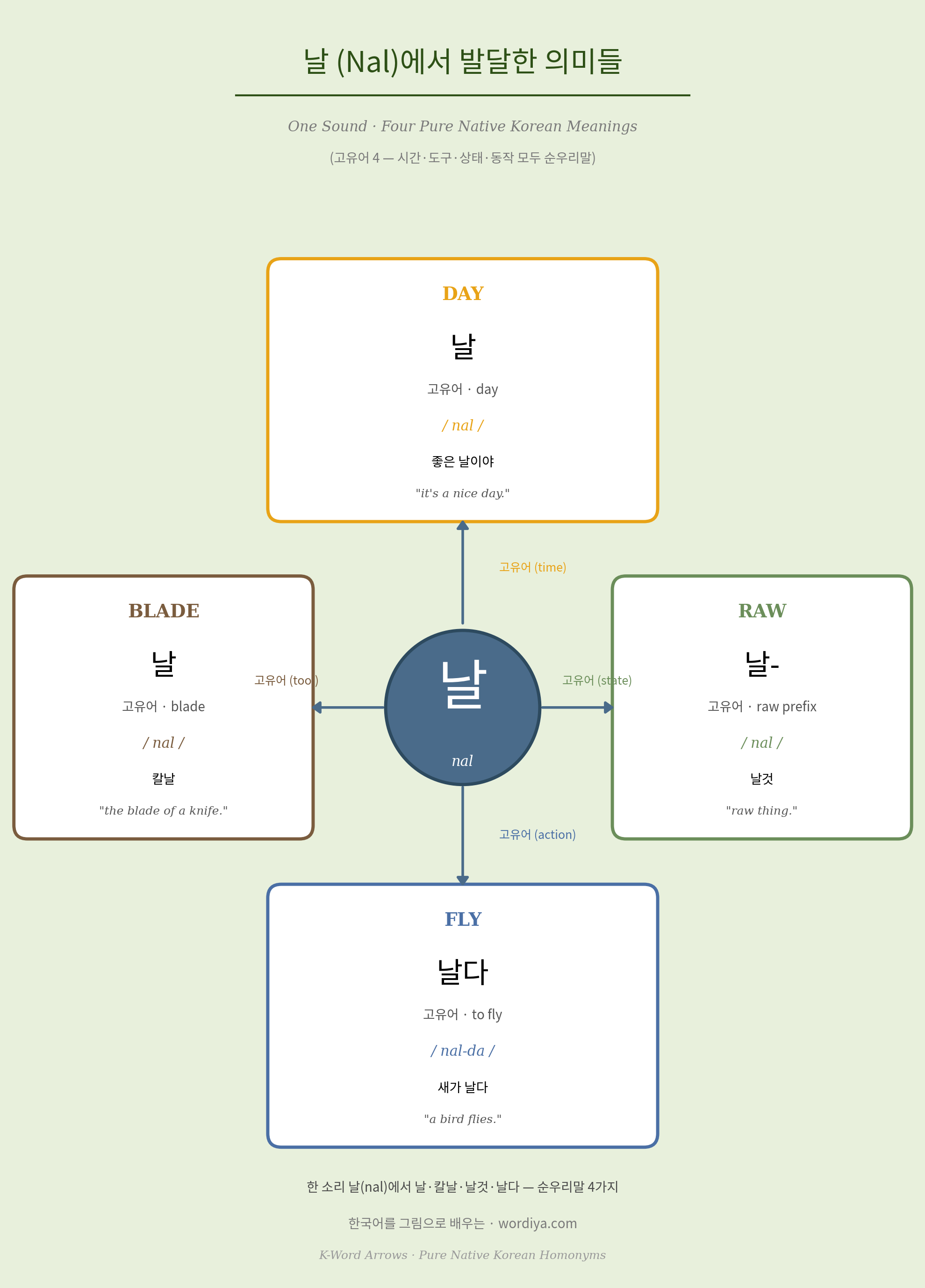
① DAY — 날 (nal) · pure native Korean
The Korean word 날 (nal, day) is pure native Korean — traceable to Old Korean, connecting modern speakers to their neolithic ancestors marking days.
Common phrases:
- 날 (nal, day)
- 좋은 날 (a good day)
- 어느 날 (one day / a certain day)
- 옛날 (long ago / ancient day)
- 그날 (that day)
- 생일 날 (birthday)
- 날짜 (date)
Korean cultural depth: 옛날 (long ago) is the traditional opening of Korean folk tales — "옛날 옛적에" is Korean's equivalent of "Once upon a time." 좋은 날 (a good day) carries warm cultural weight as an elder's blessing. Korean has both native 날 and Hanja-based 일 (日) — native 날 for meaningful days, Hanja 일 for formal dates (7월 2일).
Example: 오늘은 좋은 날이야. ("Today is a good day.")
② BLADE — 날 (nal) · pure native Korean
The Korean word 날 (nal, blade) is also pure native Korean — referring to the sharp cutting edge of a tool. Ancient tool vocabulary from Korean neolithic and bronze ages.
Common phrases:
- 날 (nal, blade)
- 칼날 (blade of a knife)
- 도끼날 (axe blade)
- 가위 날 (scissor blade)
- 톱날 (saw blade)
- 날카롭다 (sharp — adjective from 날)
- 날을 세우다 (to sharpen an edge)
- 날 서다 (to become edged / emotionally tense)
Korean cultural depth: Korean traditional smithing (대장간) crafted 칼날 with distinctive folded steel techniques. The 환도 (Korean sabre) defined Joseon dynasty military. 날카롭다 (sharp) extends metaphorically — 날카로운 눈매 (sharp gaze), 날카로운 지적 (sharp criticism), 날카로운 목소리 (sharp voice). K-Drama villains often described with 날카로운 vocabulary.
Example: 칼날이 날카롭다. ("The blade is sharp.")
③ RAW — 날- (nal-) · pure native Korean prefix
The Korean prefix 날- (nal-, raw / uncooked / natural state) is pure native Korean — attached to nouns indicating primal, uncooked, or untamed state. One of Korean's most productive prefixes.
Common phrases:
- 날것 (raw thing)
- 날생선 (raw fish) → 회 (hoe) = sashimi
- 날고기 (raw meat) → 육회 (yuk-hoe) = beef tartare
- 날김 (raw seaweed)
- 날달걀 (raw egg)
- 날씨 (weather — literally "raw sky state")
- 날짐승 (wild flying beasts = birds)
- 날파리 (small flying insect)
Korean cultural depth: Korean cuisine's raw food tradition — 회 (hoe) sashimi, 육회 (yuk-hoe) beef tartare, 낙지 산낙지 live octopus — reflects deep respect for primal ingredients. The word 날씨 (weather) is fascinating — literally "raw state," capturing atmospheric conditions as untamed nature. 날짐승 (flying beasts) distinguishes wild birds from tame 길짐승 (walking beasts) — an ancient hunter-gatherer classification.
Example: 날생선을 좋아해요. ("I like raw fish.")
④ FLY — 날다 (nal-da) · pure native Korean
The Korean verb 날다 (nal-da, to fly) is pure native Korean — a fundamental motion verb. Etymologically related to 날짐승 (flying beasts = birds) and 날개 (wing) — the same root.
Common phrases:
- 날다 (to fly)
- 날아가다 (to fly away)
- 날아오르다 (to soar up)
- 날개 (wing — from 날)
- 가슴이 날아갈 것 같다 (heart feels like flying)
- 시간이 날듯이 지나가다 (time flies)
Korean cultural depth: 날다 captures Korean poetic imagination. 날개 (wing) appears in Korean literature as freedom, transcendence, escape. Korean modernist writer 이상 (Yi Sang, 1910-1937) wrote landmark short story 날개 (Wings, 1936) — a Korean modern literature masterpiece. K-pop uses flight vocabulary extensively — BTS's Butterfly, IU's flight metaphors. Korean folk song 파랑새 (Blue Bird) features flying symbolism linked to the 1894 Donghak Peasant Revolution.
Example: 새가 하늘을 날다. ("A bird flies in the sky.")
🧠 Memory Anchor — A Korean Fisherman's Morning by the East Sea
Picture an ancient Korean fisherman waking on a 날 (nal, day) so bright he calls it "좋은 날" (a good day). He sharpens his 칼날 (kal-nal, knife blade) to prepare 날생선 (nal-saeng-seon, raw fish) freshly caught. Above him, seabirds 날다 (nal-da, fly) toward the horizon, their wings — 날개 — cutting through the morning air. Four meanings of 날 — the day itself, the blade in his hand, the raw catch on the shore, and the birds in flight — all in one Korean fisherman's morning by the East Sea.
✅ Quick Check — Which 날 (nal) is this?
- 오늘은 좋은 날이야. ("Today is a good day.")
- 칼날이 날카롭다. ("The blade is sharp.")
- 날생선을 좋아해요. ("I like raw fish.")
- 새가 하늘을 날다. ("A bird flies in the sky.")
Answers:
- DAY — 날 (native, noun)
- BLADE — 날 (native, noun)
- RAW — 날- (native, prefix)
- FLY — 날다 (native, verb)
All four pure native Korean — no Hanja anywhere.
🔊 Pronunciation Tip
- 시간 / 좋은 → DAY (native noun)
- 칼 / 도끼 → BLADE (native noun)
- 생선 / 고기 → RAW (native prefix)
- 하늘 / 새 → FLY (native verb)
💡 Bonus ① — 날 (Day) and Korean Time Vocabulary
Korean has both native 날 and Hanja 일 (日) for "day." Native 날 for meaningful individual days (좋은 날, 옛날), Hanja 일 for formal dates (7월 2일). Every Korean children's tale opens with "옛날 옛적에" — Korean's "Once upon a time."
💡 Bonus ② — 날카롭다 and Korean Sharpness Vocabulary
The word 날카롭다 (sharp) derives from 날 (blade) and extends metaphorically: 날카로운 눈매 (sharp gaze), 날카로운 지적 (sharp criticism), 날카로운 통찰력 (sharp insight), 날이 서다 (emotionally tense). K-Drama villains and cold characters are often described with 날카로운 vocabulary.
💡 Bonus ③ — 날- Prefix and Korean Culinary Culture
The prefix 날- (raw) reveals Korean cuisine's rich raw food tradition — 회 (hoe) sashimi, 육회 (yuk-hoe) beef tartare, 낙지 산낙지 live octopus. The word 날씨 (weather) is fascinating — literally "raw sky state." 날짐승 (flying beasts) distinguishes wild birds from 길짐승 (walking beasts) domestic animals.
💡 Bonus ④ — 날다 and Korean Flight Poetry
Korean modernist writer 이상 (Yi Sang) wrote landmark short story 날개 (Wings, 1936) — a Korean literature masterpiece exploring colonial identity and escape. K-pop and K-Drama use flight vocabulary extensively for freedom, transcendence, emotional lightness.
💡 Bonus ⑤ — Pure Native Korean, No Hanja Anywhere
What makes 날 distinctive is that all four meanings are pure native Korean — no Hanja borrowing whatsoever. Alongside 눈 (nun) and 달 (dal), 날 forms a trio of pure-native Korean triumphs — one syllable holding four meanings that predate any Chinese influence. Ancient dawn marking, obsidian blade sharpening, raw catch tasting, bird sky-crossing — all preserved in one Korean syllable connecting modern Seoul directly to Korean neolithic ancestors.
🎯 Wrap-Up
One sound — 날 (nal) — carries the passage of Korean days (날 day, pure native), the edge of Korean blades (칼날 blade, pure native), the primal state of Korean matter (날것 raw, pure native), and the freedom of Korean flight (날다 to fly, pure native). Four pure native Korean meanings, no Hanja, no borrowing — the deepest layer of Korean linguistic heritage in one syllable. Pure Korean, pure ancient, pure elemental.
K-Word Arrows: Korean Homonyms Visualized — ⓒ wordiya.com


