장 (Jang) — General, Marketplace, Chief, Sauce — Korean Civilization in One Syllable
If 수 (su) captures Korean daily reality, 장 (jang) captures Korean civilization — its military history, its public spaces, its corporate hierarchy, and — most uniquely — its K-food culture. It is the syllable behind the word for general (장군, jang-gun, 將), behind market (시장, si-jang, 場), behind company president (사장, sa-jang, 長), and — most famously to global K-food fans — behind the fermented pastes that define Korean cuisine (된장 doenjang, 고추장 gochujang, 간장 ganjang — all using 醬). One short syllable holds Korea's military past, its public marketplaces, its corporate present, and its 5,000-year fermentation tradition.
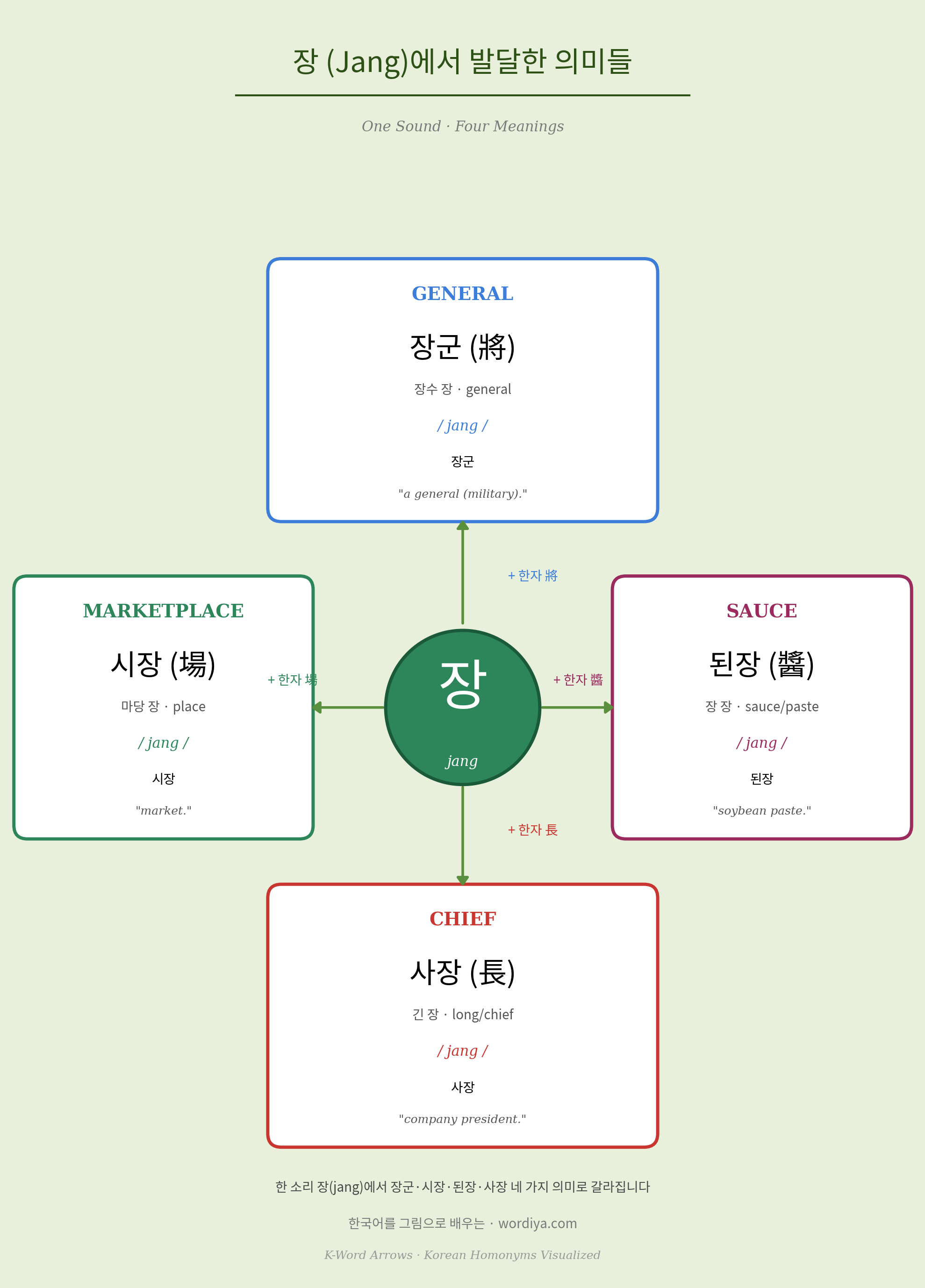
The Four Branches
① GENERAL — 장군 (將, jang-gun) · Hanja 將 (장수 장, 'general/commander')
The Sino-Korean morpheme 장 (jang, 將, general/commander) comes from the Hanja 將 (jang, 장수 장, 'general'). It depicts a hand grasping a staff — a commander's symbol of authority. Throughout Korean history, the Hanja 將 has named the great military leaders who defended the peninsula.
Common phrases:
- 장군 (jang-gun, 將軍, general)
- 명장 (myeong-jang, 名將, great/famous general)
- 대장 (dae-jang, 大將, four-star general / chief)
- 장수 (jang-su, 將帥, military commander)
- 이순신 장군 (Yi Sun-sin jang-gun, Admiral Yi Sun-sin)
- 장수왕 (jang-su-wang, King Jangsu of Goguryeo, 5-6c)
Korean historical depth: Korea's most revered historical figure is 이순신 장군 (Yi Sun-sin, 1545-1598) — the naval admiral who defeated the Japanese fleet at the Battle of Myeongnyang (1597) with only 13 ships against 333 Japanese warships, saving Korea from invasion. The Hanja 將 carries this entire heritage of Korean military protection.
Example: 이순신은 위대한 장군이었어요. ("Yi Sun-sin was a great general.")
② MARKETPLACE — 시장 (場, si-jang) · Hanja 場 (마당 장, 'place/field')
The Sino-Korean morpheme 장 (jang, 場, place/field) comes from the Hanja 場 (jang, 마당 장, 'open place/field'). The native Korean word for marketplace is 저자 (jeo-ja) but rarely used today — the Sino-Korean 시장 dominates.
Common phrases:
- 시장 (si-jang, 市場, market)
- 운동장 (un-dong-jang, 運動場, sports field)
- 공장 (gong-jang, 工場, factory)
- 농장 (nong-jang, 農場, farm)
- 주차장 (ju-cha-jang, 駐車場, parking lot)
- 광장 (gwang-jang, 廣場, plaza / square)
Korean cultural depth: Traditional Korean 시장 — open-air markets like Namdaemun, Dongdaemun, Gwangjang Market — has been the heart of Korean community life for centuries. Famous 광장 (plazas) like Gwanghwamun Plaza and Seoul Plaza host Korean political and cultural events.
Example: 시장에 가요. ("I'm going to the market.")
③ CHIEF/LONG — 사장 (長, sa-jang) · Hanja 長 (긴 장, 'long/chief')
The Sino-Korean morpheme 장 (jang, 長, long/chief) comes from the Hanja 長 (jang, 긴 장, 'long/chief'). It depicts a person with long hair, originally meaning 'elder' → 'long' → 'chief/leader.' This morpheme dominates Korean corporate and organizational hierarchy.
Common phrases:
- 사장 (sa-jang, 社長, company president / CEO)
- 회장 (hoe-jang, 會長, chairman)
- 부장 (bu-jang, 部長, department head)
- 과장 (gwa-jang, 課長, section chief)
- 팀장 (tim-jang, team leader)
- 교장 (gyo-jang, 校長, school principal)
- 장기 (jang-gi, 長期, long-term)
Korean corporate depth: Korean corporate hierarchy is built entirely on the -장 (-jang) suffix from Hanja 長. The chain is: 사원 → 대리 → 과장 → 차장 → 부장 → 이사 → 상무 → 전무 → 부사장 → 사장 → 회장. K-dramas obsessively use these titles — calling someone 부장님 (Department Head, sir) instead of their name is standard Korean office speech.
Example: 우리 회사 사장님이에요. ("This is our company president.")
④ SAUCE / FERMENTED PASTE — 된장·고추장·간장 (醬, jang) · Hanja 醬 (장 장, 'sauce/paste')
The Sino-Korean morpheme 장 (jang, 醬, sauce/paste) comes from the Hanja 醬 (jang, 장 장, 'fermented sauce'). Although technically Sino-Korean in origin, this 장 has been so thoroughly Koreanized over 2,000+ years that Koreans experience it as native Korean food vocabulary. It is the syllable behind every fermented paste that defines Korean cuisine. These words are now standard English dictionary entries as global K-food terms.
Common phrases:
- 된장 (doen-jang, fermented soybean paste — base of 된장찌개)
- 고추장 (go-chu-jang, red pepper paste — base of bibimbap, tteokbokki)
- 간장 (gan-jang, 醬油, soy sauce)
- 청국장 (cheong-guk-jang, fast-fermented soybean paste)
- 춘장 (chun-jang, black bean paste — base of jjajangmyeon)
- 장독대 (jang-dok-dae, traditional fermentation jar platform)
- 장 담그다 (jang dam-geu-da, to make/ferment Korean sauces)
Korean cultural depth — A 5,000-Year Fermentation Tradition: Korean 장 (醬) culture is UNESCO-recognized Intangible Cultural Heritage (registered 2024). The Korean tradition of making 장 at home in spring, fermenting it in 장독 (clay jars) on the 장독대 (jar platform), and using it throughout the year is over 2,000 years old. Doenjang and gochujang are the foundation of Korean flavor. Gochujang and doenjang are now standard entries in Merriam-Webster and Oxford English Dictionary, alongside kimchi, bibimbap, and chaebol. Every American Whole Foods now stocks gochujang.
Note: While 장 (醬) originates from Hanja, the fermentation traditions, recipes, and cultural meanings are entirely Korean — making this perhaps the most thoroughly Koreanized of all Sino-Korean morphemes. When global K-food fans say "gochujang" or "doenjang" — they are speaking pure Korean cultural identity.
Example: 된장찌개를 좋아해요. ("I like soybean paste stew.")
🧠 Memory Anchor — Korean Civilization in One Day
Picture a Korean village in autumn. A descendant of the great 장군 (jang-gun, 將, general — like Admiral Yi Sun-sin) walks to the village 시장 (si-jang, 場, marketplace). He is now a 사장 (sa-jang, 長, company president) returning to his hometown. He buys fresh ingredients to add to his grandmother's homemade 된장 (doen-jang, 醬, fermented soybean paste). Four meanings of 장, one Korean day, one syllable carrying the whole sweep of Korean civilization — military, public, corporate, culinary.
✅ Quick Check — Which 장 (jang) is this?
- 이순신 장군이 있었어요. ("Admiral Yi Sun-sin existed.")
- 시장에 가요. ("I'm going to the market.")
- 사장님이에요. ("He is the president.")
- 된장찌개 좋아해요. ("I like doenjang stew.")
Answers:
- GENERAL — 장군 (將軍) — Hanja 將 (장수 장)
- MARKETPLACE — 시장 (市場) — Hanja 場 (마당 장)
- CHIEF — 사장 (社長) — Hanja 長 (긴 장)
- SAUCE — 된장 (醬) — Hanja 醬 (장 장)
🔊 Pronunciation Tip — How to Tell Them Apart
All four meanings share the same /jang/ sound. The differentiator is always context.
- 장 + 군 / 수 / 대 OR 명·이순신 → GENERAL (Hanja 將)
- 시 / 운동 / 공 / 농 / 주차 / 광 + 장 → MARKETPLACE/PLACE (Hanja 場)
- 사 / 회 / 부 / 과 / 교 / 팀 + 장 → CHIEF (Hanja 長)
- 된 / 고추 / 간 / 청국 / 춘 + 장 → SAUCE/PASTE (Hanja 醬)
💡 Bonus ① — Admiral Yi Sun-sin: Korea's Most Beloved 장군
이순신 장군 (Yi Sun-sin, 1545-1598) is Korea's most revered historical figure. As naval admiral during the Imjin War (1592-1598), he defended Korea against Japanese invasions. His most famous victory was the Battle of Myeongnyang (1597) — with only 13 turtle ships (거북선) and panokseon warships, he defeated 333 Japanese warships in the narrow Myeongnyang Strait. He died from a gunshot wound in his final battle — Battle of Noryang (1598) — saying "My death must not be known" (나의 죽음을 적에게 알리지 말라) so his troops would keep fighting. His statue stands in Gwanghwamun Plaza in Seoul, and his face is on the 100-won coin. The Hanja 將 carries this entire Korean heritage of valor.
💡 Bonus ② — The K-Corporate Hierarchy: A Field Guide
Korean office culture is built on the -장 (-jang) suffix. The full ladder:
사원 (staff) → 대리 (assistant manager) → 과장 (section chief, first -장) → 차장 (deputy department head) → 부장 (department head) → 이사 (director) → 상무 (executive director) → 전무 (senior executive) → 부사장 (vice president) → 사장 (president) → 회장 (chairman)
In a Korean office, you never call colleagues by name — you call them by title + 님 (-nim, honorific): 부장님 (Department Head, sir), 사장님 (President, sir). K-dramas obsessively use these titles, which is why the K-drama universe revolves around 부장님, 사장님, 회장님.
💡 Bonus ③ — 장 Culture: Korea's UNESCO-Recognized Fermentation Heritage
The Korean tradition of making and consuming 장 (醬) — fermented sauces — is a UNESCO Intangible Cultural Heritage (registered 2024). The tradition involves:
- Boiling soybeans in autumn
- Making 메주 (me-ju, soybean blocks) and fermenting them
- Breaking the meju into a 장독 (jang-dok, clay jar) with salt water in spring
- Letting the mixture ferment for 40+ days under the sun
- Separating the liquid (간장, soy sauce) from the solid (된장, soybean paste)
- Maturing each for additional months
Gochujang adds gochugaru (red pepper powder) and glutinous rice. Korean 장 (醬) culture is now globally recognized — gochujang and doenjang are standard English dictionary entries, sold in every American supermarket. Korean cuisine without 장 simply cannot exist — every Korean stew, every bibimbap, every banchan touches some form of 장. Although the Hanja 醬 came from China 2,000+ years ago, the Korean fermentation tradition is entirely Korean, making this morpheme one of the most thoroughly Koreanized in the entire language.
🎯 Wrap-Up
One sound — 장 (jang) — carries the authority of Korean military history (將 in 장군 general, 명장 great general), the gathering of Korean public life (場 in 시장 market, 운동장 stadium), the hierarchy of Korean society (長 in 사장 CEO, 부장 manager), and — most famously — the soul of Korean cuisine itself (醬 in 된장, 고추장, 간장). To master these four 장s is to enter Korean civilization itself — from the battlefield to the marketplace to the boardroom to the fermentation pot that has defined Korean tables for 5,000 years.
K-Word Arrows: Korean Homonyms Visualized — ⓒ wordiya.com


