가 (Ga) — Go, Family, Price, Middle — Four Worlds in One Syllable
If 한 (han) captures Korean identity, 가 (ga) captures Korean daily life. It is the verb you say when leaving the house (간다, "I'm going"), the syllable in the word for family (가족, ga-jok), the unit of price (가격, ga-gyeok), and the position in the middle (가운데, ga-un-de). One short syllable carries action, kinship, value, and location — the four corners of how Koreans organize their lived experience.
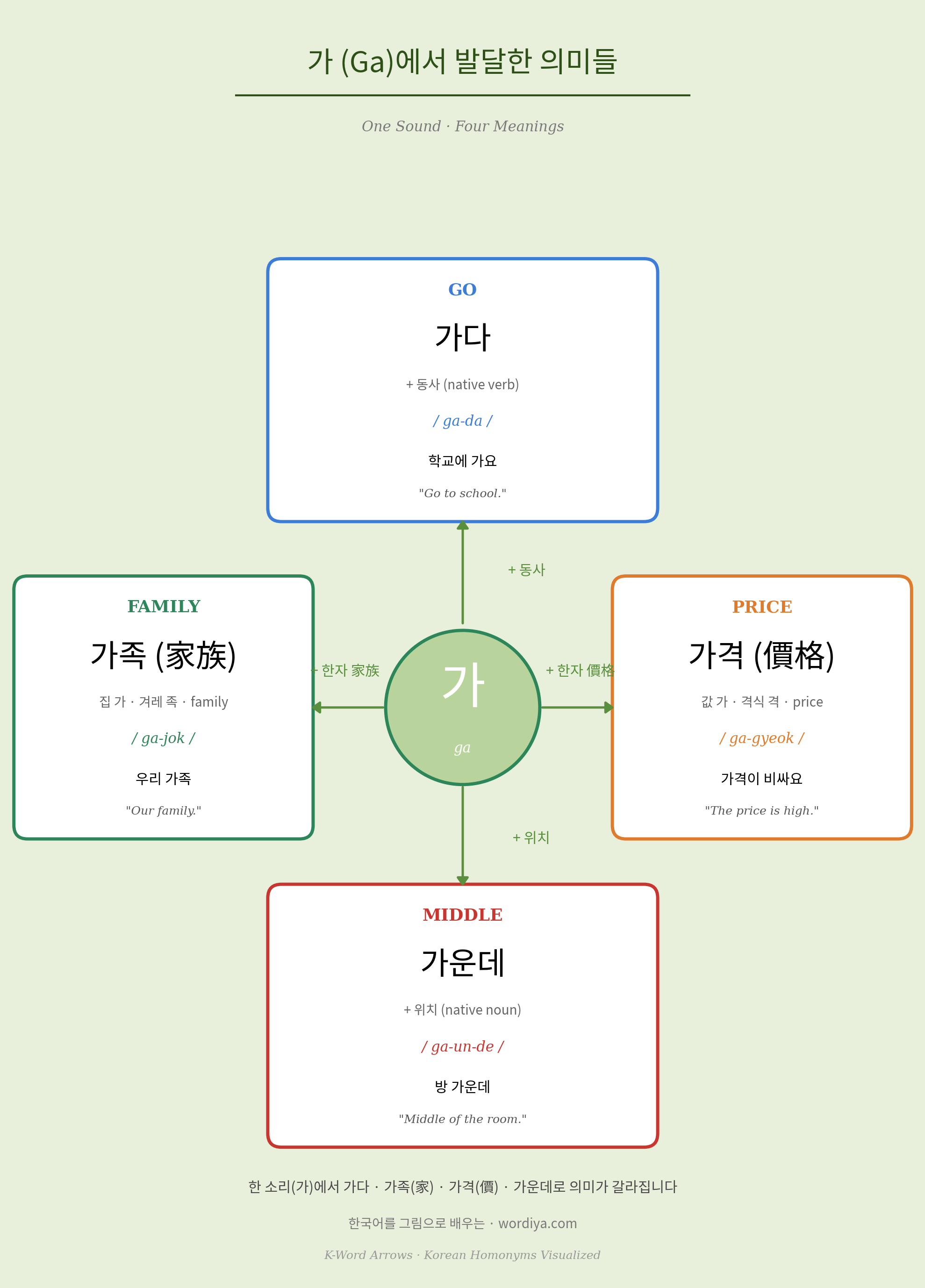
① GO — 가다 (ga-da) · Native Korean Verb
The verb 가다 (ga-da, to go) is one of the most fundamental verbs in the Korean language — purely native Korean, with no Hanja behind it. It expresses motion away from the speaker, equivalent to English "go." Along with 오다 (o-da, to come), it forms the foundational verb pair of all Korean motion.
Common phrases:
- 학교에 가다 (hak-gyo-e ga-da, to go to school)
- 집에 가다 (jib-e ga-da, to go home)
- 여행을 가다 (yeo-haeng-eul ga-da, to go on a trip)
- 가고 싶다 (ga-go sip-da, want to go)
- 간다 (gan-da, I'm going — declarative form)
- 갔어요 (ga-sseo-yo, went — past tense polite)
Korean grammar note: 가다 (ga-da) and 오다 (o-da) form the foundational motion pair in Korean. Direction in Korean is always specified relative to the speaker: 가다 (going away from me) vs 오다 (coming toward me). This pair is the first major verb pair every learner must master before moving forward.
Example: 저는 학교에 가요. (Jeo-neun hak-gyo-e ga-yo. — "I go to school.")
② FAMILY — 가족 (家族, ga-jok) · Hanja 家 (집 가, 'house')
The Sino-Korean word 가족 (ga-jok, family) combines two Hanja: 家 (ga, 집 가, 'house') + 族 (jok, 겨레 족, 'clan'). The Hanja 家 literally depicts a roof (宀) above a pig (豕) — in ancient agricultural China, a house was where livestock was kept. Over thousands of years, this character became the fundamental Korean Hanja for "household" and "family lineage."
Common phrases:
- 가족 (ga-jok, 家族, family)
- 가정 (ga-jeong, 家庭, household)
- 국가 (guk-ga, 國家, nation — literally "country house")
- 가문 (ga-mun, 家門, family clan / lineage)
- 가구 (ga-gu, 家具, furniture)
- 전문가 (jeon-mun-ga, 專門家, expert / specialist)
Korean cultural depth: The Hanja 家 in 가족 (family) carries 2,000 years of Confucian family philosophy. In Korean culture, family is not just a private unit but the foundation of social identity — every Korean carries their 가문(family clan) name in their surname, traces their lineage in 족보(family genealogy books), and shows deep respect for ancestors. The same 家 appears in 국가 (nation) — meaning the nation itself is conceived as one extended family.
Example: 우리 가족은 네 명이에요. (U-ri ga-jok-eun ne myeong-i-e-yo. — "My family has four members.")
③ PRICE — 가격 (價格, ga-gyeok) · Hanja 價 (값 가, 'price')
The Sino-Korean word 가격 (ga-gyeok, price) comes from the Hanja 價 (ga, 값 가, 'price/value') + 格 (gyeok, 격식 격, 'standard'). The Hanja 價 is composed of 人 (person) + 賈 (merchant), literally depicting a person making a commercial exchange. This Hanja anchors the entire vocabulary of value, cost, and worth in the Korean economy.
Common phrases:
- 가격 (ga-gyeok, 價格, price)
- 물가 (mul-ga, 物價, prices of goods / cost of living)
- 정가 (jeong-ga, 定價, list price)
- 반값 (ban-gap, half-price — uses native Korean 값 with Hanja 가)
- 고가 (go-ga, 高價, high price / luxury)
- 저가 (jeo-ga, 低價, low price / cheap)
- 평가 (pyeong-ga, 評價, evaluation / assessment)
Korean economic vocabulary: 가격 (price) and 물가 (cost of living) appear in every Korean news broadcast. Korean has both a Sino-Korean 가 (價) and a native Korean 값 (gap) for "price" — they're often interchangeable but Sino-Korean 가 is more formal, native 값 more casual. 반값 (ban-gap, half-price) combines both: 반 (half, Sino-Korean) + 값 (price, native).
Example: 이 가격이 정말 싸요. (I ga-gyeok-i jeong-mal ssa-yo. — "This price is really cheap.")
④ MIDDLE — 가운데 (ga-un-de) · Native Korean Noun
The noun 가운데 (ga-un-de, middle/center) is purely native Korean — no Hanja behind it. It refers to the physical center, the middle position, or the intermediate point. Korean has two words for "center": native Korean 가운데 (more colloquial) and Sino-Korean 중앙 (中央, jung-ang, more formal). For everyday spatial reference, 가운데 is the natural choice.
Common phrases:
- 가운데 (ga-un-de, the middle / center)
- 한가운데 (han-ga-un-de, the very middle / dead center)
- 가운데 자리 (ga-un-de ja-ri, the middle seat)
- 방 가운데 (bang ga-un-de, the middle of the room)
- 셋 가운데 하나 (set ga-un-de ha-na, one out of three)
- 가운데 손가락 (ga-un-de son-ga-rak, the middle finger)
Korean spatial logic: The intensifier 한- (han-) in 한가운데 doesn't refer to the number "one" or the country — it's a separate native Korean prefix meaning "exactly, precisely." So 한가운데 = "exactly the middle / dead center." Same prefix appears in 한낮 (han-nat, exactly noon), 한밤중 (han-bam-jung, the dead of night), 한겨울 (han-gyeo-ul, the dead of winter).
Example: 방 가운데에 책상이 있어요. (Bang ga-un-de-e chaek-sang-i i-sseo-yo. — "There's a desk in the middle of the room.")
🧠 Memory Anchor — A Korean Morning in One Sentence
Imagine a Korean father in Seoul. At 7 AM, he says goodbye to his 가족 (ga-jok, 家族, family) and 간다 (gan-da, goes) to the supermarket. He checks the 가격 (ga-gyeok, 價格, price) of milk. The cart is parked in the 가운데 (ga-un-de, middle) of the aisle. Four meanings of 가, one syllable, one ordinary Korean morning.
✅ Quick Check — Which 가 (ga) is this?
- 학교에 가요. (Hak-gyo-e ga-yo. — "I'm going to school.")
- 우리 가족은 행복해요. (U-ri ga-jok-eun haeng-bok-hae-yo. — "My family is happy.")
- 이거 가격이 얼마예요? (I-geo ga-gyeok-i eol-ma-ye-yo? — "What's the price of this?")
- 방 가운데에 앉아요. (Bang ga-un-de-e an-ja-yo. — "Sit in the middle of the room.")
Answers:
- GO — 가다 (ga-da) — native Korean verb
- FAMILY — 가족 (家族, ga-jok) — Hanja 家 (집 가)
- PRICE — 가격 (價格, ga-gyeok) — Hanja 價 (값 가)
- MIDDLE — 가운데 (ga-un-de) — native Korean noun
🔊 Pronunciation Tip — How to Tell Them Apart
All four meanings share the same /ga/ sound. The differentiator is always context — what comes after 가 (ga).
- 가 (ga) + 다 / 요 / ㄴ다 / 았어요 → GO (native verb 가다)
- 가 (ga) + 족 / 정 / 문 / 구 → FAMILY (Hanja 家, 집 가)
- 가 (ga) + 격 / 정가 / 물가 / 평가 → PRICE (Hanja 價, 값 가)
- 가 (ga) + 운데 / 한가운데 → MIDDLE (native noun 가운데)
💡 Bonus ① — 家: The Hanja That Built Korean Family Culture
The Hanja 家 (ga, 집 가, 'house/family') is one of the most foundational characters in East Asian civilization. Its oracle bone script form (1,200 BCE) depicts a roof above a pig — in ancient agricultural society, the family pig was kept under the same roof as the family. Over millennia, 家 came to symbolize not just "house" but "family," "household," "clan," "lineage." Korean Confucian culture took this character and built around it an entire social philosophy: 국가 (nation = country-house), 가문 (family clan), 가정 (household), 가족 (family members) — all share the same 家. To understand 家 is to understand the foundation of Korean social organization.
💡 Bonus ② — 가다 vs 오다: The Korean Direction Pair
Every motion in Korean is described relative to the speaker. 가다 (ga-da, to go) moves away from the speaker. 오다 (o-da, to come) moves toward the speaker. This is the same as English "go/come" — but Korean is much more strict about this distinction in practice. When a Korean says "올게요" (ol-ge-yo, I'll come), they mean coming toward the listener; "갈게요" (gal-ge-yo, I'll go) means going away from the listener. Beginners often confuse these two, but this pair is the first major grammar milestone in Korean learning.
💡 Bonus ③ — Why Korean Has Two Words for "Price": 가 (價) and 값 (gap)
Korean often has two parallel vocabularies — one Sino-Korean (Hanja-based) and one native Korean. For "price," Korean uses both: 가 (價, ga) from Hanja and 값 (gap) from native Korean. They are mostly interchangeable but carry different registers. Sino-Korean 가 appears in formal/technical compounds: 가격 (price), 정가 (list price), 평가 (evaluation). Native Korean 값 appears in everyday speech: 값이 비싸요 (the price is high), 반값 (half-price). The same dual vocabulary pattern appears throughout Korean — 집 (house, native) vs 가 (家, family/house, Sino-Korean), 나라 (country, native) vs 국 (國, country, Sino-Korean). Learning Korean means learning these dual vocabularies side by side.
🎯 Wrap-Up
One sound — 가 (ga) — carries the verb of all departure (가다 to go), the Hanja foundation of Korean family culture (家 family), the syllable of Korean economy (價 price), and the spatial center of the everyday Korean room (가운데 middle). To master these four 가s is to enter the daily rhythm of Korean life itself — how Koreans move, how they belong, how they value, and how they orient themselves in space.
K-Word Arrows: Korean Homonyms Visualized — ⓒ wordiya.com


