손 (Son) — Hand, Guest, Descendant (孫), Loss (損) — Two Native + Two Hanja Meanings in Perfect Balance
If 눈 (nun) showed Korean at its purest — all four meanings native, no Hanja involvement — then 손 (son) shows the perfect balance: two native Korean meanings, two Hanja-based meanings, all sharing the same single syllable. It is the syllable behind the word for hand (손, native Korean), behind the word for guest (손, native Korean), behind descendant (손, from Hanja 孫), and behind loss (손, from Hanja 損). One Korean sound, four meanings — two from the deep native layer, two from the Hanja-based layer that has been woven into Korean for 1,500 years.
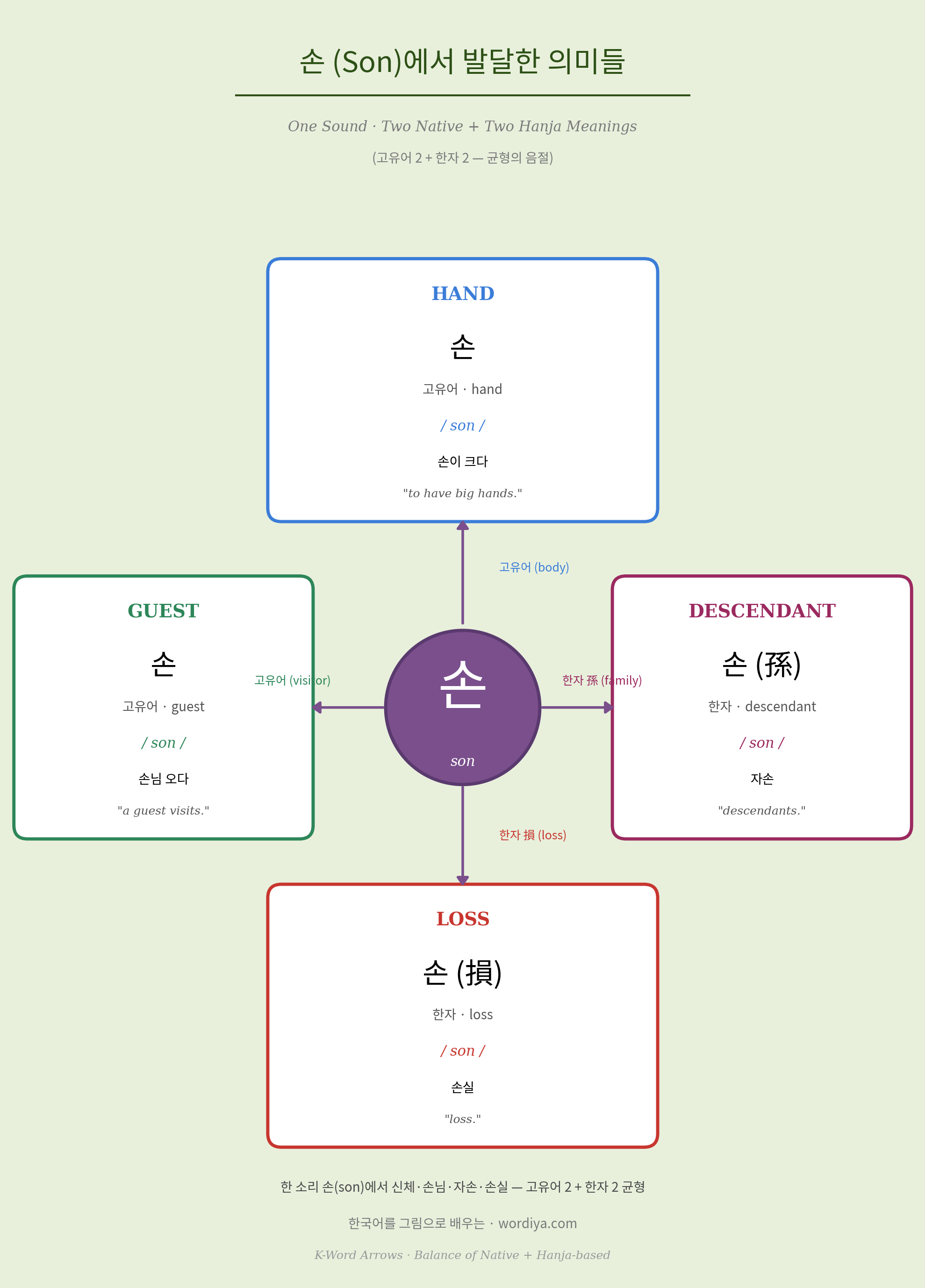
① HAND — 손 (son) · pure native Korean
The Korean word 손 (son, hand) is pure native Korean — no Hanja for this meaning, traceable to Old Korean of the Three Kingdoms period (4th-7th centuries).
Common phrases:
- 손 (son, hand)
- 손이 크다 (son-i keu-da, to have big hands / to be generous)
- 손바닥 (son-ba-dak, palm)
- 손가락 (son-ga-rak, finger)
- 손목 (son-mok, wrist)
- 손길 (son-gil, touch / helping hand)
- 손쉽다 (son-swip-da, easy)
Korean cultural depth: 손이 크다 ("to have big hands") in Korean means "to be generous" — especially in cooking, gift-giving, or hospitality. "우리 어머니는 손이 크세요" doesn't refer to physical hand size — it means "My mother prepares lots of food / gives generously."
Example: 손이 크네요. ("You're so generous!" literally "You have big hands.")
② GUEST — 손 (son) · pure native Korean
The Korean word 손 (son, guest) is also pure native Korean. The fuller form 손님 (son-nim, "guest-honored-person") adds the honorific -님.
Common phrases:
- 손 (son, guest)
- 손님 (son-nim, guest / customer)
- 단골손님 (dan-gol-son-nim, regular customer)
- 귀한 손님 (gwi-han son-nim, honored guest)
- 손님맞이 (son-nim-ma-ji, welcoming guests)
Korean cultural depth: 손님 is one of the warmest words in Korean. "손님은 왕이다" (the guest is king) was a traditional saying. Korean restaurants still practice this 손님 honor culture — calling customers 손님 rather than just "customer" carries a respect Korean has preserved for centuries.
Example: 손님이 오셨어요. ("A guest has arrived.")
③ DESCENDANT — 손 (孫) · Hanja-based
The Korean word 손 (son, descendant) comes from the Hanja 孫 (descendant). Fully Koreanized for 1,500 years.
Common phrases:
- 손 (son, 孫 — descendant)
- 자손 (ja-son, descendants — 子孫)
- 후손 (hu-son, posterity — 後孫)
- 장손 (jang-son, eldest grandson — 長孫)
- 손자 (son-ja, grandson — 孫子)
- 손녀 (son-nyeo, granddaughter — 孫女)
- 대대손손 (dae-dae-son-son, generation after generation — 代代孫孫)
Korean cultural depth: 자손과 후손 carry the weight of Korean family lineage culture. Traditional Korean Confucianism placed enormous importance on continuing the family line through 자손 — eldest sons (장손) inherited family responsibility for ancestral rites.
Example: 우리 자손이에요. ("We are descendants.")
④ LOSS — 손 (損) · Hanja-based
The Korean word 손 (son, loss) comes from the Hanja 損 (lose, damage). The backbone of Korean business and financial vocabulary.
Common phrases:
- 손 (son, 損 — loss)
- 손실 (son-sil, loss — 損失)
- 손해 (son-hae, damage / loss — 損害)
- 파손 (pa-son, breakage — 破損)
- 손익 (son-ik, profit and loss — 損益)
- 손익계산서 (son-ik-gye-san-seo, income statement — 損益計算書)
Korean cultural depth: 손익 is K-business English at its most precise. Korean accountants and CEOs use 손익계산서 (income statement) daily — directly using the Hanja 損(loss) + 益(profit) to describe the foundation of all business decisions. Modern Korean K-bio·K-semiconductor industry reports use this term in every quarterly briefing.
Example: 큰 손해를 봤어요. ("We suffered a big loss.")
🧠 Memory Anchor — A Korean Grandmother's Afternoon
Picture a Korean grandmother's home. She greets a 손 (son, guest) at the door with both 손 (son, hands) outstretched in welcome. She invites them in, serving them food prepared by her own 손 — for her 손 (손이 크다 — generous hands) are legendary in the neighborhood. As they eat, she shows the guest photos of her 손 (son 孫, descendants) — three grandchildren, two great-grandchildren. Then, with a quieter voice, she mentions the 손 (son 損, loss) — her husband, gone now five years, the deepest 손해 of her life. Four meanings of 손 — hand, guest, descendant, loss — all weaving through one Korean grandmother's afternoon.
✅ Quick Check — Which 손 (son) is this?
- 손이 크네요. ("You're so generous!")
- 손님이 오셨어요. ("A guest has arrived.")
- 자손이 많아요. ("There are many descendants.")
- 큰 손해를 봤어요. ("We suffered a big loss.")
Answers:
- HAND — 손 (pure native Korean)
- GUEST — 손 (pure native Korean)
- DESCENDANT — 손 (Hanja 孫)
- LOSS — 손 (Hanja 損)
Two native + two Hanja — perfect balance.
🔊 Pronunciation Tip — Context Is Everything
All four meanings share the same /son/ sound. Korean has woven native and Hanja layers seamlessly — neither speaker nor listener typically thinks about which is which.
- 몸 / 신체 → HAND (native)
- 방문 / 환대 / 고객 → GUEST (native)
- 자손 / 후손 / 가문 → DESCENDANT (Hanja 孫)
- 손해 / 손실 / 비용 → LOSS (Hanja 損)
💡 Bonus ① — 손 (Hand) as the Korean Metaphor for Generosity
Korean uses 손 (hand) as a remarkable metaphor for personality and generosity:
- 손이 크다 — generous (big hands)
- 손이 작다 — stingy (small hands)
- 손이 빠르다 — quick, efficient
- 손이 느리다 — slow at handling things
- 손이 야무지다 — competent, reliable
- 손이 더럽다 — corrupt, dishonest
In Korean culture, hands aren't just body parts — they reveal a person's character. This metaphor system is uniquely Korean.
💡 Bonus ② — 손님 (Son-nim): Korean Hospitality Culture
Korean small businesses still call customers 손님 rather than the more transactional "고객" (gae-gaek). The word 손님 carries warmth that 고객 lacks — a soft preservation of pre-modern Korean hospitality even in modern commerce.
💡 Bonus ③ — The Balance of Korean Vocabulary
The 손 chapter shows Korean's two great vocabulary layers in perfect balance — two native + two Hanja meanings of the same sound. This reflects the architecture of Korean vocabulary itself:
- 고유어 (pure native Korean) — about 25%
- 한자어 (Hanja-based Korean) — about 60%
- 외래어 (loanwords) — about 5-15%
손 captures this layered architecture in one syllable — the deep native roots (hand, guest) and the 1,500-year-old Hanja integration (descendant, loss) coexisting in a single Korean sound. Modern Korean speakers don't separate these layers — they flow as one language. This is what makes Korean a unique linguistic creation: not one vocabulary stream but a continuous river of two ancient sources.
🎯 Wrap-Up
One sound — 손 (son) — carries the working of Korean hands (손 hand, pure native), the welcoming of Korean guests (손 guest, pure native), the lineage of Korean families (손 孫 descendant, Hanja-based), and the careful counting of Korean accounts (손 損 loss, Hanja-based). Two native + two Hanja = the balance that defines Korean vocabulary itself, where ancient indigenous words and 1,500-year-old Hanja morphemes coexist seamlessly in everyday speech. To master these four 손s is to understand Korean's most distinctive feature — a language built on the meeting of two great lexical worlds.
K-Word Arrows: Korean Homonyms Visualized — ⓒ wordiya.com


