수 (Su) — Water, Hand, Number, Way — Four Pillars of Korean Daily Reality
If 화 (hwa) captures Korean culture and emotion, 수 (su) captures Korean daily reality. It is the syllable behind the word for swimming (수영, su-yeong, 水), behind surgery (수술, su-sul, 手), behind mathematics (수학, su-hak, 數), and — most importantly for Korean grammar — behind the most fundamental Korean expression of possibility itself (할 수 있다, hal su itda, "can do"). One short syllable holds water, hands, numbers, and the very grammar of Korean capability.
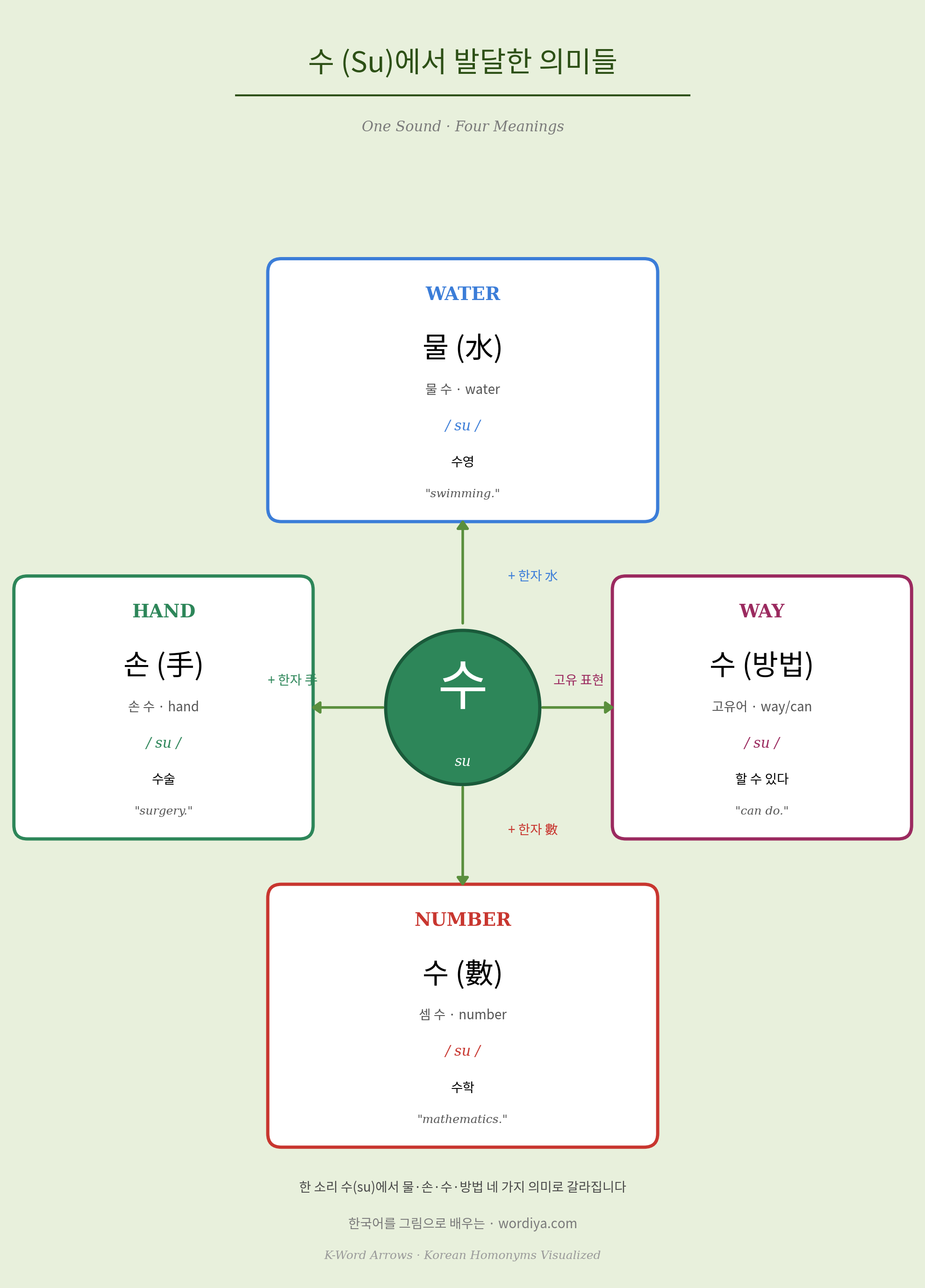
The Four Branches
① WATER — 물 (水, mul/su) · Hanja 水 (물 수, 'water')
The Sino-Korean morpheme 수 (su, 水, water) comes from the Hanja 水 (su, 물 수, 'water'). Its oracle bone script form depicts flowing streams — one of the oldest pictographs in East Asian writing. The native Korean word for water is 물 (mul), but in compound words, the Sino-Korean 수 (水) dominates Korean water-related vocabulary.
Common phrases:
- 물 (mul, water — native Korean)
- 수영 (su-yeong, 水泳, swimming)
- 수도 (su-do, 水道, water supply)
- 수돗물 (su-don-mul, tap water — native + Sino-Korean hybrid)
- 정수기 (jeong-su-gi, 淨水器, water purifier)
- 수영장 (su-yeong-jang, 水泳場, swimming pool)
- 홍수 (hong-su, 洪水, flood)
- 온수 (on-su, 溫水, hot water)
Korean cultural depth: In East Asian cosmology, water (水) is one of the 5 elements (五行, o-haeng). The Korean weekday 수요일 (Wednesday) is "water day" in the East Asian week. Korean culture has a deep relationship with water — from traditional 찜질방 (jjimjilbang, Korean bathhouses) to seafood-rich cuisine to mountain spring water.
Example: 수영을 좋아해요. (Su-yeong-eul jo-a-hae-yo. — "I like swimming.")
② HAND — 손 (手, son/su) · Hanja 手 (손 수, 'hand')
The Sino-Korean morpheme 수 (su, 手, hand) comes from the Hanja 手 (su, 손 수, 'hand'). Its oracle bone script form depicts five fingers extended. The native Korean word for hand is 손 (son), but in compound words, the Sino-Korean 수 (手) powers Korean vocabulary about hands, skills, and manual activities.
Common phrases:
- 손 (son, hand — native Korean)
- 수술 (su-sul, 手術, surgery — "hand technique")
- 수동 (su-dong, 手動, manual — "hand-moved")
- 박수 (bak-su, 拍手, applause — "striking hands")
- 가수 (ga-su, 歌手, singer — "song-hand")
- 선수 (seon-su, 選手, athlete — "selected hand")
- 악수 (ak-su, 握手, handshake — "gripping hands")
- 목수 (mok-su, 木手, carpenter — "wood-hand")
Korean cultural depth: The Hanja 手 (hand) is incredibly productive — it forms the suffix -수 (-su) that means "a person skilled with their hands in [field]." A singer is literally a "song-hand" (가수), an athlete is a "selected hand" (선수), a carpenter is a "wood-hand" (목수). This Confucian respect for skilled craftsmanship runs through Korean professional vocabulary.
Example: 어제 수술을 받았어요. (Eo-je su-sul-eul ba-da-sseo-yo. — "I had surgery yesterday.")
③ NUMBER — 수 (數, su) · Hanja 數 (셈 수, 'number')
The Sino-Korean morpheme 수 (su, 數, number) comes from the Hanja 數 (su, 셈 수, 'number/count'). Unlike the previous two, this morpheme is also used as a standalone Korean noun — 수 (su) itself means "a number" in formal Korean.
Common phrases:
- 수 (su, number — used directly as a noun)
- 수학 (su-hak, 數學, mathematics)
- 인수 (in-su, 人數, number of people / headcount)
- 다수 (da-su, 多數, majority)
- 소수 (so-su, 少數, minority / 小數 decimal)
- 점수 (jeom-su, 點數, score)
- 분수 (bun-su, 分數, fraction)
- 횟수 (hoet-su, frequency / number of times)
Korean cultural depth: The Hanja 數 is the foundation of all Korean mathematical and statistical vocabulary. 수학 (mathematics) is literally "number-learning," 점수 (score) is "point-number," 분수 (fraction) is "division-number." Korean education places enormous emphasis on 수학 — Korean students consistently rank at the top of international math assessments (PISA, TIMSS).
Example: 점수가 높아요. (Jeom-su-ga no-pa-yo. — "The score is high.")
④ WAY/ABILITY — 수 (방법, native Korean dependent noun)
Unlike the other three 수s, this 수 is a purely native Korean grammatical particle with no Hanja. It is called a dependent noun (의존명사) — a noun that cannot stand alone but must follow a verb in modifying form. It expresses possibility, ability, way, method — and it is one of the most fundamental grammatical patterns in the entire Korean language. Every Korean speaker uses this 수 dozens of times daily.
Common phrases:
- 할 수 있다 (hal su itda, "can do" — literally "have the way to do")
- 할 수 없다 (hal su eopda, "cannot do" — "no way to do")
- 어쩔 수 없다 (eo-jjeol su eopda, "cannot help it" — "no way to handle it")
- 그럴 수가 (geu-reol su-ga, "no way!" — expression of disbelief)
- 갈 수 있어요 (gal su isseo-yo, "I can go")
- 먹을 수 없어요 (meo-geul su eopseo-yo, "I cannot eat it")
- 별 수 없다 (byeol su eopda, "there's no other way")
Korean grammar foundation: This 수 is one of the three pillars of Korean ability expression. It is by far the most common and natural way to express possibility/ability in Korean. Learning this 수 is learning the very grammar of Korean possibility itself. Korean speakers say "I can do this" literally as "I have the 수 (way) to do this." The native Korean conception of ability is spatial — abilities are "ways/paths" that exist or don't exist.
Example: 한국어를 할 수 있어요. (Han-gu-geo-reul hal su isseo-yo. — "I can speak Korean.")
🧠 Memory Anchor — A Korean Day in One Sentence
Picture a Korean morning. A young Korean woman wakes up and goes to the 수영장 (su-yeong-jang, 水泳場, swimming pool) for her morning 수영 (su-yeong, 水泳, swimming). Later that day, her grandfather has minor 수술 (su-sul, 手術, surgery) — successful. In the evening, her son does his 수학 (su-hak, 數學, math) homework. When she's asked if she can attend a meeting, she replies: "네, 갈 수 있어요" ("Yes, I can go"). Four meanings of 수, one Korean day, one ordinary syllable carrying water, hand, number, and the grammar of possibility itself.
✅ Quick Check — Which 수 (su) is this?
- 수영을 배워요. (Su-yeong-eul bae-wo-yo. — "I'm learning swimming.")
- 박수를 쳤어요. (Bak-su-reul chyeo-sseo-yo. — "I clapped.")
- 점수가 좋아요. (Jeom-su-ga jo-a-yo. — "The score is good.")
- 할 수 있어요. (Hal su isseo-yo. — "I can do it.")
Answers:
- WATER — 수영 (水泳) — Hanja 水 (물 수)
- HAND — 박수 (拍手) — Hanja 手 (손 수)
- NUMBER — 점수 (點數) — Hanja 數 (셈 수)
- WAY — 수 (방법) — native Korean dependent noun
🔊 Pronunciation Tip — How to Tell Them Apart
All four meanings share the same /su/ sound. The differentiator is always context.
- 수 (su) + 영 / 도 / 돗물 / 영장 → WATER (Hanja 水, 물 수)
- 박 / 가 / 선 / 악 / 목 + 수 (su) → HAND (Hanja 手, 손 수)
- 수 (su) + 학 / 점수 / 분수 / 횟수 → NUMBER (Hanja 數, 셈 수)
- 할 / 갈 / 먹을 / 어쩔 + 수 (su) + 있다/없다 → WAY (native dependent noun)
💡 Bonus ① — The Korean Jjimjilbang and Water Culture
Korea has a deep relationship with water culture. The 찜질방 (jjimjilbang) — Korean public bathhouse and sauna complex — is a uniquely Korean institution where families spend entire days soaking in hot baths, sleeping in heated rooms, and eating boiled eggs and sikhye (rice drink). The Hanja 水 (water) appears in everything Korean: 수도 (water supply), 정수기 (water purifier — in nearly every Korean home), 수돗물 (tap water), 약수 (mineral spring water). Korean public services emphasize "pure water" as a national pride.
💡 Bonus ② — The Korean -수 (-su) Suffix: Names for Skilled Professionals
The Hanja 手 (hand) forms one of the most productive suffixes in Korean: -수 (-su) = "a skilled person." Examples: 가수 (歌手 "song-hand" = singer), 목수 (木手 "wood-hand" = carpenter), 선수 (選手 "selected hand" = athlete), 운전수 (運轉手 "driving-hand" = driver). The K-pop industry is built on 가수 (singers), and the Olympic medal counts of Korea are built on 선수 (athletes). This Confucian respect for hand-skill runs through Korean professional naming — every craft has its "hand."
💡 Bonus ③ — The Korean 'Su' of Possibility: A Grammar Window Into Korean Thought
The native Korean dependent noun 수 (su, way/ability) offers a window into how Koreans conceptualize possibility itself. In English, we say "I can do this" — can is a modal verb that modifies the action directly. In Korean, we say "할 수 있다" — literally "have the way to do." Possibility is spatial in Korean — it's a way (수) that exists. Similarly, "cannot" = "수가 없다" — "there is no way." This spatial conception of ability connects Korean grammar to deeper East Asian philosophical traditions where 道 (do, way) means both "road" and "principle." When a Korean says they can do something, they are not asserting a power — they are reporting that a path exists. Learning this 수 changes how you think about ability in Korean.
🎯 Wrap-Up
One sound — 수 (su) — carries the flow of Korean water vocabulary (水 in 수영 swimming, 수도 water supply), the dexterity of Korean hand vocabulary (手 in 수술 surgery, 박수 applause), the calculation of Korean number vocabulary (數 in 수학 mathematics, 점수 score), and — most fundamentally — the grammatical particle of all Korean possibility (수 in 할 수 있다 "can do", 어쩔 수 없다 "cannot help it"). To master these four 수s is to enter the daily reality of Korean life — from morning swims to surgery to math class to the very expression of "I can do this."
K-Word Arrows: Korean Homonyms Visualized — ⓒ wordiya.com


