화 (Hwa) — Flower, Fire, Picture, Anger — Four Pillars of Korean Cultural & Emotional Expression
If 가 (ga) captures Korean daily life, 화 (hwa) captures Korean culture and emotion. It is the syllable behind the word for flower (꽃, 花), the word for fire (불, 火), the word for picture (영화·만화, 畵), and — most importantly for Korean emotional life — the word for anger itself (화내다, hwa-nae-da, to get angry). One short syllable holds beauty, danger, art, and raw human emotion — the four pillars of Korean cultural and emotional expression.
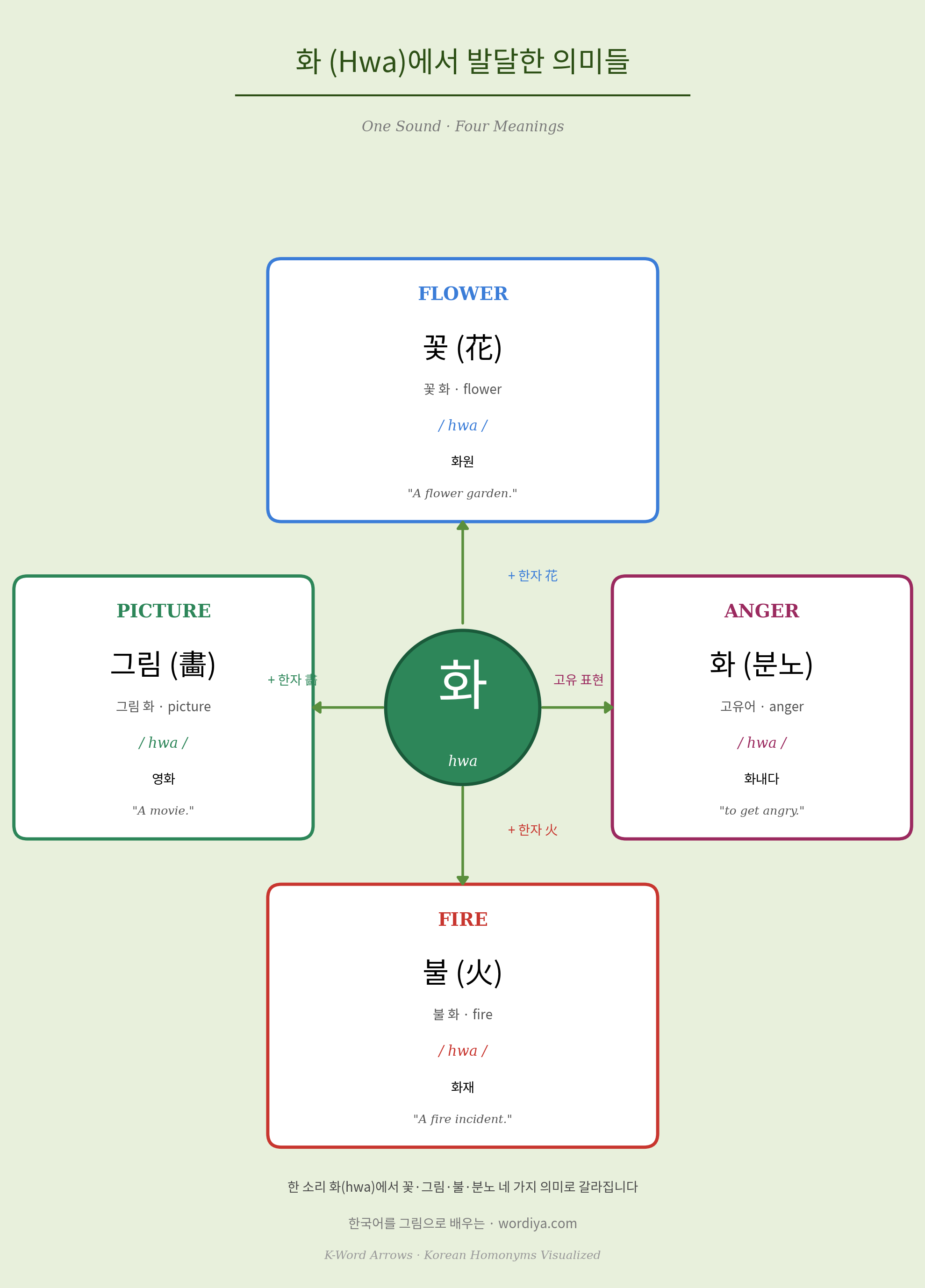
The Four Branches
① FLOWER — 꽃 (花, kkot/hwa) · Hanja 花 (꽃 화, 'flower')
The Sino-Korean morpheme 화 (hwa, 花, flower) comes from the Hanja 花 (hwa, 꽃 화, 'flower'). It depicts grass (艹) above a transforming person (化) — flowers as the transformative beauty growing from the earth. The native Korean word for flower is 꽃 (kkot), but in compound words, the Sino-Korean 화 (花) appears throughout Korean vocabulary.
Common phrases:
- 꽃 (kkot, flower — native Korean)
- 화원 (hwa-won, 花園, flower garden)
- 화병 (hwa-byeong, 花甁, flower vase)
- 무궁화 (mu-gung-hwa, 無窮花, Rose of Sharon — Korea's national flower)
- 벚꽃 (beot-kkot, cherry blossom)
Korean cultural depth: 무궁화 — "the flower of eternity" — is Korea's national flower, mentioned in the Korean national anthem. The K-culture wish 꽃길만 걸으세요 (kkot-gil-man geo-reu-se-yo) means "May you only walk on flower paths" — a beautiful expression of well-wishing.
Example: 봄에 꽃이 피어요. (Bom-e kkot-i pi-eo-yo. — "Flowers bloom in spring.")
② FIRE — 불 (火, bul/hwa) · Hanja 火 (불 화, 'fire')
The Sino-Korean morpheme 화 (hwa, 火, fire) comes from the Hanja 火 (hwa, 불 화, 'fire'). Its oracle bone script form depicts flames rising upward — one of the most ancient pictographs in East Asian writing. The native Korean word for fire is 불 (bul).
Common phrases:
- 불 (bul, fire — native Korean)
- 화재 (hwa-jae, 火災, fire incident)
- 화상 (hwa-sang, 火傷, burn injury)
- 방화 (bang-hwa, 防火 fire prevention / 放火 arson)
- 화산 (hwa-san, 火山, volcano — "fire mountain")
- 화요일 (hwa-yo-il, 火曜日, Tuesday — "fire day" in the East Asian week)
Korean cultural depth: In East Asian cosmology, fire (火) is one of the 5 elements (五行, o-haeng) along with water (水), wood (木), metal (金), and earth (土). The Korean weekday 화요일 (Tuesday) comes from this — Tuesday is "fire day" in Korean, Japanese, and Chinese alike.
Example: 어제 화재가 발생했어요. (Eo-je hwa-jae-ga bal-saeng-hae-sseo-yo. — "A fire broke out yesterday.")
③ PICTURE — 그림 (畵, geu-rim/hwa) · Hanja 畵 (그림 화, 'picture')
The Sino-Korean morpheme 화 (hwa, 畵, picture) comes from the Hanja 畵 (hwa, 그림 화, 'picture'). The native Korean word is 그림 (geu-rim), but in compound words, the Sino-Korean 화 (畵) powers Korean visual arts vocabulary.
Common phrases:
- 그림 (geu-rim, picture — native Korean)
- 화가 (hwa-ga, 畵家, painter/artist)
- 영화 (yeong-hwa, 映畵, movie — "reflected picture")
- 만화 (man-hwa, 漫畵, comic — origin of "manhwa")
- 동양화 (dong-yang-hwa, 東洋畵, oriental painting)
- 유화 (yu-hwa, 油畵, oil painting)
Korean cultural depth: 만화 (man-hwa) — the Korean word for comics — has spawned the global K-Webtoon industry. Platforms like Naver Webtoon and Kakao Webtoon have over 100 million monthly users worldwide. The same Hanja 畵 also gives us 영화 (movie) — and K-cinema has become a global cultural force from Parasite (2019 Best Picture Oscar) to Squid Game.
Example: 어제 영화를 봤어요. (Eo-je yeong-hwa-reul bwa-sseo-yo. — "I watched a movie yesterday.")
④ ANGER — 화 (분노, native Korean expression)
Unlike the other three 화s, this 화 carries no specific Hanja in modern Korean usage. Linguists trace this 화 (anger) back to the Hanja 火 (fire) — anger as the fire of the mind, the heat of the heart. But in everyday Korean, 화 (anger) functions as a purely native Korean expression — Koreans don't think of the Hanja when they say it. It appears in many of the most essential Korean emotional verbs.
Common phrases:
- 화 (hwa, anger — used as a noun: "the anger")
- 화내다 (hwa-nae-da, to get angry / to show anger)
- 화나다 (hwa-na-da, to become angry / anger arises)
- 화가 나다 (hwa-ga na-da, "anger arises" — most natural form)
- 화풀이 (hwa-pu-ri, taking out one's anger on someone)
- 화병 (hwa-byeong, 火病 — the Korean cultural syndrome of repressed anger; same pronunciation as 'flower vase' 花甁 but different Hanja)
Korean cultural depth: Korean has a unique culture-bound syndrome called 화병 (hwa-byeong, 火病) — recognized by the American Psychiatric Association as a Korean culture-bound illness. It refers to physical and psychological symptoms (insomnia, chest tightness, heart palpitations) arising from years of suppressed anger and resentment, particularly common among Korean women of older generations who endured family conflicts silently. The word literally means "fire disease" — the anger that becomes physical illness.
The Korean verb 화내다 (to express anger) is one of the most fundamental emotional verbs in Korean — used dozens of times daily in conversation. Korean culture has a complex relationship with anger expression — historically suppressed for family harmony, increasingly expressed in modern Korea.
Example: 그 사람한테 화났어요. (Geu sa-ram-han-te hwa-na-sseo-yo. — "I'm angry at that person.")
🧠 Memory Anchor — A Korean Spring in One Sentence
Picture a Korean family in spring. A grandmother walks through a 꽃 (kkot, 花, flower) garden in Yeouido during cherry blossom season. Her grandson watches a 만화 (man-hwa, 漫畵, comic) webtoon. Suddenly the kitchen catches 불 (bul, 火, fire) — a small fire from forgotten cooking. The grandmother 화가 나요 (hwa-ga na-yo, becomes angry) and 화를 내요 (hwa-reul nae-yo, shows her anger). Four meanings of 화, one Korean family, one ordinary spring afternoon — beauty, art, danger, and the very human emotion of anger.
✅ Quick Check — Which 화 (hwa) is this?
- 화원에 꽃이 많아요. (Hwa-won-e kkot-i man-a-yo. — "There are many flowers in the garden.")
- 화재가 발생했어요. (Hwa-jae-ga bal-saeng-hae-sseo-yo. — "A fire broke out.")
- 영화를 봤어요. (Yeong-hwa-reul bwa-sseo-yo. — "I watched a movie.")
- 화가 났어요. (Hwa-ga na-sseo-yo. — "I got angry.")
Answers:
- FLOWER — 화원 (花園) — Hanja 花 (꽃 화)
- FIRE — 화재 (火災) — Hanja 火 (불 화)
- PICTURE — 영화 (映畵) — Hanja 畵 (그림 화)
- ANGER — 화 (분노) — native Korean expression
🔊 Pronunciation Tip — How to Tell Them Apart
All four meanings share the same /hwa/ sound. The differentiator is always context.
- 화 (hwa) + 원 / 병 / 환 / 무궁- → FLOWER (Hanja 花, 꽃 화)
- 화 (hwa) + 재 / 상 / 산 / 요일 → FIRE (Hanja 火, 불 화)
- 영 / 만 / 동양 / 유 + 화 (hwa) → PICTURE (Hanja 畵, 그림 화)
- 화 (hwa) + 내다 / 나다 / 가 나다 / 풀이 → ANGER (native Korean expression)
💡 Bonus ① — The Korean Cherry Blossom Culture (벚꽃 beot-kkot)
Every spring, Korean cities transform into pink seas of 벚꽃 (beot-kkot, cherry blossoms). Yeouido in Seoul, Jinhae in the south, and the Han River parks become destinations for 꽃놀이 (kkot-no-ri, flower viewing parties). The K-culture wish 꽃길만 걸으세요 ("May you only walk on flower paths") has become a popular wish in modern Korea — used in graduation cards, retirement parties, and farewell messages.
💡 Bonus ② — Manhwa: Korea's Comic Revolution
만화 (man-hwa) is the Korean word for comics. Unlike Japanese manga (read right-to-left, black and white), Korean manhwa is increasingly webtoon — full-color, vertical-scroll digital comics designed for smartphones. Naver Webtoon and Kakao Webtoon have over 100 million monthly users worldwide. Hit manhwas like Tower of God, Solo Leveling, and The Beginning After the End have been adapted into anime, Netflix series, and global merchandise.
💡 Bonus ③ — 화병 (Hwa-byeong): Korea's Culture-Bound Syndrome of Anger
화병 (hwa-byeong, 火病, literally "fire disease") is a unique Korean cultural syndrome — recognized by the American Psychiatric Association in DSM-IV as a Korean culture-bound illness. It refers to physical and psychological symptoms (insomnia, chest tightness, heart palpitations, indigestion) arising from years of suppressed anger and resentment, particularly common among Korean women of older generations who endured family conflicts silently. The condition reflects Korea's traditional cultural pressure to suppress strong emotions, especially anger, for the sake of family harmony.
Modern Korea is increasingly open about anger expression — and the verb 화내다 (to get angry) is one of the most commonly used emotional verbs in daily Korean conversation. Understanding 화병 opens a window into Korean emotional culture: the tension between inner heat (화) and outer composure — the same word represents both the fire and the disease it causes when suppressed.
🎯 Wrap-Up
One sound — 화 (hwa) — carries the beauty of Korean flowers (花), the destructive power of fire (火), the artistry of Korean cinema and comics (畵 in 영화 and 만화), and — most personally — the rising heat of human anger (화내다 to get angry, 화나다 to become angry). To master these four 화s is to enter the heart of how Koreans see beauty, danger, art, and emotion — all condensed into a single syllable that fills every day, every conversation, and every emotional moment of Korean life.
K-Word Arrows: Korean Homonyms Visualized — ⓒ wordiya.com


