One Sound, Four Different Origins
The Korean syllable 손 (son) is one of the most versatile homonyms in the language. It has four completely different meanings, each from a different Chinese character (한자):
| Hand | 手 (수) | body part |
| Guest | 客 (객) | visitor |
| Loss | 損 (손) | damage |
| Grandchild | 孫 (손) | descendant |
For Korean learners, 손 covers body, hospitality, business, and family — four pillars of Korean daily life.
Let's untangle this — visually.
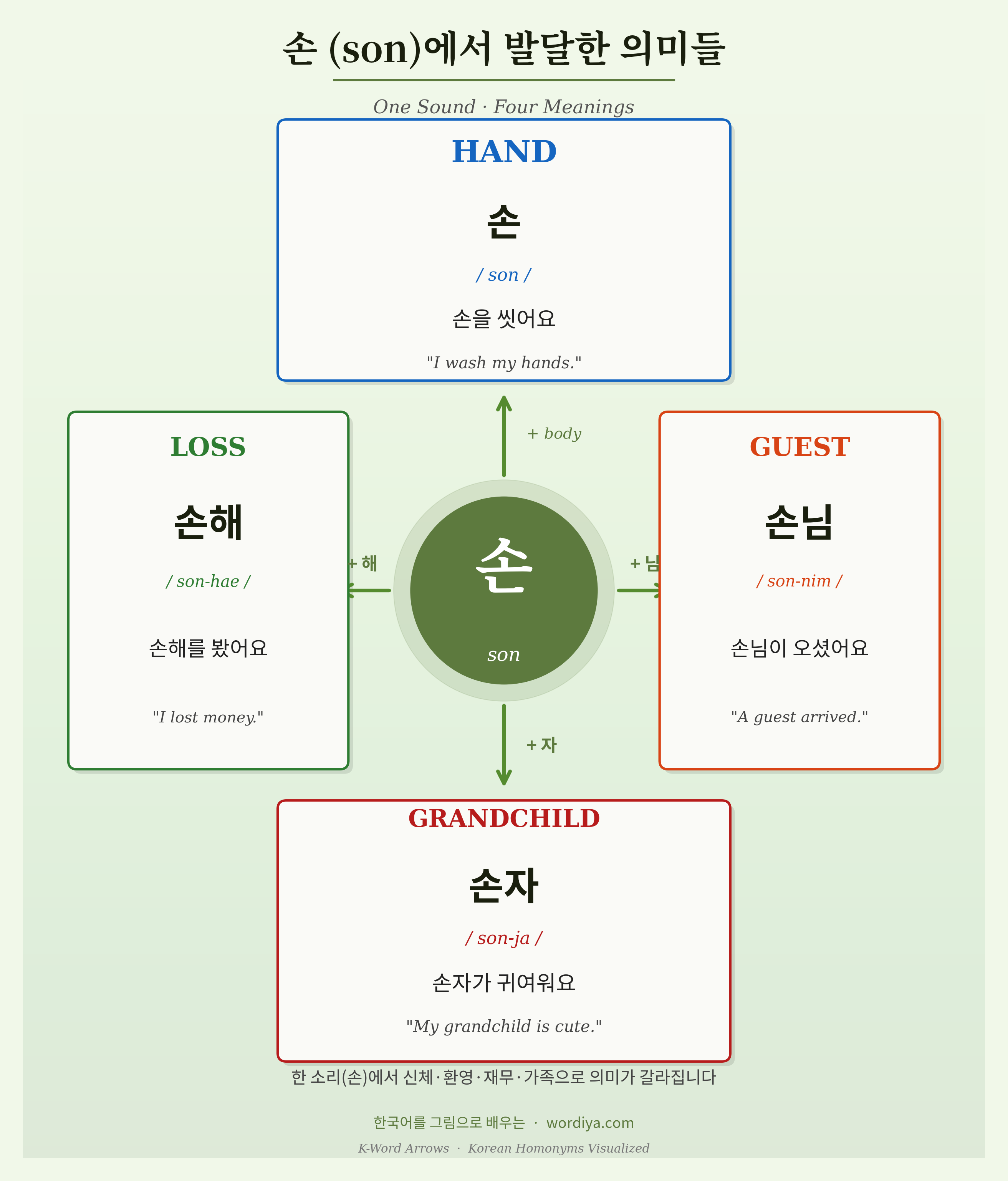
손 — Four Directions, Four Meanings
| ↑ Up | hand | 손 | son |
| → Right | guest | 손님 | son-nim |
| ← Left | loss | 손해 | son-hae |
| ↓ Down | grandchild | 손자 | son-ja |
One sound. Four meanings. One picture.
↑ Up — 손 (son): Hand
손을 씻어요.
Son-eul ssi-seo-yo.
I wash my hands.
The noun 손 (son) means hand — one of the most fundamental Korean nouns.
Common phrases:
- 손을 씻다 (son-eul ssit-da) — to wash hands
- 손을 잡다 (son-eul jap-da) — to hold hands
- 손가락 (son-ga-rak) — finger
- 손바닥 (son-ba-dak) — palm
- 손목 (son-mok) — wrist
- 손톱 (son-top) — fingernail
- 오른손 (o-reun-son) — right hand
- 왼손 (oen-son) — left hand
- 손을 흔들다 (son-eul heun-deul-da) — to wave hand
Chinese character origin: 手 (수) = hand
Korean idioms with 손:
- 손이 크다 (son-i keu-da) — "to have big hands" = to be generous (with food/gifts)
- 손이 작다 (son-i jak-da) — "to have small hands" = to be stingy
- 손에 잡히다 (son-e jap-hi-da) — to feel within reach
- 손을 떼다 (son-eul tte-da) — to wash one's hands of (quit involvement)
→ Right — 손님 (son-nim): Guest
손님이 오셨어요.
Son-nim-i o-syeo-sseo-yo.
A guest has arrived. / The customer arrived.
The noun 손님 (son-nim) means guest or customer — central to Korean hospitality culture.
Common phrases:
- 손님을 맞이하다 (son-nim-eul ma-ji-ha-da) — to welcome a guest
- 손님 접대 (son-nim jeop-dae) — receiving guests
- 단골 손님 (dan-gol son-nim) — regular customer
- 손님 방 (son-nim bang) — guest room
- 외국 손님 (oe-guk son-nim) — foreign guest
- 손님 한 분 (son-nim han bun) — one guest (honorific)
Chinese character origin: 客 (객) = visitor + 님 (Korean honorific suffix)
Korean culture — 손님 is sacred:
Korean hospitality treats guests with deep respect:
| 손님은 왕이다 | "The customer is king" — Korean business motto |
| 손님이 최고다 | "The guest is the best" |
| 손님 대접 | "Treating a guest" — central Korean concept |
When Koreans say "손님 오셨어요" (sonnim osyeoss eoyo), they use the honorific verb (오시다 instead of 오다) — showing the deep respect Korean culture has for guests.
K-drama scenes:
Korean dramas constantly show 손님 접대 scenes — preparing elaborate meals for guests, kneeling when serving tea, offering the best seat. This isn't just politeness; it's a cultural identity.
← Left — 손해 (son-hae): Loss
큰 손해를 봤어요.
Keun son-hae-reul bwa-sseo-yo.
I suffered a big loss.
The noun 손해 (son-hae) means financial loss or damage — essential Korean business vocabulary.
Common phrases:
- 손해를 보다 (son-hae-reul bo-da) — to suffer a loss
- 손해를 입다 (son-hae-reul ip-da) — to receive damage
- 손해배상 (son-hae-bae-sang) — compensation for damages
- 큰 손해 (keun son-hae) — big loss
- 손실 (son-sil) — loss (more formal)
- 손익 (son-ik) — profit and loss
- 손익계산서 (son-ik-gye-san-seo) — profit and loss statement
- 손해보험 (son-hae-bo-heom) — casualty insurance
Chinese character origin: 損 (손) = damage, loss
Korean business culture:
손해 is one of the most-used words in Korean business:
| 손익분기점 (son-ik-bun-gi-jeom) | Break-even point |
| 순손실 (sun-son-sil) | Net loss |
| 손해보험 (son-hae-bo-heom) | Property/casualty insurance |
| 손해사정 (son-hae-sa-jeong) | Loss adjustment (insurance) |
Korean saying:
- 손해 보고 산다 (son-hae bo-go san-da) — "Living while taking losses"
- A Korean cultural saying meaning: sometimes accepting small losses for long-term harmony or relationships is wise.
↓ Down — 손자 (son-ja): Grandchild
손자가 너무 귀여워요.
Son-ja-ga neo-mu gwi-yeo-wo-yo.
My grandchild is so cute.
The noun 손자 (son-ja) means grandchild (specifically grandson) — central to Korean family culture.
Common phrases:
- 손자 (son-ja) — grandson
- 손녀 (son-nyeo) — granddaughter
- 손주 (son-ju) — grandchildren (general/cute term)
- 친손자 (chin-son-ja) — paternal grandson
- 외손자 (oe-son-ja) — maternal grandson
- 손자병법 (son-ja-byeong-beop) — "Sun Tzu's Art of War" (Sun Tzu's name in Korean)
Chinese character origin: 孫 (손) = descendant, grandchild
Korean family culture — 손주바보:
There's a beautiful Korean term for grandparents who adore their grandchildren too much:
- 손주바보 (son-ju-ba-bo) — literally "grandchild fool"
- Means: a grandparent who is foolishly in love with their grandchild
- Used affectionately, not negatively
Korean grandparents are famous for spoiling grandchildren — buying anything, traveling far to see them, posting endless photos on KakaoTalk.
K-drama trope:
Almost every Korean family drama features a 할아버지/할머니 + 손주 scene — grandparents secretly slipping money to grandchildren, cooking their favorite foods, or saving them from strict parents.
How to Tell Them Apart
Context decides which 손 you hear. Here's how to decode:
| Body verbs (씻다, 잡다, 흔들다) | hand (손) |
| 님 (honorific) → 손님 | guest |
| 해/실 (damage/loss) → 손해/손실 | loss |
| 자/녀 (child) → 손자/손녀 | grandchild |
Try It Yourself
Can you guess which 손 is used in each sentence?
| 1. 손님 한 분이 기다리세요. | ? |
| 2. 주식으로 손해를 많이 봤어. | ? |
| 3. 손이 차가워. 장갑 끼자. | ? |
| 4. 우리 손녀가 초등학교 들어갔어요. | ? |
Answers:
- guest (One guest is waiting)
- loss (I lost a lot of money in stocks)
- hand (My hand is cold. Let's wear gloves)
- grandchild (Our granddaughter entered elementary school)
Key Takeaway
손 (son) is one syllable with four distinct meanings — hand, guest, loss, grandchild. Each comes from a different Chinese character: 手 (hand), 客 (visitor), 損 (damage), 孫 (descendant). Context, suffixes, and compound words make them clear. One sound covers body, hospitality, business, and family — four pillars of Korean life. Once mapped visually, the confusion disappears.
Pronunciation Tip
All four meanings are pronounced exactly the same: son (sounds like "sohn" — not like the English word "son"). With suffixes:
- 손 = son (hand)
- 손님 = son-nim (guest)
- 손해 = son-hae (loss)
- 손자 = son-ja (grandchild)
Bonus — 손 in Korean Business English
If you're doing business in Korea, you'll hear 손해 constantly:
| 손해 보험 | Property/casualty insurance |
| 손익 계산서 | P&L statement |
| 순손실 | Net loss |
| 손해 배상 | Compensation |
| 손익 분기점 | Break-even point |
| 손실 충당금 | Loss provision |
Korean accounting and finance vocabulary is built around 손익 (son-ik) — "loss and profit."
Bonus — Why "Sun Tzu" is "손자" in Korean
The famous Chinese military strategist Sun Tzu (孫子, 5th century BC) is written as 손자 (Son-ja) in Korean. His classic work "The Art of War" is called 손자병법 (Son-ja-byeong-beop) in Korean — literally "Sun Tzu's Military Method."
This is why some Korean learners get confused when they hear "손자 (Son-ja)" — it could mean:
- Your grandson
- The ancient Chinese strategist
Context (and history class vs family chat) makes it clear.
Bonus — Korean Hospitality Phrases
Since 손님 (guest) is so culturally important, here are key phrases for visitors to Korea:
| 어서 오세요 | Welcome (entering store/home) |
| 손님 오셨어요 | A guest has arrived |
| 잘 오셨어요 | Glad you came |
| 편하게 계세요 | Make yourself at home |
| 다음에 또 오세요 | Please come again |
These phrases reveal how deeply Korean culture values hospitality — every guest deserves honorific language.
Coming Next — 발 (bal)
Next we map another Korean homonym: 발 (bal) — meaning foot, curtain, and counter for shots/arrows. Three meanings, one sound, useful for daily life and K-drama vocabulary.
도움이 되셨다면 구독, 공감 한 번 부탁드립니다. (Thank you for reading!)
K-Word Arrows: Korean Homonyms Visualized
ⓒ wordiya.com

