고개 (gogae): Neck · Pass · Nod · Turning Point — One Korean Sound, Four Meanings
Some Korean words are quiet giants. 고개 (gogae) looks small — two syllables, no Hanja, pure native Korean — but it climbs all the way from your body to a mountain to the shape of your whole life. One sound. Four meanings. And, as always with K-Word Arrows, the four are secretly one.
(다이어그램: kword_gogae_color.png)
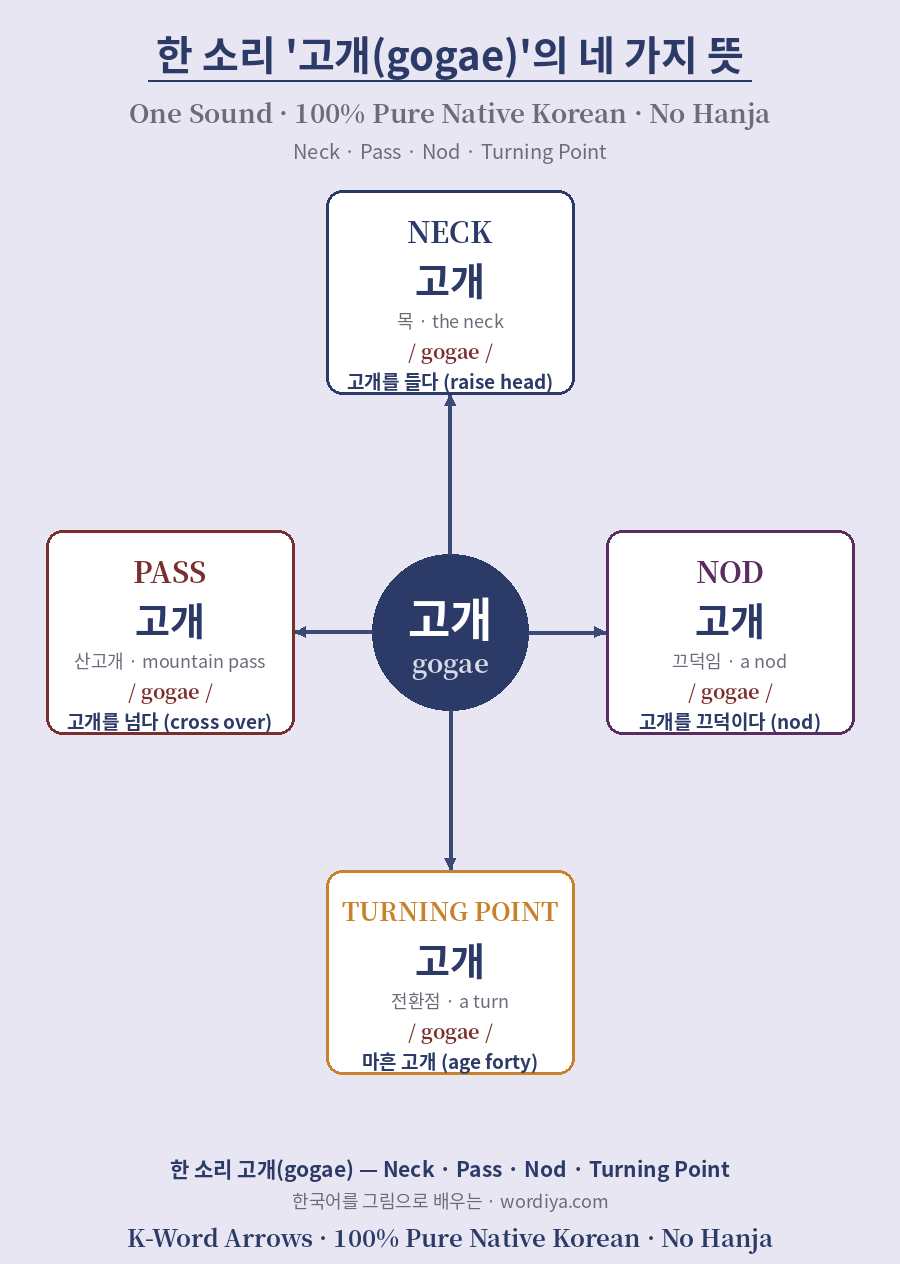
① NECK — 고개
The first 고개 is the back of your neck, and the head that sits on it.
- 고개를 들다 — to raise one's head
- 고개를 숙이다 — to bow one's head (and, by extension, to yield, to feel humbled)
Notice something already: the head rising and falling on the neck is itself a small hill you go up and down. The metaphor is hiding in the body from the very start.
② MOUNTAIN PASS — 고개
The same word is the pass over a mountain — the low saddle in a ridge where a trail is worn so travelers can cross.
Korea is a land of mountains, and the 고개 was where a village ended and the wider world began.
- 고개를 넘다 — to cross a pass
- 고개마루 — the very crest of the pass
Two of the most powerful words in Korean live here:
🎵 아리랑 (Arirang) — the most beloved Korean folk song opens with "아리랑 고개를 넘어간다" — "crossing over the Arirang pass."
🌾 보릿고개 (borit-gogae) — literally the "barley pass." It was the cruel hungry gap in late spring, after last year's grain ran out but before the barley ripened. The hardest 고개 a poor family climbed each year — a hill made not of earth, but of time.
③ NOD — 고개
Because the neck-head is a 고개, the small motion of that head becomes a word too.
- 고개를 끄덕이다 — to nod (yes) — tipping the head-hill forward
- 고개를 젓다 / 고개를 가로젓다 — to shake one's head (no)
- 고갯짓 — the gesture itself, a signal made with the head
A whole silent language of yes and no lives on top of this one syllable.
④ TURNING POINT — 고개
Finally the pass turns into a metaphor for any hard peak you must get over in life.
- 인생의 고개 — a critical stage of life
- 마흔 고개 — "the hill of forty," the crossing into one's forties
- 고비의 고개 — a decisive turning point
Every sense keeps the original image intact: something rises in front of you, you climb, and on the far side the ground is different.
🎯 One Picture, Four Meanings
From neck → mountain → nod → milestone, 고개 never really changes its shape. It is always a rise, and the crossing of it — bone, then earth, then gesture, then time.
English needs four unrelated words — neck, pass, nod, turning point — where Korean keeps one, because Korean remembered that they are, at heart, the same act: to come up to a high place, and to go over.
Try it yourself: cover the English and read only the Korean.
고개를 들다 · 고개를 넘다 · 고개를 끄덕이다 · 마흔 고개.
One sound, four crossings.
This is part of the K-Word Arrows series — one native Korean sound, many meanings, no Hanja. 📗 Available as a book on Amazon KDP.
한국어를 그림으로 배우는 · ⓒ wordiya.com


