가지 (gaji): Branch · Eggplant · Kind · Offshoot — One Korean Sound, Four Meanings
Some Korean words grow in every direction at once. 가지 (gaji) is one of them — pure native Korean, no Hanja — and it means a tree branch, the purple vegetable on your plate, a kind of thing, and the offshoot where a story wanders off. Four meanings, one gesture: the one dividing into the many.
(Diagram: kword_gaji_color.png)
① BRANCH — 가지
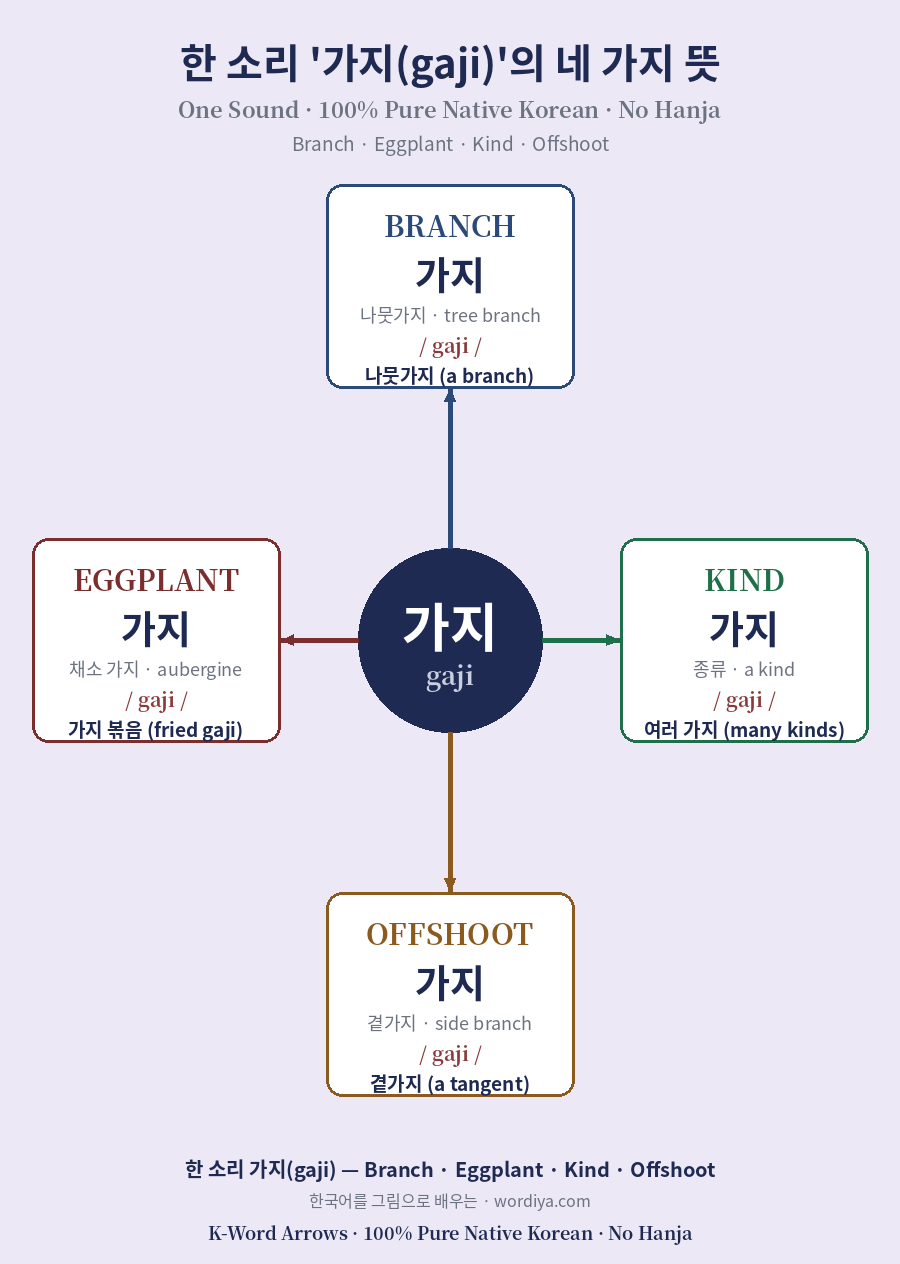
The root sense is the tree branch — the part that splits off from the trunk and reaches outward.
- 나뭇가지 (namut-gaji) — a tree branch (나무 tree + 가지)
- 가지를 치다 (gaji-reul chi-da) — to branch out; to split into offshoots
The oldest recorded form, 갖 (gat), appears in the Songs of the Flying Dragons (용비어천가, 1447). From one trunk, many 가지 spread — and that image of one-into-many becomes every other meaning.
② EGGPLANT — 가지
The same sound names the eggplant (aubergine), 🍆. Why the same word? The plant grows on spreading, branching stems. In Korean kitchens 가지 is everywhere:
- 가지볶음 (gaji-bokkeum) — stir-fried eggplant
- 가지나물 (gaji-namul) — seasoned steamed eggplant
③ KIND — 가지
Widened into the abstract, 가지 becomes a kind, sort, or type — a counter for varieties.
- 여러 가지 (yeoreo gaji) — many kinds
- 몇 가지 (myeot gaji) — a few kinds
- 갖가지 (gat-gaji) — all sorts / 온갖 (on-gat) — every kind (both from the old form 갖)
The metaphor is transparent: just as a tree divides into branches, a category divides into kinds. English sort hides the same picture; Korean keeps it visible in the branch itself.
④ OFFSHOOT — 가지
Finally 가지 turns figurative. 곁가지 (gyeot-gaji) — a "side branch" — means a tangent, a minor offshoot of the main point.
- 곁가지로 새다 (gyeot-gaji-ro sae-da) — to wander off on a tangent
Any subplot, digression, or secondary issue that splits from the main line is a 가지.
🎯 One Picture, Four Meanings
From branch → eggplant → kind → tangent, 가지 never stops doing one thing: dividing the one into the many. A trunk into branches, a plant into fruit, a category into kinds, a story into digressions.
English needs four unrelated words where Korean keeps one — because Korean saw that they are all the same act: splitting, spreading, multiplying from a single source.
Try it yourself: read only the Korean.
나뭇가지 (namut-gaji) · 가지볶음 (gaji-bokkeum) · 여러 가지 (yeoreo gaji) · 곁가지 (gyeot-gaji).
One sound, four ways of branching.
Part of the K-Word Arrows series — one native Korean sound, many meanings, no Hanja. 📗 Available on Amazon KDP.
한국어를 그림으로 배우는 · ⓒ wordiya.com


