자리 (jari): Seat · Place · Mark · Bed — One Korean Sound, Four Meanings
Korean has sounds that open like fans. One syllable, and four worlds unfold from it. Today's is 자리 (jari) — not a single character of Hanja in it, pure native Korean, yet it names the seat you sit in, the place where something stands, the mark a thing leaves behind, and the bed where you sleep. What English scatters into four separate words, Korean holds together in one sound. Let's follow the thread that connects them.
[jari_blog.png diagram here]
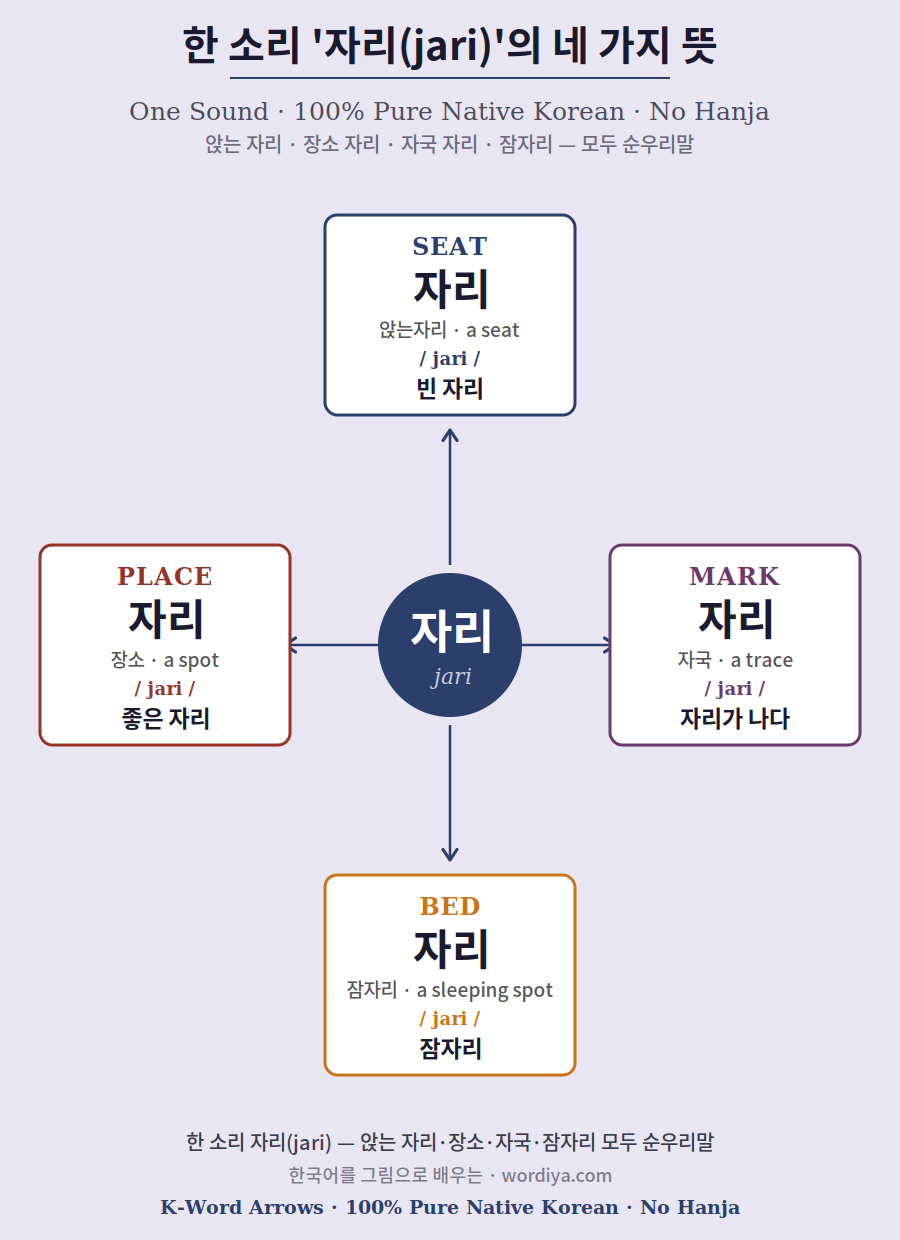
🎯 One Sound, Four Native Meanings
Every meaning below is 100% pure native Korean — no Hanja layer, no borrowing. Just one ancient Korean sound branching four ways.
· · ·
⬆️ SEAT — 자리 (a place to sit)
The first 자리 is the seat — the space where a person sits. A chair, a bench, an assigned spot in a theater, a train, a classroom.
Common phrases: 빈 자리 (bin jari, an empty seat) · 자리에 앉다 (jari-e an-da, to sit down) · 자리를 잡다 (jari-reul jab-da, to grab a seat) · 앞자리 (ap-jari, front seat).
On Korean subways and buses, offering your 자리 to an elderly person is a deep-rooted courtesy. And "자리 좀 맡아 줘" (please save me a seat) echoes through every café and lecture hall — 자리 is the currency of shared public space.
Example: 빈 자리가 없어요. (Bin jari-ga eop-seo-yo. — "There are no empty seats.")
· · ·
⬅️ PLACE — 자리 (a spot/location)
The same 자리 widens into place — a location, a position in space. Where a building stands, where furniture goes, a good spot for a shop.
Common phrases: 좋은 자리 (jo-eun jari, a good location) · 제자리 (je-jari, the proper place) · 명당자리 (myeong-dang-jari, an auspicious site).
Koreans speak of 명당 (myeong-dang) — an auspicious 자리 with good energy, a concept from traditional geomancy (풍수). Choosing the right 자리 for a home, a shop, even a grave is taken seriously.
Example: 가게 자리가 참 좋아요. (Ga-ge jari-ga cham jo-a-yo. — "The shop's location is really good.")
· · ·
➡️ MARK — 자리 (a trace left behind)
Now 자리 turns inward: the mark a thing leaves — the trace of something now gone. A scar, a stain, a dent, the pale square on a wall where a picture hung.
Common phrases: 흉터 자리 (hyung-teo jari, the site of a scar) · 자리가 나다 (jari-ga na-da, a mark forms) · 상처 자리 (sang-cheo jari, the spot of a wound).
When a Korean says "자리가 남았다" (a mark was left), they mean the memory a thing leaves in space — the dent in a cushion, the outline of what was there. Here 자리 shifts from a place you occupy to a place something used to occupy.
Example: 상처 자리가 남았어요. (Sang-cheo jari-ga nam-a-sseo-yo. — "A scar mark was left behind.")
· · ·
⬇️ BED — 자리 (a spot to sleep)
In the compound 잠자리 (jam-jari), 자리 becomes the place where you sleep. 잠 (jam) means "sleep," and 자리 gives it a spot: literally "sleep-place."
Common phrases: 잠자리 (jam-jari, a sleeping spot / bedding) · 잠자리에 들다 (jam-jari-e deul-da, to go to bed) · 잠자리를 펴다 (jam-jari-reul pyeo-da, to lay out the bedding).
In the traditional Korean 온돌 (ondol) home, there was no fixed bed — families laid out 이불 (bedding) each night on the warm floor, making the 잠자리 fresh every evening. The goodnight blessing "잠자리 편히 주무세요" (sleep comfortably) carries this warmth. (A charming aside: 잠자리 with a different pitch also means "dragonfly" — a homonym nested inside a homonym.)
Example: 잠자리가 참 편해요. (Jam-jari-ga cham pyeon-hae-yo. — "The sleeping spot is very comfortable.")
· · ·
⚡ Memory Anchor
Picture arriving late to a lecture hall. You hunt for a 자리 (SEAT) to sit. You find a good 자리 (PLACE) near the front. When you stand later, your bag has left a 자리 (MARK) on the soft cushion. That night, exhausted, you sink into your 잠자리 (BED). One sound — 자리 — carried you from the seat, to the spot, to the trace, to sleep.
· · ·
⚡ At a Glance
| SEAT | a place to sit | 빈 자리 (empty seat) |
| PLACE | a spot/location | 좋은 자리 (good location) |
| MARK | a trace left behind | 흉터 자리 (scar site) |
| BED | a sleeping spot | 잠자리 (bedding) |
Why does one native word cover all four? Because they share a single core idea: a spot that something occupies. A person occupies a seat; a building occupies a location; an object leaves the memory of the spot it held; a sleeper occupies bedding. 자리 is the Korean word for "the space a thing takes."
· · ·
📌 In One Line
자리 (jari) is one pure-native Korean sound with four meanings — seat, place, mark, and sleeping spot — all united by a single idea: the space something occupies. From 빈 자리 (an empty seat) to 잠자리 (a place to sleep), one sound holds them all.
K-Word Arrows ⓒ wordiya.com


