채 (Chae) — Beater · House · Shredded · In-a-State
One Sound · All Pure Native Korean Meanings — a Beater, a House, Shredded, and In a State
[※ 도식: chae_color_diagram.png]
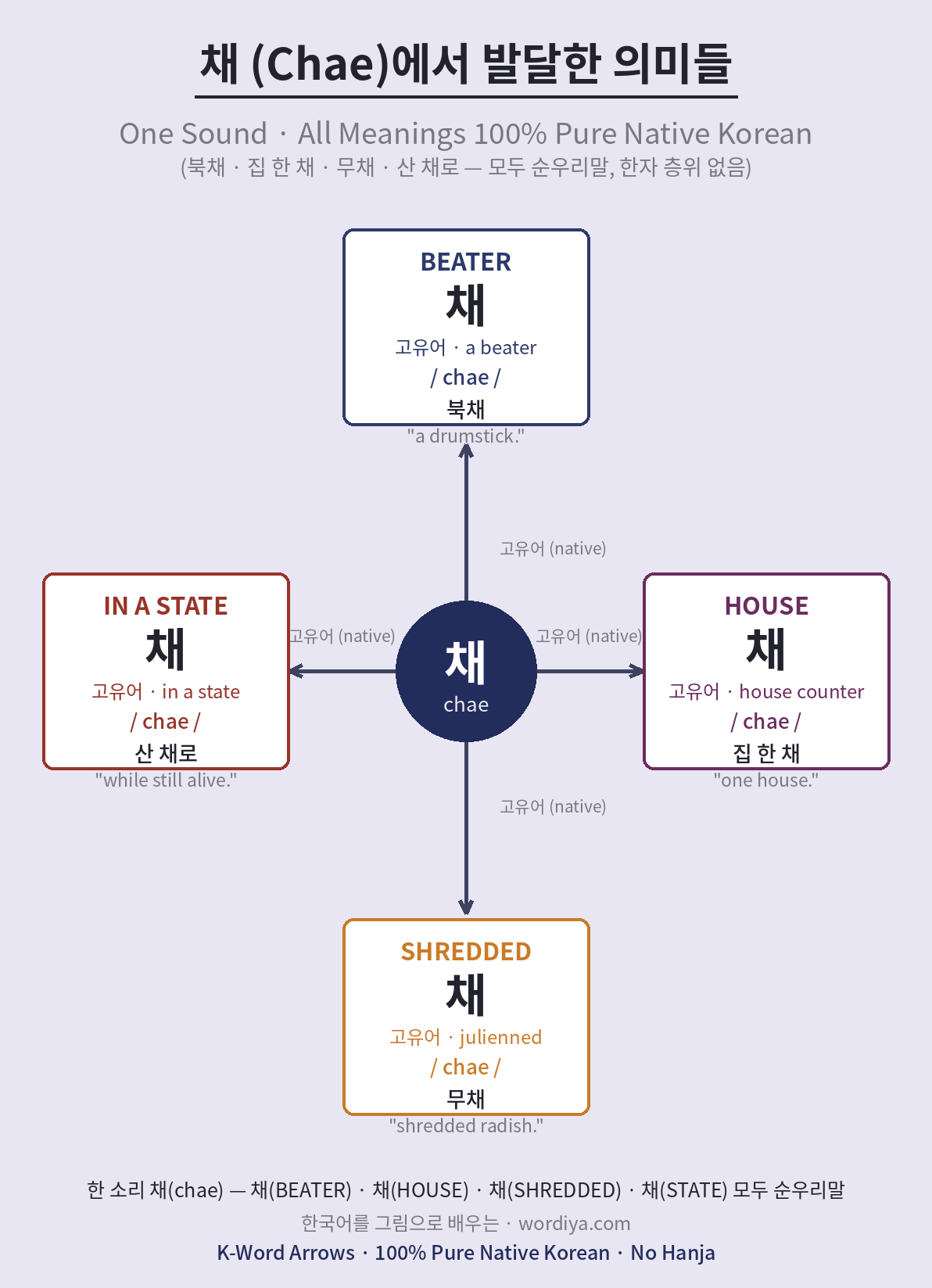
For the fiftieth and final chapter, one last Korean sound that fans out into four everyday lives. When Koreans say "북채" (a drumstick), 채 is the beater that strikes. When they say "집 한 채" (one house), the same sound becomes the word that counts whole buildings. When they say "무채" (shredded radish), 채 names food sliced into fine threads. And when they say "산 채로" (while still alive), the same syllable turns into a grammatical word meaning "in the state of." A striking stick, a standing house, a plate of slivered vegetables, and a state of being — one Korean sound holds them all. Zero Hanja anywhere.
· · ·
① BEATER — 채 (chae) · pure native Korean
The first 채 is a beater — a stick for striking. A drumstick, a whip, a mallet. 북채(drumstick), 장구채(janggu stick), 채찍(whip). The hand's extension for hitting. Pure native Korean.
Related pure native Korean expressions:
- 채 (chae, a beater) — 치는 막대
- 북채 (buk-chae, drumstick) — 북 치는 채
- 장구채 (jang-gu-chae) — 장구 치는 채
- 채찍 (chae-jjik, whip) — 후려치는 채
- 매채 (mae-chae) — 때리는 막대
Example sentences:
- 북채로 북을 두드린다. (Buk-chae-ro buk-eul du-deu-rin-da. — He beats the drum with a drumstick.)
- 말에 채찍을 가했다. (Mal-e chae-jjik-eul ga-haet-da. — He whipped the horse.)
- 장구채를 힘차게 놀린다. (Jang-gu-chae-reul him-cha-ge nol-lin-da. — She wields the janggu stick vigorously.)
· · ·
② HOUSE COUNTER — 채 (chae) · pure native Korean
The second 채 counts buildings and names the wings of a traditional home. 집 한 채(one house), 안채(inner quarters), 사랑채(guest quarters), 별채(detached annex). The unit of standing structures. Pure native Korean.
Related pure native Korean expressions:
- 채 (chae, house counter) — 집을 세는 단위
- 집 한 채 (jip han chae) — 집 하나
- 안채 (an-chae) — 안쪽 본채
- 사랑채 (sa-rang-chae) — 손님을 맞는 채
- 별채 (byeol-chae) — 따로 떨어진 채
Example sentences:
- 그는 집 두 채를 가졌다. (Geu-neun jip du chae-reul ga-jyeot-da. — He owns two houses.)
- 손님은 사랑채에 묵었다. (Son-nim-eun sa-rang-chae-e muk-eot-da. — The guest stayed in the guest quarters.)
- 별채에서 글을 쓴다. (Byeol-chae-e-seo geul-eul sseun-da. — I write in the detached annex.)
· · ·
③ SHREDDED — 채 (chae) · pure native Korean
The third 채 is food cut into fine threads — julienned vegetables. 채 썰다(to julienne), 무채(shredded radish), 오이채(slivered cucumber). The shape of vegetables cut thin for banchan and bibimbap. Pure native Korean.
Related pure native Korean expressions:
- 채 (chae, julienned) — 가늘게 썬 것
- 채 썰다 (chae sseol-da) — 가늘게 썰다
- 무채 (mu-chae) — 무를 채 썬 것
- 오이채 (o-i-chae) — 오이를 채 썬 것
- 골패채 (gol-pae-chae) — 골패 모양으로 썬 채
Example sentences:
- 무를 채 썰어 무친다. (Mu-reul chae sseol-eo mu-chin-da. — I julienne the radish and season it.)
- 비빔밥에 오이채를 올린다. (Bi-bim-bap-e o-i-chae-reul ol-lin-da. — I top the bibimbap with slivered cucumber.)
- 채 썬 채소가 아삭하다. (Chae sseon chae-so-ga a-sak-ha-da. — The julienned vegetables are crisp.)
· · ·
④ IN A STATE — 채 (chae) · pure native Korean
The fourth 채 is a grammatical word — a bound noun meaning "in the state of, still, as it is." It marks that a condition remains unchanged while something else happens. 산 채로(while still alive), 문을 연 채(with the door left open), 눈을 감은 채(with eyes still closed). Pure native Korean.
Related pure native Korean expressions:
- -ㄴ 채 (-n chae) — ~한 상태 그대로
- 산 채로 (san chae-ro) — 살아있는 상태로
- 문을 연 채 (mun-eul yeon chae) — 문이 열린 상태로
- 눈을 감은 채 (nun-eul gam-eun chae) — 눈 감은 상태로
- 선 채로 (seon chae-ro) — 서 있는 상태로
Example sentences:
- 불을 켠 채 잠들었다. (Bul-eul kyeon chae jam-deul-eot-da. — I fell asleep with the light still on.)
- 신발을 신은 채 들어왔다. (Sin-bal-eul sin-eun chae deul-eo-wat-da. — He came in with his shoes still on.)
- 선 채로 밥을 먹었다. (Seon chae-ro bap-eul meok-eot-da. — I ate standing up.)
· · ·
Bonus ① — From a Striking Stick to Pure Grammar
채 is perhaps the widest-reaching syllable in this entire book. It begins as the most physical thing imaginable — a stick that strikes a drum — and ends as one of the most abstract words in the language, a grammatical marker of state with no physical form at all. In between it counts the houses people live in and names the vegetables on their plates. Korean asked one small sound to carry the concrete and the abstract, the kitchen and the cosmos of grammar.
Bonus ② — 안채 and 사랑채: A House Divided by 채
In a traditional Korean home, 채 was the very architecture of family life. The 안채 (inner quarters) was the women's domestic center; the 사랑채 (guest quarters) was where men received visitors; a 별채 stood apart for study. Each 채 was a world with its own rules. To count a house in 채 was to acknowledge that a home is not one box but a cluster of standing lives.
Bonus ③ — 산 채로: The Grammar of "As It Is"
The grammatical 채 gives Korean a graceful way to say that one thing holds still while another moves. 눈을 감은 채, 문을 연 채, 산 채로 — in each, 채 freezes one condition so a second action can unfold against it. English needs whole phrases ("with... still..."); Korean needs a single syllable. A small marvel of economy.
· · ·
What makes 채 remarkable is that it holds a striking beater, a whole house, a plate of slivered vegetables, and the pure grammar of state together in one native Korean sound. From the drumstick that beats a rhythm (북채) to the house one calls home (집 한 채), from the radish shredded for supper (무채) to the door left open through the night (문을 연 채) — Korean gathers the concrete and the abstract into a single syllable. When you say 채 in Korean, you speak a language that saw the drumstick and the shape of existence itself as one.
K-Word Arrows: Korean Homonyms Visualized · ⓒ wordiya.com
https://wordiya.com/866 for another K-WORD
'K-Word Arrows: Korean Homonyms Visualize' 카테고리의 다른 글
| 자리 (jari): Seat · Place · Mark · Bed — One Korean Sound, Four Meanings (0) | 2026.07.11 |
|---|---|
| 마디 (madi): Node · Joint · Word · Bar — One Korean Sound, Four Meanings (0) | 2026.07.10 |
| 낫 [nat] — Sickle · Daytime · Face · Better/Heal (0) | 2026.07.09 |
| 깃 (Git) — Feather · Collar · Bedding · Dwell (0) | 2026.07.09 |
| 참 (Cham) — True · Genuine · While · Endure (0) | 2026.07.08 |


