낫 [nat] — Sickle · Daytime · Face · Better/Heal
One Sound · Four Pure Native Korean Words — Sickle, Daytime, Face, and to Be Better
[※ 도식: nat_color_diagram.png]
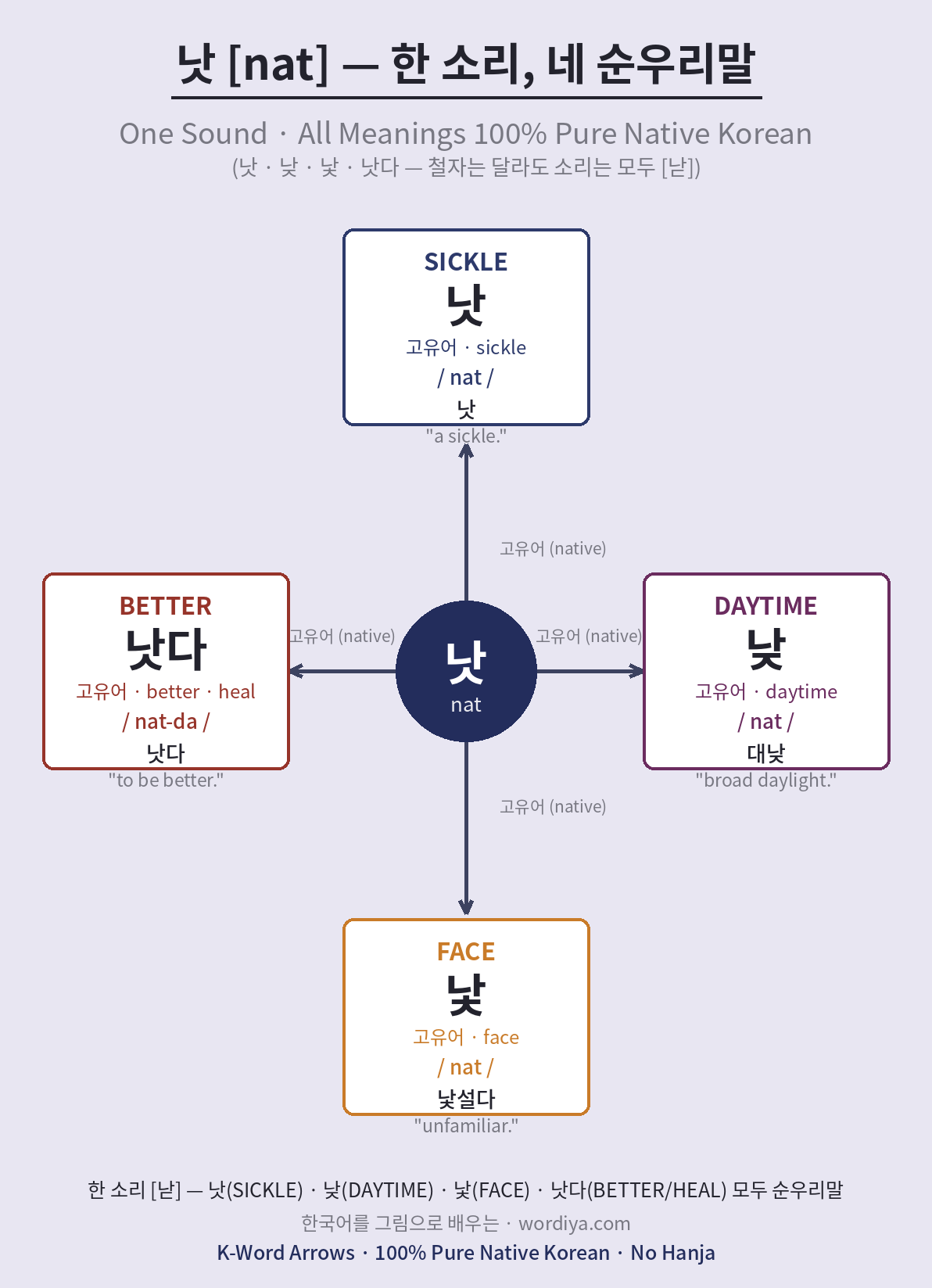
Here is one of the most famous puzzles in the Korean language. Four everyday words — 낫 (a sickle), 낮 (daytime), 낯 (a face), and 낫다 (to be better / to heal) — are spelled with four different final consonants, yet all four are pronounced exactly the same: [nat]. To the ear they are identical; on the page they are distinct. This is not one word with four meanings, but four separate native Korean words that fate pressed into a single sound. Every one is pure native Korean (고유어), zero Hanja anywhere.
· · ·
① SICKLE — 낫 (nat) · pure native Korean
The first [nat] is 낫, the farmer's sickle — the curved blade for cutting grass and grain. The only one of the four written with final ㅅ. From harvesting rice to cutting weeds, one of the oldest tools in Korean farming life. Pure native Korean.
Related pure native Korean expressions:
- 낫 (nat, sickle) — 풀·곡식을 베는 굽은 칼
- 낫으로 베다 (nat-eu-ro be-da) — 낫으로 자르다
- 풀낫 (pul-nat) — 풀 베는 낫
- 벼낫 (byeo-nat) — 벼 베는 낫
- 낫날 (nan-nal) — 낫의 날
- 낫자루 (nat-ja-ru) — 낫의 손잡이
Example sentences:
- 농부가 낫으로 벼를 벤다. (Nong-bu-ga nat-eu-ro byeo-reul ben-da. — The farmer cuts rice with a sickle.)
- 낫 놓고 기역 자도 모른다. (Nat no-ko gi-yeok ja-do mo-reun-da. — He doesn't even know "ㄱ" with a sickle in front of him. — utterly illiterate.)
- 낫날이 잘 들도록 갈았다. (Nan-nal-i jal deul-do-rok gal-at-da. — I sharpened the sickle's blade well.)
· · ·
② DAYTIME — 낮 (nat) · pure native Korean
The second [nat] is 낮, the daytime — the bright hours between dawn and dusk, opposite of 밤(night). Written with final ㅈ. 대낮(broad daylight), 낮잠(a nap), 한낮(midday). Pure native Korean.
Related pure native Korean expressions:
- 낮 (nat, daytime) — 해가 떠 있는 동안 (↔ 밤)
- 대낮 (dae-nat, broad daylight) — 환한 낮
- 한낮 (han-nat, midday) — 낮의 한가운데
- 낮잠 (nat-jam, nap) — 낮에 자는 잠
- 밤낮 (bam-nat, day and night) — 늘, 언제나
Example sentences:
- 대낮에 별이 보였다. (Dae-nat-e byeol-i bo-yeot-da. — Stars were visible in broad daylight.)
- 한낮에는 너무 덥다. (Han-nat-e-neun neo-mu deop-da. — It is too hot at midday.)
- 밤낮으로 일했다. (Bam-nat-eu-ro il-haet-da. — I worked day and night.)
· · ·
③ FACE — 낯 (nat) · pure native Korean
The third [nat] is 낯, the human face — and by extension one's honor. Written with final ㅊ. 낯설다(unfamiliar), 낯익다(familiar), 낯가리다(to be shy of strangers). A face carries dignity here — 낯을 들다 means to face others without shame. Pure native Korean.
Related pure native Korean expressions:
- 낯 (nat, face) — 얼굴
- 낯설다 (nat-seol-da, unfamiliar) — 익숙하지 않다
- 낯익다 (nan-ik-da, familiar) — 눈에 익다
- 낯가리다 (nat-ga-ri-da) — 낯선 사람을 꺼리다
- 낯을 들다 (nat-eul deul-da) — 떳떳이 대하다
- 낯빛 (nat-bit, complexion) — 얼굴빛
Example sentences:
- 처음 온 곳이라 낯설다. (Cheo-eum on got-i-ra nat-seol-da. — It feels unfamiliar since it's my first time here.)
- 아기가 낯을 가린다. (A-gi-ga nat-eul ga-rin-da. — The baby is shy around strangers.)
- 부끄러워 낯을 들 수 없다. (Bu-kkeu-reo-wo nat-eul deul su eop-da. — I am too ashamed to hold my face up.)
· · ·
④ TO BE BETTER / TO HEAL — 낫다 (nat-da) · pure native Korean
The fourth [nat] is the verb 낫다: to be better/superior (A가 B보다 낫다) and to heal/recover (병이 낫다). Both share the idea of moving toward a better state. Written with final ㅅ before -다. Pure native Korean.
Related pure native Korean expressions:
- 낫다 (nat-da, to be better) — 더 좋다·우월하다
- 낫다 (nat-da, to heal) — 병이 나아지다
- 나아지다 (na-a-ji-da, to improve) — 점점 낫다
- 한결 낫다 (han-gyeol nat-da) — 훨씬 낫다
- 다 나았다 (da na-at-da) — 완전히 회복했다
Example sentences:
- 이게 저것보다 낫다. (I-ge jeo-geot-bo-da nat-da. — This one is better than that one.)
- 감기가 다 나았다. (Gam-gi-ga da na-at-da. — My cold has completely healed.)
- 쉬는 게 낫겠다. (Swi-neun ge nat-get-da. — It would be better to rest.)
· · ·
Bonus ① — The [nat] Knot: One Sound, Four Spellings
낫, 낮, 낯, 낫다 — say them aloud and they are indistinguishable: [nat]. This happens because of 받침 중화 (final-consonant neutralization): at a syllable's end, Korean flattens ㅅ, ㅈ, ㅊ all into a single [t]. So the sickle's ㅅ, the daytime's ㅈ, and the face's ㅊ collapse into the same closing [t] when spoken. The spellings preserve the true root; the sound erases the difference. This is why [nat] is a beloved dictation trap in Korean schools.
Bonus ② — 낫 놓고 기역 자도 모른다: A Sickle and a Letter
Korea's famous proverb: 낫 놓고 기역 자도 모른다 — "with a sickle set down before him, he doesn't even recognize the letter ㄱ." A 낫 is shaped exactly like ㄱ, so the saying mocks someone so unlettered they can't connect the tool in their hand to the simplest letter it resembles. The Korean equivalent of not knowing your ABCs.
Bonus ③ — Why 낫다 Means Both "Better" and "Healed"
It is no accident that 낫다 means both "to be better" and "to recover from illness." Both are the same motion: movement toward a better state. When one thing is 낫다 than another, it stands in the better position; when a sickness 낫다, the body returns to its better condition. To get well is simply to become better — one native verb, one quiet philosophy.
· · ·
What makes 낫 [nat] remarkable is that four unrelated native words — a farmer's sickle, the bright daytime, the human face, and the act of getting better — meet in a single spoken sound while keeping four distinct spellings. From cutting rice with a 낫 to napping in the 대낮, from a 낯선 stranger's face to a cold that finally 낫다 — Korean holds tool, time, face, and healing in one breath. When you say [nat] in Korean, you speak four ancient words at once.
K-Word Arrows: Korean Homonyms Visualized · ⓒ wordiya.com
'K-Word Arrows: Korean Homonyms Visualize' 카테고리의 다른 글
| 마디 (madi): Node · Joint · Word · Bar — One Korean Sound, Four Meanings (0) | 2026.07.10 |
|---|---|
| 채 (Chae) — Beater · House · Shredded · In-a-State (0) | 2026.07.09 |
| 깃 (Git) — Feather · Collar · Bedding · Dwell (0) | 2026.07.09 |
| 참 (Cham) — True · Genuine · While · Endure (0) | 2026.07.08 |
| 목 (Mok) — Neck · Junction · Voice · Thirst (0) | 2026.07.08 |

