One Sound, Four Worlds
In Korean, the single syllable 배 (bae) has at least four completely different meanings — to learn, stomach, pear, and ship.
This phenomenon is called a homonym (동음이의어, dong-eum-i-ui-eo). For Korean learners, 배 is especially fun because one of its meanings is the verb "배우다 (bae-u-da, to learn)" — the verb you use when describing your Korean studies.
Let's solve this — visually.
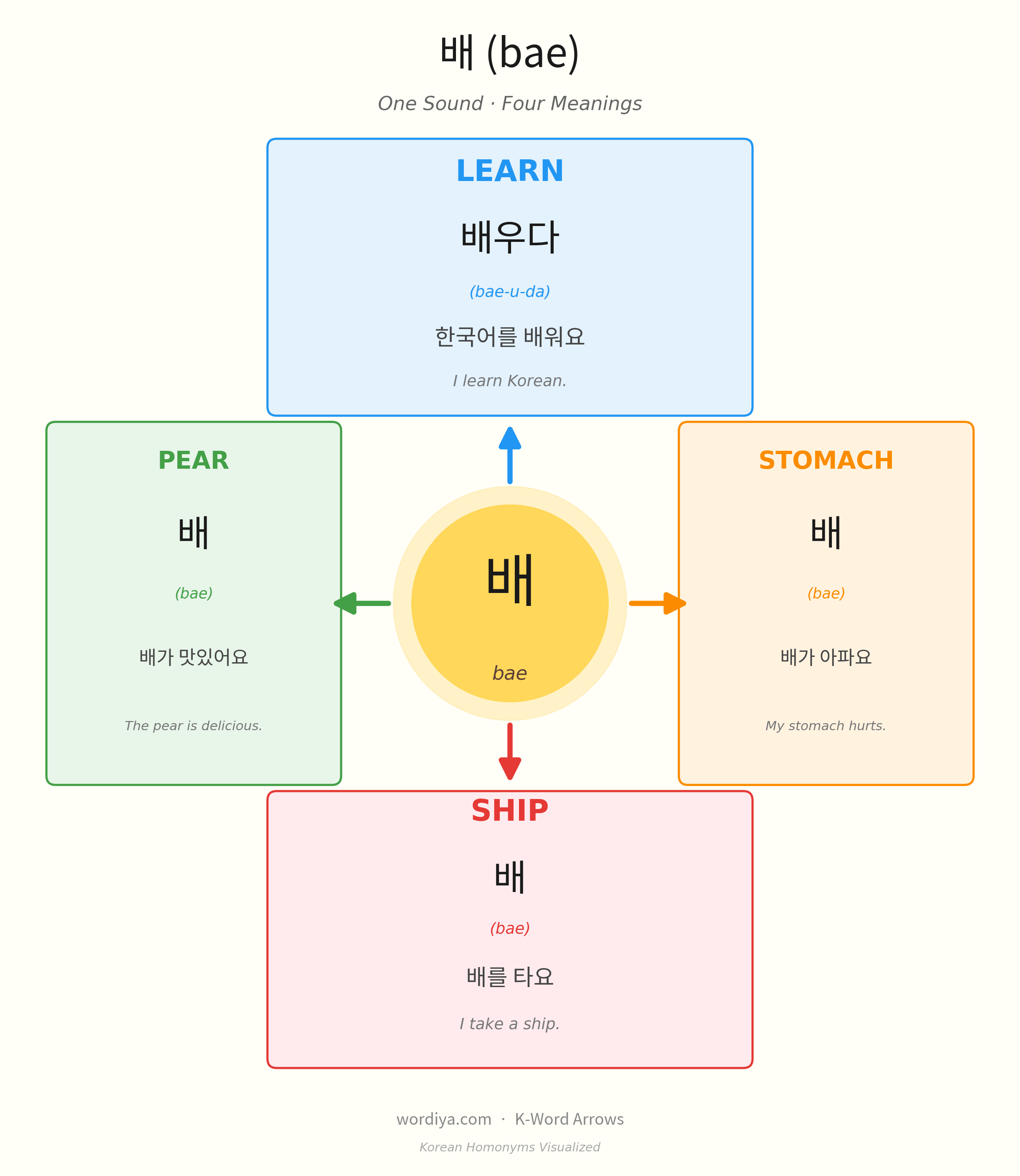
배 — Four Directions, Four Meanings
Direction Meaning Korean Romanization
| ↑ Up | learn | 배우다 | bae-u-da |
| → Right | stomach | 배 | bae |
| ← Left | pear | 배 | bae |
| ↓ Down | ship | 배 | bae |
One sound. Four meanings. One picture.
↑ Up — 배우다 (bae-u-da): Learn
저는 한국어를 배워요. Jeo-neun han-gu-geo-reul bae-wo-yo. I learn Korean.
The verb 배우다 (bae-u-da) means to learn. This is one of the most important verbs for any Korean learner — you'll use it constantly.
Common phrases:
- 한국어를 배우다 (han-gu-geo-reul bae-u-da) — to learn Korean
- 영어를 배우다 (yeong-eo-reul bae-u-da) — to learn English
- 새로운 것을 배우다 (sae-ro-un geo-seul bae-u-da) — to learn something new
- 가르치다 (ga-reu-chi-da) — to teach (opposite verb)
- 배움 (bae-um) — learning (noun)
- 배우는 중이에요 (bae-u-neun jung-i-e-yo) — I'm in the middle of learning
For Korean learners: This is the verb that describes what you're doing right now. The next time someone asks what you're studying, you can say "한국어를 배워요" (I'm learning Korean).
→ Right — 배 (bae): Stomach, Belly
배가 아파요. Bae-ga a-pa-yo. My stomach hurts.
The noun 배 (bae) means stomach or belly. This is essential for daily life — especially when you visit Korea and need to describe how you feel.
Common phrases:
- 배가 아프다 (bae-ga a-peu-da) — to have a stomachache
- 배가 고프다 (bae-ga go-peu-da) — to be hungry
- 배가 부르다 (bae-ga bu-reu-da) — to be full
- 배꼽 (bae-kkop) — belly button
- 배가 나오다 (bae-ga na-o-da) — to gain belly fat
- 배 안의 아기 (bae an-ui a-gi) — baby in the womb
K-Drama connection: You'll hear "배고파" (bae-go-pa, "I'm hungry") in almost every K-drama. Characters say it before meals, while staring at food, or as a complaint.
← Left — 배 (bae): Pear
한국 배가 맛있어요. Han-guk bae-ga ma-si-sseo-yo. Korean pears are delicious.
The noun 배 (bae) also means pear. Korean pears (한국 배) are famous globally — much larger, juicier, and crunchier than Western pears.
Common phrases:
- 한국 배 (han-guk bae) — Korean pear
- 배 한 개 (bae han gae) — one pear
- 배즙 (bae-jeup) — pear juice
- 배 농사 (bae nong-sa) — pear farming
- 나주 배 (na-ju bae) — Naju pear (famous Korean pear region)
Korean food culture: Korean pears are often used as a meat tenderizer in 불고기 (bulgogi) marinade. The natural enzymes in pears soften the meat. Also commonly served as a fresh dessert after meals.
↓ Down — 배 (bae): Ship, Boat
부산에서 배를 타요. Bu-san-e-seo bae-reul ta-yo. I take a ship from Busan.
The noun 배 (bae) also means ship or boat. Important when visiting Korean port cities like Busan, Incheon, or Jeju.
Common phrases:
- 배를 타다 (bae-reul ta-da) — to take a boat/ship
- 여객선 (yeo-gaek-seon) — passenger ferry
- 어선 (eo-seon) — fishing boat
- 군함 (gun-ham) — warship
- 배 멀미 (bae meol-mi) — seasickness
- 노아의 방주 (no-a-ui bang-ju) — Noah's Ark
Travel tip: If you visit Jeju Island, you can take 배 (a ferry) from Busan or Mokpo. The journey is part of the experience.
How to Tell Them Apart
Context is everything in Korean. Here's how to decode 배:
Look for... Meaning
| 우다 ending (verb), 한국어/영어 | learn (배우다) |
| 아프다/고프다/부르다 (body verbs) | stomach (배) |
| 맛있다/먹다/사다 (food verbs) | pear (배) |
| 타다/항구/바다 (transport/sea) | ship (배) |
Try It Yourself
Can you guess which 배 is used in each sentence?
Sentence learn / stomach / pear / ship?
| 1. 저는 영어를 배워요. | ? |
| 2. 배가 너무 아파요. | ? |
| 3. 한국 배는 정말 달아요. | ? |
| 4. 부산에서 일본까지 배로 가요. | ? |
Answers:
- learn (jeo-neun yeong-eo-reul bae-wo-yo, "I learn English")
- stomach (bae-ga neo-mu a-pa-yo, "My stomach hurts a lot")
- pear (han-guk bae-neun jeong-mal da-ra-yo, "Korean pears are really sweet")
- ship (bu-san-e-seo il-bo-nkka-ji bae-ro ga-yo, "I go from Busan to Japan by ship")
Key Takeaway
배 (bae) is one syllable with four distinct meanings — learn (배우다), stomach, pear, and ship. The verb 배우다 is especially important for Korean learners since it describes the very act of studying Korean. Context, particles, and verb endings make them clear. Once mapped visually, the confusion disappears. One picture = four meanings mastered.
A Quick Pronunciation Tip
All four meanings start with bae (sounds like "beh" in English, similar to the "ba" in "bat"). The difference is what comes before or after:
- bae + u-da → learn (verb)
- bae (with body verb) → stomach
- bae (with food verb) → pear
- bae (with transport verb) → ship
Listen for what verb follows 배 — that's your clue.
Bonus — "Bae" Outside Korean
Interesting fact: The English internet slang "bae" (meaning "baby" or "sweetheart") sounds the same as Korean 배, but they have no etymological connection.
Word Origin
| Korean 배 (bae) | Native Korean, multiple meanings |
| English "bae" | Internet slang (2010s), short for "babe" or "baby" |
So when K-pop fans say "BTS is my bae," they're using English slang — not Korean. But the coincidence makes 배 memorable for English speakers.
Coming Next — 눈 (nun)
Next we map another Korean homonym: 눈 (nun) — which means eye and snow. Two meanings, one sound, one picture.
도움이 되셨다면 구독, 공감 한 번 부탁드립니다. (Thank you for reading!)
K-Word Arrows: Korean Homonyms Visualized ⓒ wordiya.com


