One Sound, Four Worlds
In Korean, the single syllable 말 (mal) has at least four completely different meanings — depending on context.
This phenomenon is called a homonym (동음이의어, dong-eum-i-ui-eo). For Korean learners, homonyms are often the most confusing part of the language.
Let's solve this — visually.
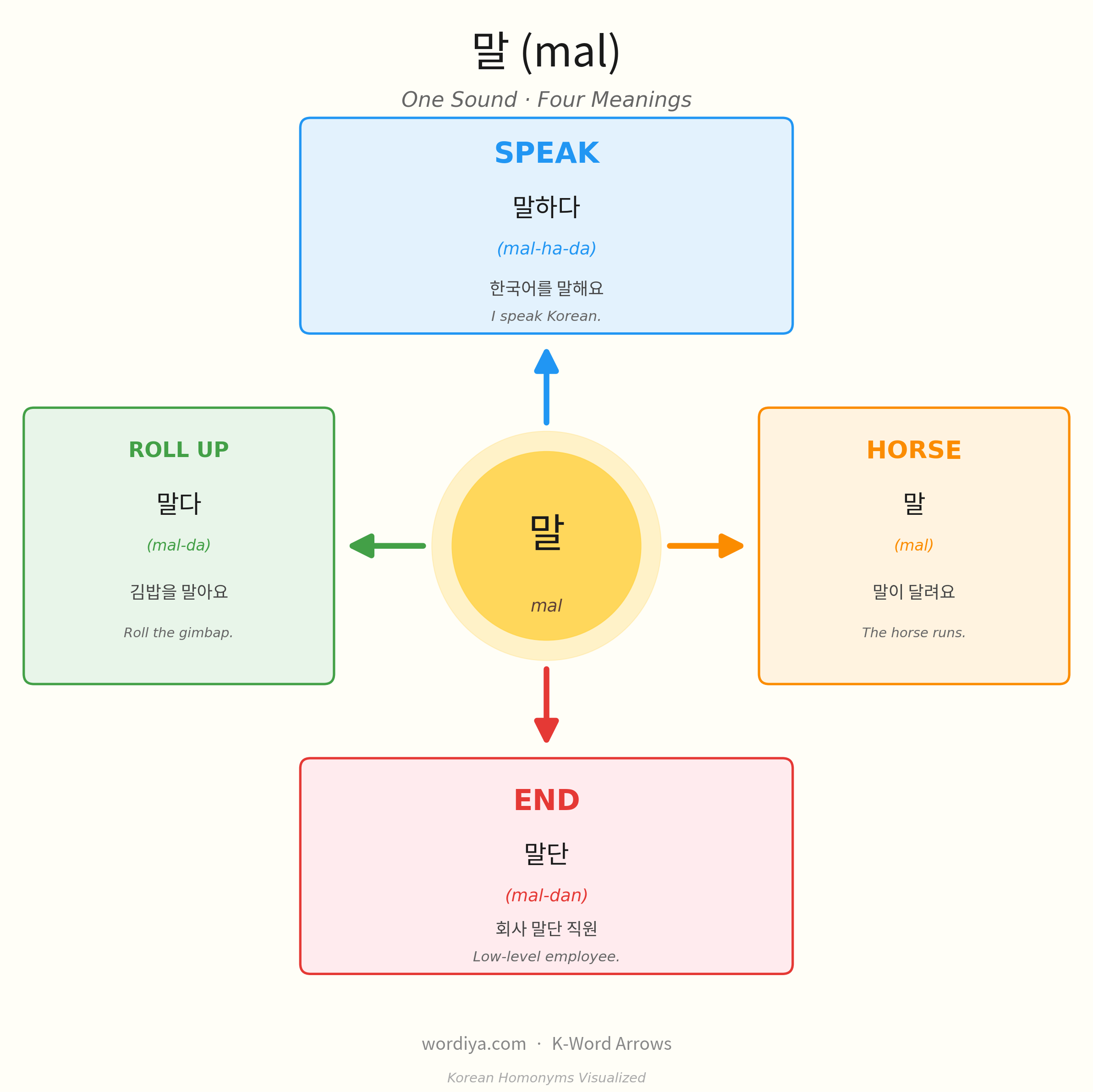
말 — Four Directions, Four Meanings
Direction Meaning Korean Romanization
| ↑ Up | speak | 말하다 | mal-ha-da |
| → Right | horse | 말 | mal |
| ← Left | roll up | 말다 | mal-da |
| ↓ Down | end, bottom | 말단 | mal-dan |
One sound. Four meanings. One picture.
↑ Up — 말하다 (mal-ha-da): Speak
저는 한국어를 말해요. Jeo-neun han-gu-geo-reul mal-hae-yo. I speak Korean.
The verb 말하다 (mal-ha-da) is one of the most essential Korean verbs. It means "to speak" or "to say."
Common phrases:
- 말해 주세요 (mal-hae ju-se-yo) — please tell me
- 말이 안 돼요 (ma-ri an dwae-yo) — it doesn't make sense
- 말씀 (mal-sseum) — polite form of "words"
- 말 잘하다 (mal jal-ha-da) — to be good at speaking
You'll hear 말하다 in every K-drama and K-pop song. It's foundational.
→ Right — 말 (mal): Horse
말이 빠르게 달려요. Ma-ri ppa-reu-ge dal-lyeo-yo. The horse runs fast.
The noun 말 (mal) also means horse. This is one of the rare cases where a pure Korean word and another meaning share the exact same sound.
Cultural notes:
- 백마 (baek-ma) — white horse
- 말띠 (mal-tti) — Year of the Horse (Korean zodiac)
- 경마 (gyeong-ma) — horse racing
- 말 한 마리 (mal han ma-ri) — one horse
In historical K-dramas (사극, sa-geuk), you'll see warriors riding 말 — horses being a central part of Korean history.
← Left — 말다 (mal-da): Roll Up
김밥을 말아요. Gim-ba-beul ma-ra-yo. I roll the gimbap.
The verb 말다 (mal-da) means "to roll something up." Essential when ordering or making Korean food.
Common uses:
- 김밥 말다 (gim-bap mal-da) — to roll gimbap
- 종이를 말다 (jong-i-reul mal-da) — to roll paper
- 소매를 말다 (so-mae-reul mal-da) — to roll up sleeves
- 말지 마세요 (mal-ji ma-se-yo) — don't roll / don't bother
If you've watched Korean cooking videos, you've seen 말다 in action — rolling rice and seaweed into perfect gimbap.
↓ Down — 말단 (mal-dan): End, Bottom
그는 회사 말단 직원이에요. Geu-neun hoe-sa mal-dan ji-gwo-ni-e-yo. He's a low-level employee at the company.
The word 말단 (mal-dan) means "the end" or "the bottom" — usually referring to hierarchy, position, or physical extremity.
This comes from the Chinese characters (Hanja) 末端:
- 末 (mal) — end, last
- 端 (dan) — tip, edge
Common uses:
- 말단 직원 (mal-dan ji-gwon) — low-level employee
- 말단 신경 (mal-dan sin-gyeong) — nerve ending (medical)
- 말단부 (mal-dan-bu) — extremity, far end
How to Tell Them Apart
Context is everything in Korean. Here's how to decode 말:
Look for... Meaning
| Verb + 하다 / 해요 / 합니다 | speak (말하다) |
| Animal + counter 마리 (ma-ri) | horse (말) |
| Verb form + 아요 / 어요 | roll up (말다) |
| Hanja compound (단, 부) | end (말단) |
Try It Yourself
Can you guess which 말 is used in each sentence?
Sentence speak / horse / roll / end?
| 1. 친구에게 말했어요. | ? |
| 2. 말이 풀밭에 있어요. | ? |
| 3. 김밥을 말 줄 알아요. | ? |
| 4. 그는 회사의 말단이에요. | ? |
Answers:
- speak (mal-haet-seo-yo, "I spoke to my friend")
- horse (ma-ri pul-ba-te i-sseo-yo, "The horse is in the field")
- roll up (gim-ba-beul mal jul a-ra-yo, "I know how to roll gimbap")
- end / bottom (geu-neun hoe-sa-ui mal-da-ni-e-yo, "He's at the bottom of the company")
Key Takeaway
말 (mal) is one syllable with four distinct meanings — speak, horse, roll up, and end (the last from Hanja 末). Korean uses context, particle endings, and Hanja roots to distinguish them. Once you see the four meanings mapped visually, the confusion disappears. One picture = four meanings mastered.
A Quick Pronunciation Tip
All four meanings are pronounced the same: mal (rhymes with "doll" but shorter). The difference is entirely in what follows:
- mal + ha-da → speak
- mal (alone) → horse
- mal + da → roll
- mal + dan → end
Listen for what comes after 말 — that's your clue.
Coming Next — 차 (cha)
Next we map another tricky Korean homonym: 차 (cha) — which means car, tea, cold, full, and difference. Five meanings, one sound, one picture.
도움이 되셨다면 구독, 공감 한 번 부탁드립니다. (Thank you for reading!)
K-Word Arrows: Korean Homonyms Visualized ⓒ wordiya.com


