One Sound, Four Worlds
In Korean, the single syllable 차 (cha) has at least four completely different meanings — car, tea, kick, and difference.
This phenomenon is called a homonym (동음이의어, dong-eum-i-ui-eo). For Korean learners, 차 is one of the most confusing homonyms because all four meanings appear in everyday conversation.
Let's solve this — visually.
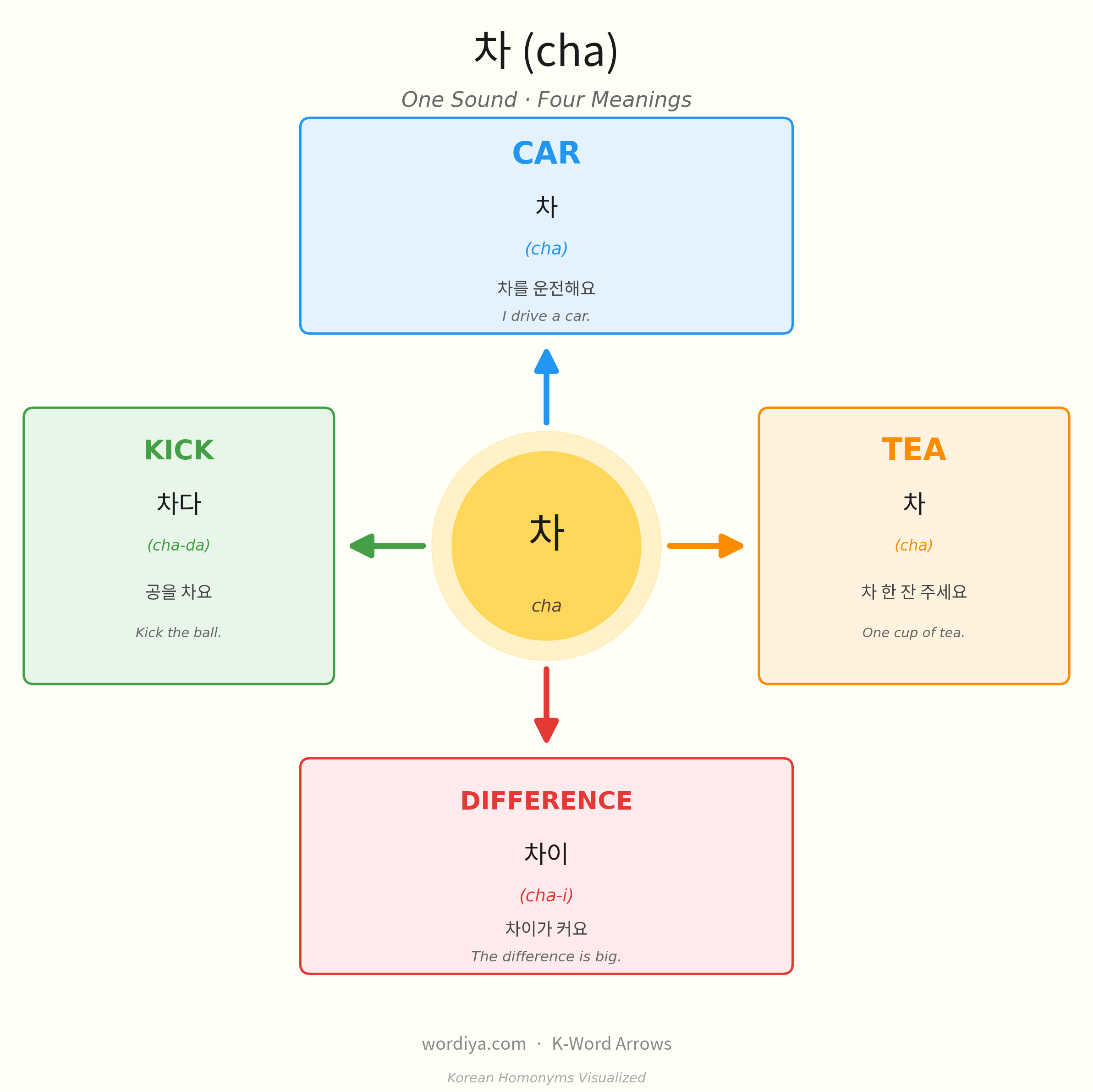
차 — Four Directions, Four Meanings
Direction Meaning Korean Romanization
| ↑ Up | car | 차 | cha |
| → Right | tea | 차 | cha |
| ← Left | kick | 차다 | cha-da |
| ↓ Down | difference | 차이 | cha-i |
One sound. Four meanings. One picture.
↑ Up — 차 (cha): Car
저는 매일 차를 운전해요. Jeo-neun mae-il cha-reul un-jeon-hae-yo. I drive a car every day.
The noun 차 (cha) means car. This comes from the Chinese character (Hanja) 車 which means vehicle.
Common phrases:
- 자동차 (ja-dong-cha) — automobile
- 기차 (gi-cha) — train
- 전철 (jeon-cheol) — subway
- 주차장 (ju-cha-jang) — parking lot
- 차 운전 (cha un-jeon) — driving a car
- 차 한 대 (cha han dae) — one car (한 대 is the counter)
K-Drama connection: You'll see 차 used constantly in K-dramas — characters driving expensive cars (often Hyundai or Kia) is a classic K-drama scene.
→ Right — 차 (cha): Tea
차 한 잔 주세요. Cha han jan ju-se-yo. One cup of tea, please.
The noun 차 (cha) also means tea. This also comes from the Chinese character (Hanja) 茶 which means tea. The same Hanja character traveled to English as "chai" (Indian tea) and to many other languages.
Common Korean teas:
- 녹차 (nok-cha) — green tea
- 홍차 (hong-cha) — black tea
- 보리차 (bo-ri-cha) — barley tea
- 유자차 (yu-ja-cha) — citron tea
- 인삼차 (in-sam-cha) — ginseng tea
Korean tea culture: Korea has a deep tea tradition called 다도 (da-do, "the way of tea"). Tea is offered to guests, served at temples, and shared in formal settings.
← Left — 차다 (cha-da): Kick
그는 공을 차요. Geu-neun gong-eul cha-yo. He kicks the ball.
The verb 차다 (cha-da) means to kick. Essential when watching Korean sports!
Common uses:
- 공을 차다 (gong-eul cha-da) — to kick a ball
- 발로 차다 (bal-lo cha-da) — to kick with a foot
- 태권도를 차다 (tae-kwon-do-reul cha-da) — to kick in taekwondo
- 페널티킥 (pe-neol-ti-kik) — penalty kick
K-Drama connection: The verb 차다 has another K-drama-specific meaning: to dump someone. 남자친구를 찼어요 (nam-ja-chin-gu-reul cha-sseo-yo) literally means "I kicked my boyfriend" but actually means "I dumped my boyfriend." Watch for this in K-dramas!
Other 차다 meanings:
- 차다 (cha-da) — to be full (e.g., 가득 차다, full)
- 차다 (cha-da) — to be cold (e.g., 차가운 물, cold water — though this uses 차갑다)
- 차다 (cha-da) — to wear (e.g., 시계를 차다, to wear a watch)
Korean is highly contextual!
↓ Down — 차이 (cha-i): Difference
두 의견의 차이가 커요. Du ui-gyeon-ui cha-i-ga keo-yo. The difference between the two opinions is big.
The word 차이 (cha-i) means "difference" or "gap." This comes from the Chinese characters (Hanja) 差異:
- 差 (cha) — difference, gap
- 異 (i) — different
Common uses:
- 차이가 있다 (cha-i-ga it-da) — there is a difference
- 큰 차이 (keun cha-i) — big difference
- 의견 차이 (ui-gyeon cha-i) — difference in opinion
- 세대 차이 (se-dae cha-i) — generation gap
- 문화 차이 (mun-hwa cha-i) — cultural difference
K-culture connection: Foreigners learning about Korea often encounter the phrase "문화 차이 (mun-hwa cha-i, cultural difference)" when discussing Korean customs vs. their home culture.
How to Tell Them Apart
Context is everything in Korean. Here's how to decode 차:
Look for... Meaning
| 운전 (drive), 주차 (parking), 자동 (auto) | car (차) |
| 마시다 (drink), 잔 (cup), 녹차/홍차 | tea (차) |
| 다 ending (verb), 공/발 (ball/foot) | kick (차다) |
| 이 ending, 크다/작다 (big/small) | difference (차이) |
Try It Yourself
Can you guess which 차 is used in each sentence?
Sentence car / tea / kick / difference?
| 1. 녹차가 맛있어요. | ? |
| 2. 차가 빠르게 달려요. | ? |
| 3. 공을 강하게 찼어요. | ? |
| 4. 두 가격의 차이가 커요. | ? |
Answers:
- tea (nok-cha-ga ma-si-sseo-yo, "Green tea is delicious")
- car (cha-ga ppa-reu-ge dal-lyeo-yo, "The car runs fast")
- kick (gong-eul gang-ha-ge cha-sseo-yo, "I kicked the ball hard")
- difference (du ga-gyeo-gui cha-i-ga keo-yo, "The price difference is big")
Key Takeaway
차 (cha) is one syllable with four distinct meanings — car (車), tea (茶), kick (차다), and difference (差異). Three meanings come from Chinese characters (Hanja), and one is a pure Korean verb. Korean uses context, particles, and verb endings to distinguish them. Once you see the four meanings mapped visually, the confusion disappears. One picture = four meanings mastered.
A Quick Pronunciation Tip
All four meanings are pronounced the same: cha (sounds like "chah" in English). The difference is entirely in what comes before or after:
- cha (alone, with 운전·주차) → car
- cha (alone, with 마시다·잔) → tea
- cha + da → kick (verb)
- cha + i → difference
Listen for what surrounds 차 — that's your clue.
Bonus — The Global Journey of 차
Interesting fact: The Korean word 차 (cha) for tea shares its origin with English "chai" (Indian spiced tea). Both come from the Chinese character 茶 (chá).
Language Word for Tea
| Korean | 차 (cha) |
| Chinese (Mandarin) | 茶 (chá) |
| Japanese | 茶 (cha) |
| Hindi | चाय (chai) |
| Turkish | çay |
| Russian | чай (chay) |
| English | tea (different route, via Min Chinese) |
One Chinese character — many languages, two pronunciations (cha/te).
Coming Next — 눈 (nun)
Next we map another tricky Korean homonym: 눈 (nun) — which means eye and snow. Two meanings, one sound, one picture.
도움이 되셨다면 구독, 공감 한 번 부탁드립니다. (Thank you for reading!)
K-Word Arrows: Korean Homonyms Visualized ⓒ wordiya.com


