잠 (Jam) — Sleep, Submerge, Lock, Dragonfly — Four Pure Native Korean Meanings
One Korean sound reveals a deep primordial insight — the observation that four seemingly different states all share the same essence of "being closed, sealed, submerged into stillness." When you sleep (잠), your consciousness closes. When water submerges something (잠기다), it is sealed under liquid. When you lock a door (잠그다), you seal the passage. And the dragonfly (잠자리) — Korea's most beloved autumn insect — famously rests motionless before darting away. All four states share the primordial concept of "envelopment and closure," captured by Korean in one native sound with zero Hanja anywhere.
🌙 Background — The Unified Concept of Closure
Ancient Koreans observed nature with a unifying eye. They saw that four different phenomena — a sleeping person, a submerged object, a locked door, and a resting dragonfly — all shared the same essential state: being sealed away from motion and openness.
One primordial concept: closure, sealing, envelopment. One Korean sound: 잠. This is not accidental — it is deep linguistic observation preserved for millennia.
🎯 The K-Word Arrows Diagram
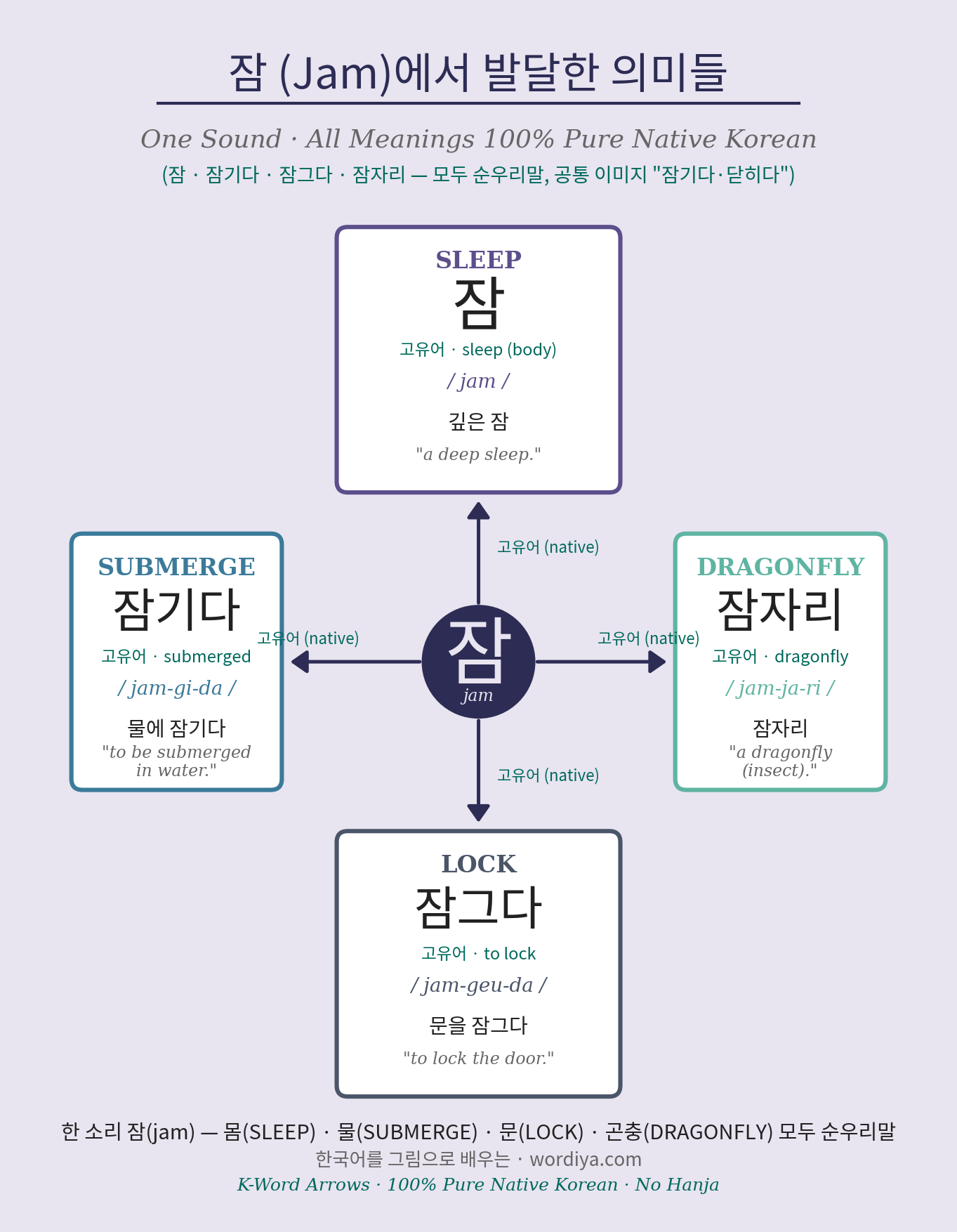
The center holds 잠 (jam). Arrows extend in four directions, and every card is pure native Korean (고유어) — no Hanja anywhere.
- UP (SLEEP · 잠) — Consciousness closes into rest · 고유어
- DOWN (LOCK · 잠그다) — Passage sealed shut · 고유어
- LEFT (SUBMERGE · 잠기다) — Object enveloped in water · 고유어
- RIGHT (DRAGONFLY · 잠자리) — Insect rests in stillness · 고유어
🌱 Decisive Point — All Native Korean
Every 잠-based word is pure native Korean:
Sleep cluster: 잠, 잠들다, 잠자다, 깊은 잠, 풋잠, 늦잠, 낮잠, 단잠 — all 고유어
Submerge cluster: 잠기다, 물에 잠기다, 홍수에 잠기다, 문이 잠기다, 목이 잠기다, 생각에 잠기다 — all 고유어
Lock cluster: 잠그다, 문을 잠그다, 자물쇠를 잠그다, 수도를 잠그다, 단추를 잠그다, 입을 잠그다 — all 고유어
Dragonfly cluster: 잠자리, 고추잠자리, 실잠자리, 왕잠자리 — all 고유어
Notably absent: Korean did not adopt Hanja words like 睡眠 (sumyeon, sleep) or 沈沒 (chimmol, submerge) as primary colloquial terms. The native word dominates. Deep linguistic conservatism.
📖 Etymology — Proto-Koreanic *cam-
Alexander Vovin (CNRS) reconstructs 잠 as Proto-Koreanic cam- carrying the primordial meaning of "closure, sealing, being enveloped."
The metaphorical journey:
- Root: enveloped, closed off
- Extension 1 (biological): consciousness enveloped = sleep (잠)
- Extension 2 (physical): object enveloped by water = submerge (잠기다)
- Extension 3 (mechanical): passage enveloped by lock = lock (잠그다)
- Extension 4 (behavioral): insect enveloped in stillness = dragonfly (잠자리)
Cross-linguistic comparison:
Language Sleep Submerge Lock Dragonfly One root?
| Korean | 잠 [cam] | 잠기다 [cam-gi-] | 잠그다 [cam-geu-] | 잠자리 [cam-ja-ri] | ✅ ALL ONE ROOT |
| English | sleep | submerge | lock | dragonfly | ❌ 4 different |
| Chinese | 睡 [shuì] | 沉 [chén] | 鎖 [suǒ] | 蜻蜓 [qīng tíng] | ❌ 4 different |
| Japanese | 眠 [nemuru] | 沈 [shizumu] | 施錠 [sejō] | トンボ [tonbo] | ❌ 4 different |
Only Korean unifies all four under one native root.
🎬 K-Culture Examples — All with Romanization
① SLEEP — Universal Korean Rest
Example ①:
- 어젯밤에 깊은 잠을 잤다.
- Eo-jet-bam-e gip-eun jam-eul jat-da.
- "I had a deep sleep last night."
Example ② — K-drama family scene:
- 엄마, 아기 단잠 자게 조용히 해요.
- Eom-ma, a-gi dan-jam ja-ge jo-yong-hi hae-yo.
- "Mom, be quiet so the baby can sleep sweetly."
Example ③ — Common expression:
- 늦잠을 자서 지각했다.
- Neut-jam-eul ja-seo ji-gak-haet-da.
- "I overslept and was late."
② SUBMERGE — Physical & Emotional Depth
Example ④ — Physical:
- 홍수로 마을이 물에 잠겼다.
- Hong-su-ro ma-eul-i mul-e jam-gyeot-da.
- "The village was submerged in water by the flood."
Example ⑤ — Emotional (metaphor):
- 그는 깊은 슬픔에 잠겼다.
- Geu-neun gip-eun seul-peum-e jam-gyeot-da.
- "He was submerged in deep sorrow."
- (Note: Korean uses the same word for physical flooding AND emotional overwhelm — a beautiful precise metaphor.)
Example ⑥ — K-drama classic line:
- 오랫동안 그녀는 생각에 잠겨 있었다.
- O-raet-dong-an geu-nyeo-neun saeng-gak-e jam-gyeo it-eot-da.
- "For a long time, she was lost in thought."
Example ⑦ — Voice becoming hoarse:
- 감기에 걸려 목이 잠겼다.
- Gam-gi-e geol-lyeo mok-i jam-gyeot-da.
- "I caught a cold and my voice became hoarse."
③ LOCK — Everyday & Metaphorical
Example ⑧ — Physical:
- 외출할 때 문을 꼭 잠그세요.
- Oe-chul-hal ttae mun-eul kkok jam-geu-se-yo.
- "Please lock the door when you go out."
Example ⑨ — K-drama emotional lock:
- 그녀는 마음의 문을 잠갔다.
- Geu-nyeo-neun ma-eum-ui mun-eul jam-gat-da.
- "She locked the door of her heart."
- (Emotional shutdown expressed as physical lock.)
Example ⑩ — Daily task:
- 수도를 잠그는 것을 잊었다.
- Su-do-reul jam-geu-neun geot-eul ij-eot-da.
- "I forgot to turn off the water."
Example ⑪ — Silence metaphor:
- 그는 입을 잠그고 아무 말도 하지 않았다.
- Geu-neun ip-eul jam-geu-go a-mu mal-do ha-ji an-at-da.
- "He locked his mouth and said nothing."
④ DRAGONFLY — K-Childhood Nostalgia
Example ⑫ — Rural Korea memory:
- 어릴 때 잠자리를 잡으며 놀았어요.
- Eo-ril ttae jam-ja-ri-reul jab-eu-myeo no-ra-sseo-yo.
- "When I was young, I played by catching dragonflies."
Example ⑬ — Autumn imagery:
- 가을 하늘에 고추잠자리가 날아다닌다.
- Ga-eul ha-neul-e go-chu-jam-ja-ri-ga nal-a-da-nin-da.
- "Red dragonflies fly around in the autumn sky."
- (Iconic Korean autumn image.)
Example ⑭ — The magical double meaning:
- 편안한 잠자리에서 자고 싶어요.
- Pyeon-an-han jam-ja-ri-e-seo ja-go sip-eo-yo.
- "I want to sleep in a comfortable bed."
- (잠자리 here means "sleeping place / bed" — NOT dragonfly! Same word, two meanings.)
🌏 The Stunning Insight — Dragonflies Named After Sleep
Why is the dragonfly called 잠자리 (jam-ja-ri) in Korean?
Etymology reveals the observation: 잠 (sleep/rest) + 자리 (place/spot) = "resting place."
Ancient Koreans watched dragonflies. They noticed something remarkable — dragonflies famously rest motionless on plants, fingers, and water surfaces for long periods before suddenly darting away. This resting behavior is so distinctive that Koreans named the entire species after it: the insect of the resting place.
Compare Chinese 蜻蜓, Japanese トンボ, English "dragonfly" (from "dragon flying") — none capture the resting behavior. Only Korean did. This is primordial observational naming.
The exquisite double meaning: 잠자리 also means "sleeping place / bed" — because both share the concept of restful stillness. The insect that rests peacefully becomes a metaphor for peaceful rest itself.
⚡ The Shocking Point — Physical and Emotional Unified
Korean uses the same word 잠기다 for physical flooding AND emotional overwhelm:
- 물에 잠기다 (mul-e jam-gi-da) — submerged in water (physical)
- 슬픔에 잠기다 (seul-peum-e jam-gi-da) — submerged in sorrow (emotional)
- 침묵에 잠기다 (chim-muk-e jam-gi-da) — sunk in silence (mental)
- 생각에 잠기다 (saeng-gak-e jam-gi-da) — lost in thought (mental)
This is not metaphor — this is Korean's built-in psychological insight. In Korean thinking, being overwhelmed by emotion is the SAME state as being overwhelmed by water. Both involve loss of freedom, sealed away from normal function, enveloped by an external force.
Modern psychology confirms: emotional overwhelm produces the same brain activation patterns as physical drowning. Korean anticipated modern psychology by thousands of years, embedding it in the language itself.
When a K-drama character says 그는 슬픔에 잠겼다 (Geu-neun seul-peum-e jam-gyeot-da — He was submerged in sorrow), that character is being described using the exact same word Koreans use for houses submerged in floods. The metaphor is precise, natural, and deep. Only Korean unifies these experiences under one word.
🎨 K-Drama and K-Poetry — 잠 Everywhere
K-drama uses 잠 richly:
Character depression:
- 그녀는 며칠 동안 잠에 빠져 있었다.
- Geu-nyeo-neun myeo-chil dong-an jam-e ppa-jyeo it-eot-da.
- "She was submerged in sleep for days."
- (Implies deep emotional shutdown.)
Emotional silence:
- 그는 오랫동안 침묵에 잠겼다.
- Geu-neun o-raet-dong-an chim-muk-e jam-gyeot-da.
- "He sunk into long silence."
- (Pain that cannot speak.)
Locked hearts:
- 그의 마음은 잠겨 있었다.
- Geu-ui ma-eum-eun jam-gyeo it-eot-da.
- "His heart was locked."
- (Emotional closure.)
Autumn dragonflies (nostalgia):
- 가을 잠자리 앞에서 그녀는 아버지를 기억했다.
- Ga-eul jam-ja-ri ap-e-seo geu-nyeo-neun a-beo-ji-reul gi-eok-haet-da.
- "Before autumn dragonflies, she remembered her father."
Korean poetry loves 잠: Baek Seok, Yun Dong-ju, Kim So-wol all used 잠 metaphors — physical and emotional simultaneously.
🎯 Learning Tips
Beginner:
- Learn basic vocabulary: 잠 (jam, sleep), 잠자리 (jam-ja-ri, dragonfly AND sleeping place)
- Learn everyday verbs: 잠들다 (jam-deul-da, fall asleep), 잠그다 (jam-geu-da, lock)
Intermediate:
- Master emotional metaphors: 슬픔에 잠기다 (seul-peum-e jam-gi-da), 생각에 잠기다 (saeng-gak-e jam-gi-da)
- Understand the double meaning of 잠자리 (context determines dragonfly vs bed)
Advanced:
- Recognize the unified pattern: all 잠 words share "closure / envelopment"
- Use poetic expressions: 침묵에 잠기다 (chim-muk-e jam-gi-da), 마음의 문을 잠그다 (ma-eum-ui mun-eul jam-geu-da)
Decisive tip: When you encounter any 잠 word, imagine the concept of envelopment — being surrounded, sealed, closed off. This visual anchor works for sleep, water, locks, dragonflies, sorrow, silence, and thought.
🎯 One-Line Summary
잠 (Jam) — Sleep · Submerge · Lock · Dragonfly — Four Pure Native Korean Meanings. One Korean syllable 잠 [cam] carries SLEEP (잠 jam, consciousness closes), SUBMERGE (잠기다 jam-gi-da, water envelops), LOCK (잠그다 jam-geu-da, passage seals), and DRAGONFLY (잠자리 jam-ja-ri, insect at rest) — four completely different domains unified by one primordial concept of envelopment and closure — and every meaning plus every related word (잠들다, 잠자다, 물에 잠기다, 홍수에 잠기다, 목이 잠기다, 문을 잠그다, 수도를 잠그다, 잠자리, 고추잠자리, 왕잠자리) is 100% pure native Korean (고유어) with zero Hanja influence. Academic backing: Alexander Vovin (CNRS) Proto-Koreanic reconstruction cam- meaning "closure, sealing, being enveloped." Decisive insight: Korean built psychological wisdom into vocabulary — 슬픔에 잠기다 (seul-peum-e jam-gi-da — submerged in sorrow) uses the exact same word as 물에 잠기다 (mul-e jam-gi-da — submerged in water), anticipating modern psychology's finding that emotional overwhelm shares brain patterns with physical drowning. Cross-linguistic contrast: Only Korean unifies all four concepts under one native root (English sleep/submerge/lock/dragonfly, Chinese 睡/沉/鎖/蜻蜓, Japanese 眠/沈/施錠/トンボ — all use 4 different words). Stunning etymological observation: the dragonfly (잠자리) is named "resting place" because ancient Koreans observed dragonflies famously rest motionless before darting — primordial observational naming that other languages lost. The double meaning: 잠자리 uniquely means both "dragonfly" AND "sleeping place / bed" — a beautiful K-language homonym within a homonym. K-culture connections: K-drama emotional depth (슬픔에 잠기다 seul-peum-e jam-gi-da, 마음의 문을 잠그다 ma-eum-ui mun-eul jam-geu-da), K-childhood nostalgia (autumn 고추잠자리 go-chu-jam-ja-ri hovering over rice paddies), K-poetry tradition (Baek Seok, Yun Dong-ju using 잠 metaphors), K-family scenes (아기 단잠 a-gi dan-jam sweet baby sleep). Every time a Korean says "잠" to describe sleep, water, locks, or dragonflies, that speaker unknowingly preserves the ancient observation that closure is one unified state across nature. Korean = living fossil of primordial conceptual unity — this is 잠's revelation.
K-Word Arrows Series ⓒ wordiya.com

