눈 (Nun) — Eye, Snow, Bud, Notch — Four Pure Native Korean Meanings in One Sound
If 장 (jang) showed how Hanja-based morphemes Koreanized completely, 눈 (nun) is the opposite — a syllable where ALL FOUR meanings are pure native Korean, with no Hanja involvement at all. It is the syllable behind the word for eye (눈, nun), behind snow (눈, nun), behind a bud on a tree (눈, nun), and behind the notch or mesh of a measuring tool (눈, nun). One Korean sound, four pure Korean meanings — no Chinese characters, no Hanja-based morphemes. This chapter is K-Word Arrows in its purest form.
The Four Branches — All Pure Native Korean
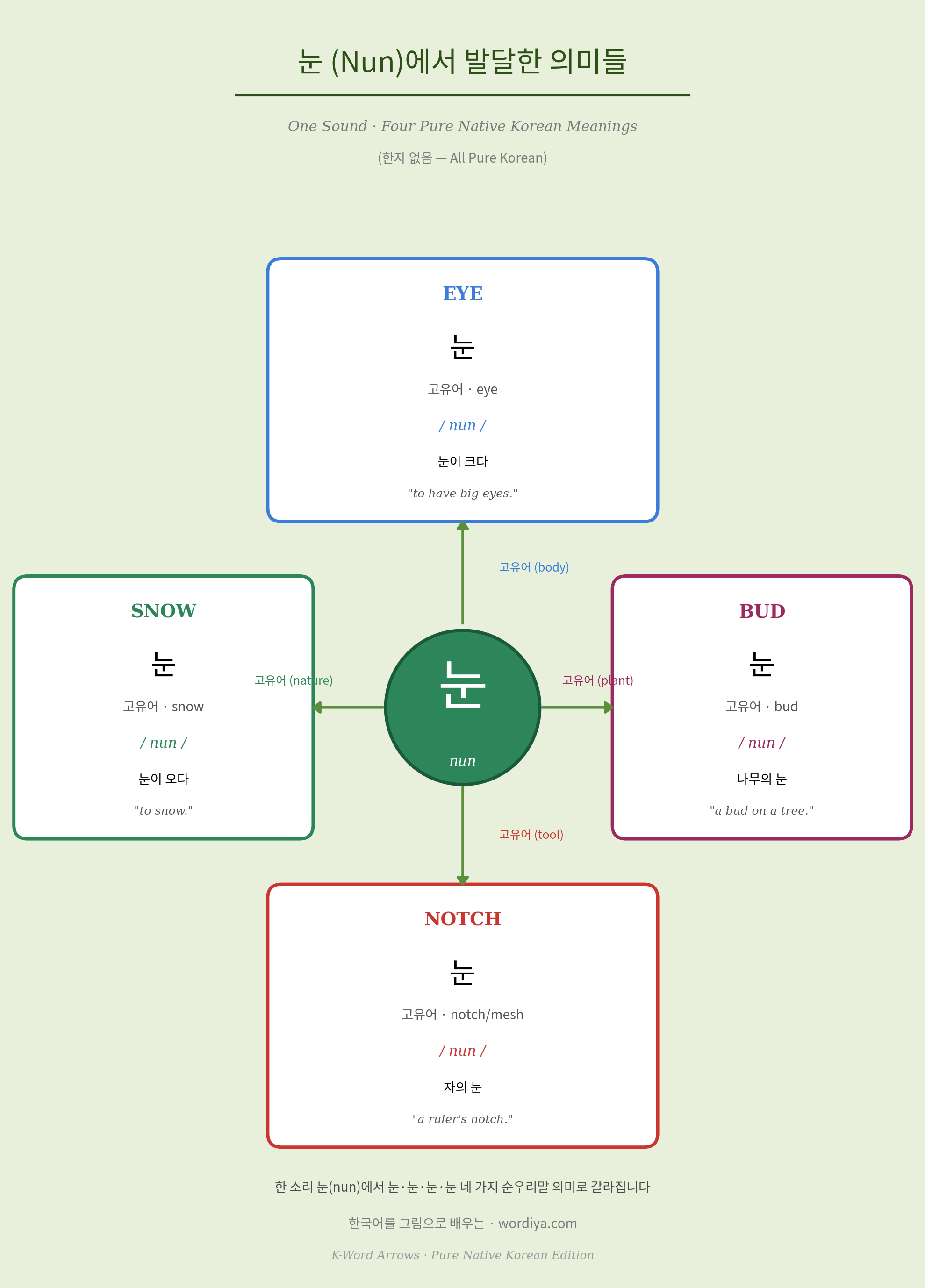
① EYE — 눈 (nun) · pure native Korean
The Korean word 눈 (nun, eye) is pure native Korean — no Hanja for this meaning, no foreign borrowing. It is one of the most ancient Korean body part words, traceable to Old Korean of the Three Kingdoms period (4th-7th century).
Common phrases:
- 눈 (nun, eye)
- 눈이 크다 (nun-i keu-da, to have big eyes)
- 눈물 (nun-mul, tears — literally "eye water")
- 눈썹 (nun-sseop, eyebrow)
- 눈동자 (nun-dong-ja, pupil)
- 눈치 (nun-chi, social awareness — "reading the eyes")
- 눈에 띄다 (nun-e tti-da, to stand out — "catch the eye")
Korean cultural depth: 눈치 (nun-chi) is a uniquely Korean concept — the social awareness of reading others' moods and unspoken cues, literally "eye-measure." Saying "그 사람 눈치가 빠르다" means "that person reads situations quickly" — a high compliment in Korean society.
Example: 눈이 크네요. ("You have big eyes.")
② SNOW — 눈 (nun) · pure native Korean
The Korean word 눈 (nun, snow) is also pure native Korean. The Hanja 雪 (seol) exists for compound words like 설탕 (sugar — "snow sugar"), but the simple word for "snow" is the pure Korean 눈.
Common phrases:
- 눈 (nun, snow)
- 눈이 오다 (nun-i o-da, to snow)
- 눈사람 (nun-sa-ram, snowman)
- 눈싸움 (nun-ssa-um, snowball fight)
- 눈송이 (nun-song-i, snowflake)
- 함박눈 (ham-bak-nun, heavy snow / large snowflakes)
- 첫눈 (cheot-nun, first snow of the season)
Korean cultural depth: 첫눈 (cheot-nun, first snow) holds romantic cultural significance in Korea. K-dramas and K-pop songs often feature 첫눈 as a moment of fated meetings or first confessions of love. "첫눈 오는 날 만나자" (Let's meet on the day of the first snow) is a classic K-romance phrase.
Example: 어제 눈이 왔어요. ("It snowed yesterday.")
③ BUD/SPROUT — 눈 (nun) · pure native Korean
The Korean word 눈 (nun, bud/sprout) refers to the growing tip on a plant — the small swelling on a branch where a leaf, flower, or new shoot is about to emerge. Pure native Korean botanical vocabulary.
Common phrases:
- 눈 (nun, bud/sprout)
- 나무의 눈 (na-mu-ui nun, a bud on a tree)
- 새눈 (sae-nun, new bud)
- 꽃눈 (kkot-nun, flower bud)
- 잎눈 (ip-nun, leaf bud)
- 눈이 트다 (nun-i teu-da, for buds to open/break)
Korean cultural depth: In Korean tradition, 눈이 트다 (the moment when buds break open in spring) is a celebrated sign of life returning. Traditional Korean poetry (시조 si-jo) frequently uses 눈 (bud) as a metaphor for new beginnings, hope, and rebirth.
Example: 나무에 눈이 났어요. ("Buds appeared on the tree.")
④ NOTCH/MESH — 눈 (nun) · pure native Korean
The Korean word 눈 (nun, notch/mesh/measurement mark) refers to the small marks or holes used for measuring or weaving. Pure native Korean technical vocabulary from traditional Korean craft.
Common phrases:
- 눈 (nun, notch/mesh)
- 자의 눈 (ja-ui nun, the notch/mark on a ruler)
- 눈금 (nun-geum, gradation/scale marks)
- 그물의 눈 (geu-mul-ui nun, the mesh of a net)
- 체의 눈 (che-ui nun, the holes of a sieve)
- 주사위의 눈 (ju-sa-wi-ui nun, the dots on a die)
Korean cultural depth: This 눈 reveals how Korean uses the eye metaphor for any small repeating pattern — the holes of a net are "eyes" (그물눈), the dots on a die are "eyes," the gradations on a ruler are "eyes." The visual metaphor: each notch/hole/dot looks like an eye in the structure. Korean uses this metaphor more systematically than most languages.
Example: 자의 눈을 잘 봐요. ("Look carefully at the ruler's notches.")
🧠 Memory Anchor — A Korean Winter to Spring
Picture a Korean winter day. A child looks up with her wide 눈 (nun, eye) at the falling 눈 (nun, snow). Three months later, spring arrives. She runs to a tree where small 눈 (nun, bud) is breaking. Her grandfather sits in the garden with an ancient measuring rope, counting the 눈 (nun, mesh) — the holes that tell him how thick to weave. Four meanings of 눈 — eye, snow, bud, mesh — all pure native Korean, all from one ancient Korean root.
✅ Quick Check — Which 눈 (nun) is this?
- 눈이 크네요. ("You have big eyes.")
- 눈이 와요. ("It's snowing.")
- 나무에 눈이 났어요. ("Buds appeared on the tree.")
- 자의 눈을 봐요. ("Look at the ruler's notches.")
Answers — All four are pure native Korean, no Hanja distinctions:
- EYE — 눈 (pure Korean)
- SNOW — 눈 (pure Korean)
- BUD — 눈 (pure Korean)
- NOTCH — 눈 (pure Korean)
🔊 Pronunciation Tip — Context Is Everything
All four meanings share the same /nun/ sound — pronounced identically. The differentiator is context only. There are no Hanja distinctions to memorize. This is Korean's pure native vocabulary at work.
- 얼굴 / 몸 / 시선 관련 → EYE
- 날씨 / 겨울 / 하늘에서 내림 관련 → SNOW
- 나무 / 잎 / 꽃 / 식물 관련 → BUD
- 자 / 그물 / 체 / 주사위 관련 → NOTCH/MESH
💡 Bonus ① — 눈치 (Nun-chi): The Korean Concept Without a Translation
눈치 (nun-chi) is one of the most uniquely Korean concepts in the language. Literally "eye-measure," it refers to the social awareness of reading others' moods, intentions, and unspoken cues. Korean culture places enormous emphasis on having 눈치 — being able to read situations without being told. The 2019 book "The Power of Nunchi" by Euny Hong became an international bestseller, introducing the concept globally. "눈치가 빠르다" ("to have quick nun-chi") is a major social compliment in Korea — it means you understand without explanation, read the room, and behave appropriately. In job interviews, family dinners, and workplace meetings, 눈치 is the invisible currency of Korean social success. The word literally combines 눈 (eye) + 치 (measure) — "measuring with the eye."
💡 Bonus ② — Why Korean Uses 눈 (Eye) for So Many Things
Korean systematically uses 눈 (eye) as a metaphor for any small, repeating, opening-like pattern. Beyond the main four meanings:
- 그물눈 (net mesh — "net eyes")
- 주사위의 눈 (dice dots — "die eyes")
- 자의 눈 (ruler notches — "ruler eyes")
- 구두의 눈 (shoelace holes — "shoe eyes")
- 바늘의 눈 (needle eye — "needle eye")
This systematic eye-metaphor reveals something deep about Korean's view of the world — anything that "sees" through a small opening has "eyes" in Korean. It's a beautifully animistic linguistic worldview where tools and patterns share consciousness with humans.
💡 Bonus ③ — Korean's Pure Native Vocabulary: Why It Matters
Korean has three vocabulary layers:
- 고유어 (go-yu-eo, pure native Korean)
- 한자어 (han-ja-eo, Hanja-based Korean — about 60% of vocabulary)
- 외래어 (oe-rae-eo, foreign loanwords — mostly English)
The 눈 chapter is special because all four meanings are pure native Korean — preserving the deepest layer of the language. Native Korean words tend to express:
- Body parts (눈 eye, 손 hand, 발 foot, 입 mouth)
- Basic natural phenomena (눈 snow, 비 rain, 바람 wind)
- Primary emotions (사랑 love, 미움 hate, 기쁨 joy)
- Ancient daily life (밥 rice, 옷 clothes, 집 house)
These words connect modern Korean to the Old Korean of the Three Kingdoms period (4th-7th centuries). When you say 눈, you are speaking Korean exactly as Koreans spoke it 1,500 years ago — before Hanja, before Buddhism, before Confucianism. Pure native Korean is the living memory of the Korean peninsula itself.
🎯 Wrap-Up
One sound — 눈 (nun) — carries the seeing of Korean eyes (눈 eye), the falling of Korean winters (눈 snow), the budding of Korean springs (눈 bud), and the measuring of Korean tools (눈 notch/mesh). All four are pure native Korean — no Hanja, no foreign borrowing, just the deep linguistic memory of the Korean peninsula. To master these four 눈s is to step into Korean's most ancient layer — the language as it existed before Hanja arrived, when Koreans named the world with their own sounds.
K-Word Arrows: Korean Homonyms Visualized — ⓒ wordiya.com